


 Nature
 PUBLISHED
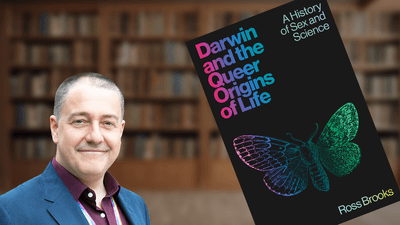


Just how queer is the natural world, and when did scientists start exploring this?
Dr Ross Brooks takes us through the extraordinary history of queer natural history, showing that Darwin’s evolutionary theories were very much queer, even back when they were written.
Then, enjoy an exclusive excerpt of Darwin and the Queer Origins of Life.
What inspired you to write Darwin and the Queer Origins of Life?
I was primarily inspired by the growing number of books about queerness in nature, beginning with Bruce Bagemihl’s Biological Exuberance and Joan Roughgarden’s Evolution’s Rainbow, and then more recently Eliot Schrefer’s Queer Ducks (And Other Animals) and A Little Gay Natural History by IFLScience’s fabulous Josh Luke Davis.
There was nothing like this when I was growing up gay in the 1970s and ‘80s, and indeed we were told that being queer was “unnatural”, even “against nature”. I wanted to better understand how and why something so ubiquitous as nature’s queerness could have been so poorly recognised, and even denied, for so long.
That question eventually led me back to university in my mid-30s, and ultimately to a PhD. It was a 15-year adventure, constantly full of surprises that transformed the way I think about nature and how science is done (and, sometimes, not done). I wanted to share that journey, and the opportunities it opened up.
What was one of the most surprising things you discovered while researching it?
The greater surprise was English suffragist and botanist Lydia Ernestine Becker. In his writings, Darwin was reticent to extend his ideas about sexual diversity in nature to humans, despite his insistence on animal-human continuity.
Becker, who read Darwin’s works and corresponded with him, had no such qualms. In a controversial lecture in 1868, she argued that “the attribute of sex does not extend to mind”.
She pointed to female plants being as vigorous as males, queen bees ruling their hives, and female eagles and sparrowhawks being larger than males. Turning to humans, she stated that many women secretly worked in jobs regarded as exclusively male.
As an example, she referred to Mary Walker, who lived as a man while working variously as a stoker on a Cunard ship, a porter on the Great Western Railway, a barman and a sailor.
Becker concluded that human minds could not be neatly divided into female and male in any scientifically meaningful way. Instead, she proposed that there were “numerous intermediate varieties” between what society regarded as masculine and feminine minds, regardless of a person’s genital sex.
It was a tour de force of inclusive, science-based feminism that was largely forgotten, but which some people today could learn much from.
How exactly are Darwin’s theories queer?
Darwin’s theories can be considered queer because his observations and ideas implicitly unsettled supposedly fixed categories of sexual characteristics, reproduction and sexual behaviour. Indeed, he believed that “[e]very animal surely is hermaphrodite”.
ven in its 19th-century meaning as strange or anomalous, the term “queer” was applied to Darwin’s ideas about sexual evolution.
What is the one thing you’d want people to take away from the book?
I hope that readers will fall in love with queer approaches to the life sciences, and the queer history of science. Art and literature have rich queer histories and have long formed part of LGBTQ+ cultures, even though both have had their queerphobic aspects. Science is such a huge part of the human experience, touching our lives in so many different ways.
There’s no good reason at all why LGBTQ+ people should be excluded from science, or why science should be excluded from queer life and culture. I therefore hope Queer Origins will go some way towards building better relationships between science and queer communities.
In this excerpt from Darwin and the Queer Origins of Life: A History of Sex and Science, Dr Ross Brooks reveals how Darwin’s curiosity about sex variance underscored his conviction that “no character appears to be absolutely fixed”.
“How Facts Do Beat The Wildest Imagination!”
On 17 March 1863, Darwin wrote to [Sir Joseph Dalton] Hooker: ‘I have been writing during last fortnight on this subject, i.e., on reversions to particular characters, & have got curious collection of facts & experiments.’ This curious collection strengthened Darwin’s commitment to the principle ‘that a crowd of characters lie latent in every living creature & parent’.
On 26 March, Darwin again wrote to Hooker, telling him, ‘this view of latency collects a lot of facts’, these facts including ‘both secondary sexual character in each individual’. He continued: ‘When one thinks of a latent character being handed down hidden for a thousand or ten-thousand generations & then suddenly appearing, one is quite bewildered at the host of characters written in invisible ink on the germ.’ Hooker responded amusingly, ‘it is a subject on which I have a huge latent interest’.
Having set out what he viewed as a sketch of his evolutionism in On the Origin of Species, Darwin set to work on a more expansive exposition. He had a significant amount of unpublished text but nonetheless pressed ahead with numerous researches, writing and copious correspondence.
As he did so, he became ever more aware of sex-variant phenomena in the natural world, new descriptions of which, as we’ve seen, continued to be made apace through the middle decades of the nineteenth century.
A North American correspondent, anatomist Jeffries Wyman, told him how males of some species of the catfish family Siluridae in Guiana stored eggs and young in their mouths – a significant discovery of male parenting.
Mouthbrooding (oral or buccal incubation) has evolved independently several times in diverse groups of fish. Parents carry eggs and fry in their mouths, protecting them from predation and parasites. Surprisingly few references to the phenomenon are found in earlier natural history literature, although it was known that female soldier catfishes carried eggs in their mouths. Wyman’s observation of male mouthbrooding was a first and generated much excitement.
He discussed it at a meeting of the Boston Society of Natural History in September 1857 and in the American Journal of Science and Arts in 1859. When he told Darwin about it in December 1860, Darwin was palpably gobsmacked. ‘You cannot tell how much your paper on Gestation has interested me’, he wrote, adding: ‘How facts do beat the wildest imagination!’
Numerous other observations about sex variance in nature continued to trigger Darwin’s instinctive curiosity about their evolution, especially as his attention turned more intently to domestic breeding. The analogy between the selective practices of animal breeders and his theory of natural selection was central to his method; indeed, it’s how he introduces the theory in Origin.
He now undertook a major appraisal of the subject, eventually published in two volumes as The Variation of Animals and Plants under Domestication in January 1868. The work repeatedly emphasises the plasticity of plants and animals under artificial selection, underscoring Darwin’s conviction that ‘no character appears to be absolutely fixed’.
His interest and painstaking experiments in domestic breeding spanned a wide range of plant and animal species. Birds, however, prompted the most concerted development in his biological sexology, much as they had during the late 1830s when his evolutionism took shape.
In 1855, William Yarrell persuaded him to breed fancy pigeons. Having installed a pigeon house in the garden at Down House (now gone), Darwin pursued life as a pigeon fancier with characteristic gusto and scientific curiosity, immersing himself in the often gruesome world of domestic breeding.
He joined two London pigeon clubs, attended poultry and pigeon shows, engrossed himself in the extensive literature and corresponded with leading fanciers who provided him with key information, skins and skeletons.
Darwin and the Queer Origin of Life by Dr Ross Brooks is published by Yale University Press.
This Meet The Author and Book Bites first appeared in Issue 50 (Sept 26) of our digital magazine CURIOUS. To access exclusive CURIOUS content first and receive the quarterly digital magazine, become an All Access Member.

 1
1