Nature
 PUBLISHED


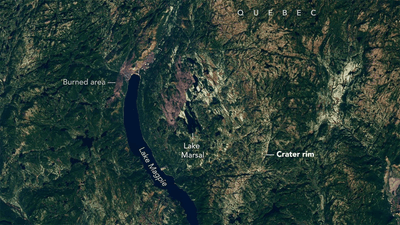


In 2024, we reported the story of a man who spotted an unusual spherical structure in Quebec's Côte-Nord region on Google Maps. New research has confirmed that he had made a truly remarkable discovery.
Joël Lapointe was planning a camping trip in the area when he spotted the feature, around 15 kilometers (9.3 miles) across, surrounding Marsal Lake in Quebec. Lapointe contacted geophysicist Pierre Rochette of the Environmental Geosciences Research and Teaching Center (CEREGE) in France for help identifying the strange feature, believing that it could potentially be the site of an ancient impact crater.
We're sure (extrapolating from our own inboxes) that scientists get a large volume of claimed potential discoveries from the public, but thankfully Rochette did take the claim seriously enough to investigate further.
"Looking at the topography, it's very suggestive of impact," Rochette told Canadian news outlet CBC in 2024.
With colleagues, Rochette took a closer look at the area, and came to the conclusion that the small ring of mountains surrounding the lake may have previously been miscategorized.
"This formation, interpreted as a volcanoclastic diatreme formation named Marsal breccia, in an area devoid of post Grenvillian magmatism," the team wrote in a paper presented at the 86th Annual Meeting of the Meteoritical Society 2024, "is in fact more in agreement with a crater floor clast-poor melt rock, quite similar to the Mistastin and Janisjarvi cases."
It was intriguing, but it wasn't exactly confirmation of an impact event. Currently there are only around 200 confirmed impact structures that we have found on Earth, so it would represent a rare and pretty impressive find.
Gordon Osinski, a planetary geologist at Western University and director of the Impact Earth database, was skeptical that it was an impact crater, but nonetheless intrigued by the potential discovery, and chose to join an expedition to the site run by CEREGE.
That turned out to be a very good decision. After arriving at the lake via floatplane, the team soon found "shatter cones", conical features in rocks that result from the passage of shockwaves following an impact.
"It's the only unequivocal evidence of an impact event that you can see in the field with the naked eye," Osinski explained in a NASA statement.
Examining samples of the rock, the team determine that the impact likely occurred around 390 million years ago, which is pretty good luck for modern humans. According to Osinski, were the same meteor to hit today it would cause "regional devastation on a scale that would wipe out major cities and have global climate impacts."
The team have named the impact crater Uhackatik after discussing it with local Ekuanitshit Innu people, and it is expected to be confirmed as an impact when the Meteoritical Society committee next meets.
"I encourage everyone to not ignore intuition or an observation, even if it isn’t part of your field of expertise," Lapointe said to Radio Canada, adding that he was "over the Moon" to Montreal City News.
It is expected that there are other undiscovered impact craters on Earth, out there waiting to be found. Maybe take a look around the next time you're planning a camping trip.