Nature
 PUBLISHED






A new analysis of exceptional fossil sites in China and Mongolia suggests the earliest animals could have evolved up to 200 million years before they first show up in the fossil record.
The study argues that the main evidence used to pin the origin of animals to the Ediacaran Period (roughly 590 million years ago) is fundamentally flawed.
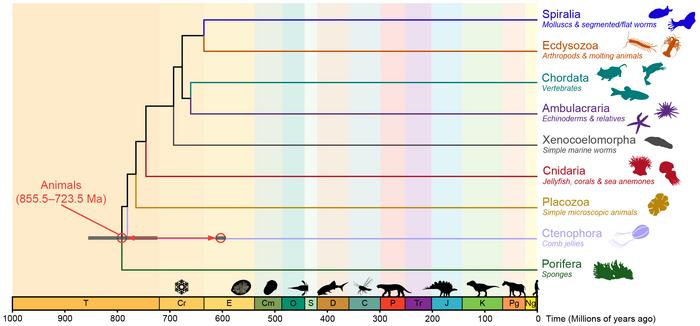
Instead, the researchers say more weight should be given to genetic evidence, which implies animal life first appeared between 800 and 700 million years ago, as well as to the chemical traces early animals might have left behind.
An absence of evidence
The earliest definitive animal fossils date to roughly 560 million years ago. But because these organisms are already multicellular and somewhat complex (despite lacking some trivial things like a mouth or gut), their true origin is thought to be older still.
However, researchers hunting for fossils of these more ancient animals have so far come up empty handed. That's despite some fossil sites showing exceptional preservation that should, in theory, have captured any simple animals that were swimming about.
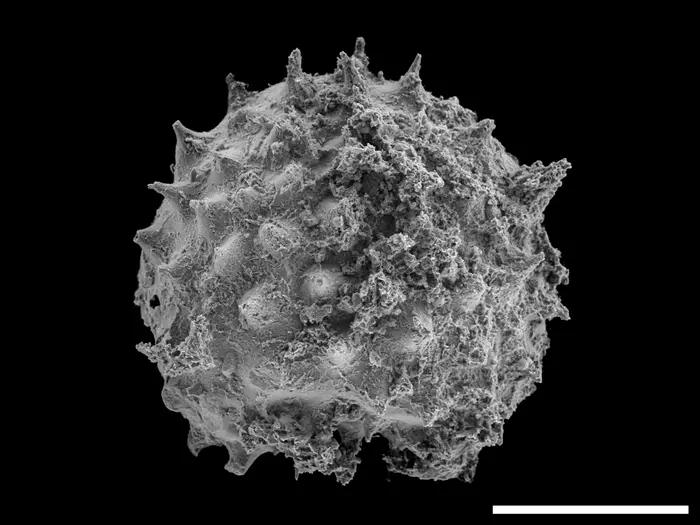
One of these is a site in China known as the Doushantuo Formation, which contains an assemblage called the Weng’an Biota. Dating back around 590 million years, it preserves an incredible snapshot of microscopic marine organisms in three dimensions.
And yet, despite the near-perfect level of preservation, there is no evidence of animal life. This has been used to argue that animals must have evolved during the 30-million-year gap between the Weng’an Biota and the first definitive animal fossils.
Now, however, new evidence from a fossil assemblage in Mongolia called the Kheseen Biota is challenging that interpretation.
Like Weng’an, the Kheseen assemblage contains an astonishing array of well-preserved marine organisms without a single animal fossil. But there is one key difference: the Kheseen Biota is a full 40 million years younger than Weng’an, dating to a time when animals are known to have already evolved.
“The Kheseen Biota breaks the argument that the exceptional microfossils of Weng'an mean we would have seen animal fossils in the assemblage had they existed at the time,” says Associate Professor Ross Anderson, from the Museum of Natural History, Oxford University, in a statement.
“The Kheseen microfossils are just as well-preserved, yet animals continue to be absent despite the fact we know at that point they existed.”
The researchers are using this to argue that despite the high levels of preservation, the absence of animal fossils at Weng’an is not evidence that there were no animals 590 million years ago.
Molecular dating
This explanation also lines up with the genetic evidence. That’s because when researchers look at the DNA of all living animals and then trace it back to the origin, it comes up with a date hundreds of millions of years earlier than Weng’an, which previously was a problem.
“Pre-Ediacaran animal body fossils still elude us, and this analysis does not prove that animals existed 800 million years ago,” explains Orin Lole Durbin, PhD student and first author.
“However, our new fossil evidence from Mongolia undermines one of the main arguments for restricting animal origins to the Ediacaran interval. Meanwhile, our molecular-clock analyses show how much further back their evolutionary history could extend.”
The researchers suggest that perhaps the sites in China and Mongolia are preserving environments that, for whatever reason, were not inhabited by early animals. Instead, they argue we should be looking for early signs in different parts of the world that could represent different environments.
Previously, fossil traces of chemically altered fats from Oman have been used to argue that sponges – which, although quite different from almost all other animals, are indeed animals – could have hit the scene as early as 650 million years ago.
If animals really evolved earlier than around 635 million years ago, it would push back their origin to within the Cryogenian, when it is thought that most or all of the planet was covered with ice – a scenario commonly known as Snowball Earth.
The new study had been published in the journal Science Advances.