


 Nature
 PUBLISHED
 1
1


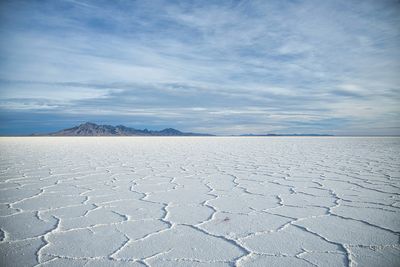


The precipitation of salt out of sea ice created a feedback mechanism that might explain the formation of Snowball Earth, the most extreme climatic event in the history of our planet. The idea, released in a preprint that is yet to complete peer review, could shed light on the role of sea ice in climate change today if it stands up to further scrutiny.
The event known as Snowball Earth, when the ocean froze all the way to the equator, has become a major topic of research in recent years. While much of that addresses the question of whether any unfrozen pockets survived, and other scientists investigate the ending of the event’s influence on life, probably the biggest Snowball Earth question is how it happened at all. There’s no reason to think the Sun suddenly put out much less heat, so what caused the planet to cool so drastically, probably more than once?
Part of the answer is well-known: a vicious circle where expanding ice reflected more sunlight, which cooled the planet further and allowed ice to grow even more. Geologic processes that removed carbon dioxide from the atmosphere faster than it was added are also thought to have been involved, but those we know of are also not enough. Now a trio of scientists have proposed an additional feedback mechanism that may fill in at least part of the gap.
Graduate student Aksel Samuelsberg, Professor Per Jakobsen, and Professor Martin Rypdal are all at the Arctic University of Norway, where ice probably comes up a lot. They note that, “Under sufficiently low temperatures, salt begins to precipitate out of sea ice, forming a lag deposit of crystals.” These salt crystals are very reflective – amazingly, even more so than snow or ice – and therefore can perform the same role as ice itself in preventing the absorption of sunlight, and consequently cooling the planet.
The trio note that modeling of conditions at lower latitudes during part of Snowball Earth’s initiation indicates that ice was sublimating (turning to gas) faster than very limited snow and rain of the era could replace it. This net loss of ice is known as ablation, and has created a paradox for climate modelers. If a net ablation zone existed across much of the planet for thousands of years, as models suggest, how could the cycle of ice expansion continue? Perhaps, they suggest, it wasn’t just ice reflecting the sunlight, but salt.
Before going on, it’s worth addressing something that might be puzzling people. Salty water does not freeze well, and salt is usually excluded when it does. This is why as sea ice expands in the Arctic or Antarctic winter, the waters around it become saltier. Knowing this, people may wonder how there could be any salt in sea ice to precipitate out. The answer is that although a lot of salt is excluded during freezing, some does get captured when conditions are cold enough.
The authors propose that when the expansion of sea ice reached a limit, because ice loss exceeded ice gain, salt production took over as the method for making the Earth more reflective, at least in the tropics. They then explore the formulae for how the production of this salt would have affected Earth’s reflectiveness and therefore temperature.
Although they report, “Based on this study, it is not possible to determine how long a salt deposit lasted on Snowball Earth,” the authors conclude such a deposit very likely existed. Past attempts to model the climate of a Snowball Earth have required improbably low levels of atmospheric carbon dioxide, but when salt is factored in, the CO2 in the atmosphere can be at more plausible levels.
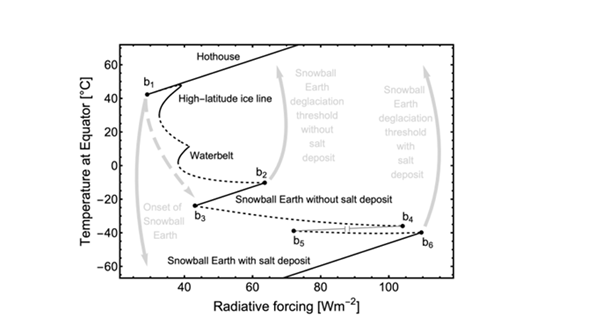
The explanation works particularly well, the team argue, because sea salt is not all the same molecule. Some salts precipitate from ice at -8°C, whereas others require -36°C. This makes it easier for a feedback cycle to occur – somewhat low temperatures release a few and their reflectiveness cools the planet until others emerge.
The authors acknowledge their modeling does not consider all the known factors, for example, clouds, that would have been relevant as Snowball Earth expanded. They also admit the strength of the feedback salt precipitation would produce remains unknown, but even a small effect may have been crucial.
The preprint is available at Climate of the Past.
[H/T Phys.org]


