Nature
 PUBLISHED



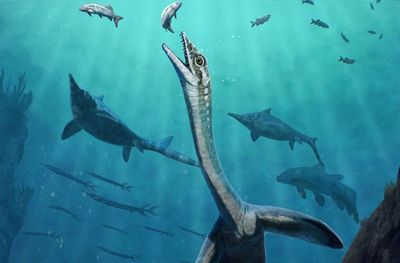


Sometime during the Triassic Period, a small marine reptile took its last breath, and its body sank slowly to the bottom of the warm sea.
Now, 245 million years later, researchers have uncovered its perfectly preserved remains, revealing an almost complete set of digestive organs including stomach, liver, and intestines.
Just one more of the weird and wonderful denizens of the Sea of Tethys.
Nick Fraser
The fossil belongs to a marine reptile called Austronaga, and it is giving scientists a better idea of how the internal organs of these curious reptiles evolved.
It shows that while their bodies were highly adapted for swimming, they had much simpler internal anatomy.
“This is a fairly basic intestine with a simple stomach not divided into two parts as it is in more derived archosaurs, such as crocodiles,” study author Dr Nick Fraser at National Museums Scotland told IFLScience.
“The neat thing is that so much of the internal organs are preserved and it is possible to see the different parts of the gut.”
This has given the researchers direct evidence of what the marine reptiles might have been eating, as tiny little fish scales were found in the hindgut. More extraordinarily still, the preservation is so good that the liver is still a “a dull reddish color."
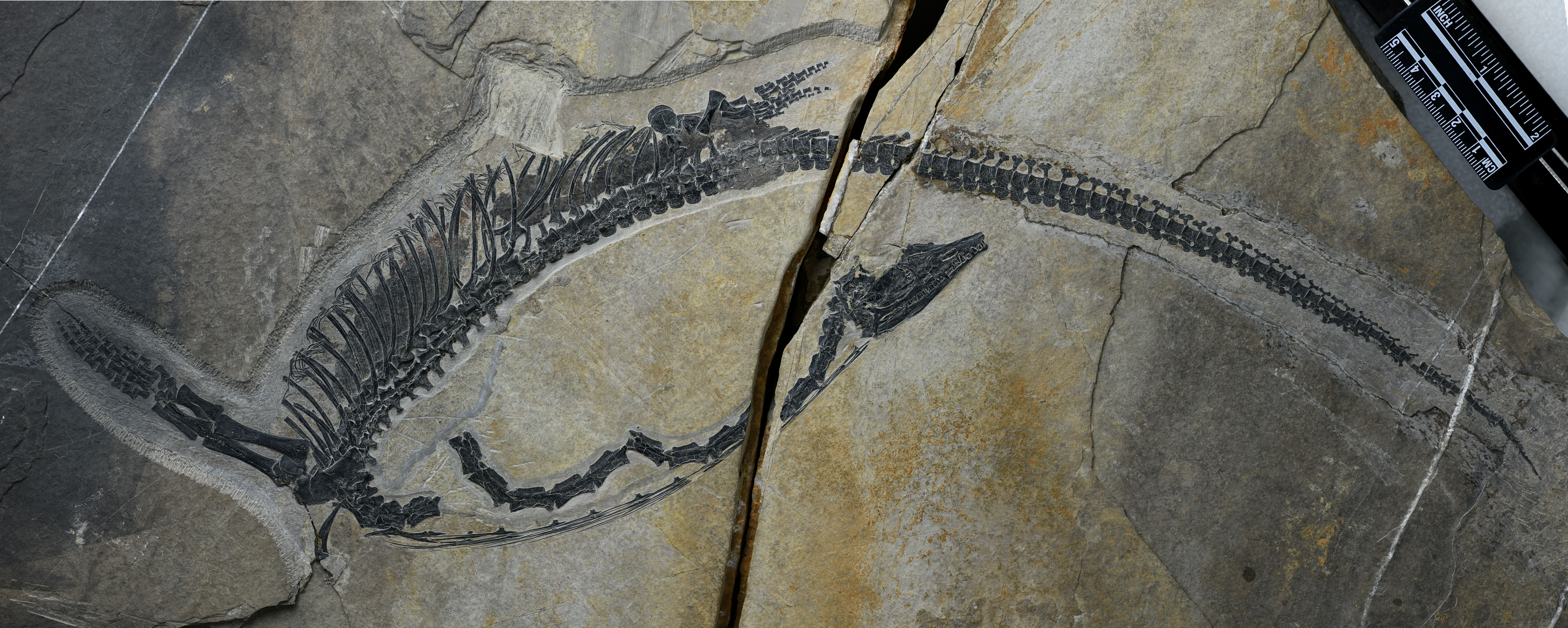
“The overall arrangement shows that the digestive system of Austronaga was relatively simple in structure,” says Dr Wei Wang, lead author of the study and marine reptile expert at the Institute of Vertebrate Palaeontology and Palaeoanthropology in Beijing, in a statement.
“This fossil is the oldest-known example of a largely complete digestive system in a reptile.”
Life in the Tethys Sea
The fossil belongs to a relatively small animal called Austronaga minuta. It was incredibly well-adapted for swimming, with a long, slender neck, paddle-like limbs, and a strong, muscular tail.
While it looked similar to a miniature plesiosaur, it was completely unrelated.
Unearthed from the Guanling geological formation in southwestern China, it would once have swum in a warm equatorial sea teeming with life.
At only 60 centimeters (24 inches) long, the researchers suspect the reptile didn't live in the open ocean, which would have been patrolled by the likes of much larger ichthyosaurs, and might have hunted in coastal waters instead.
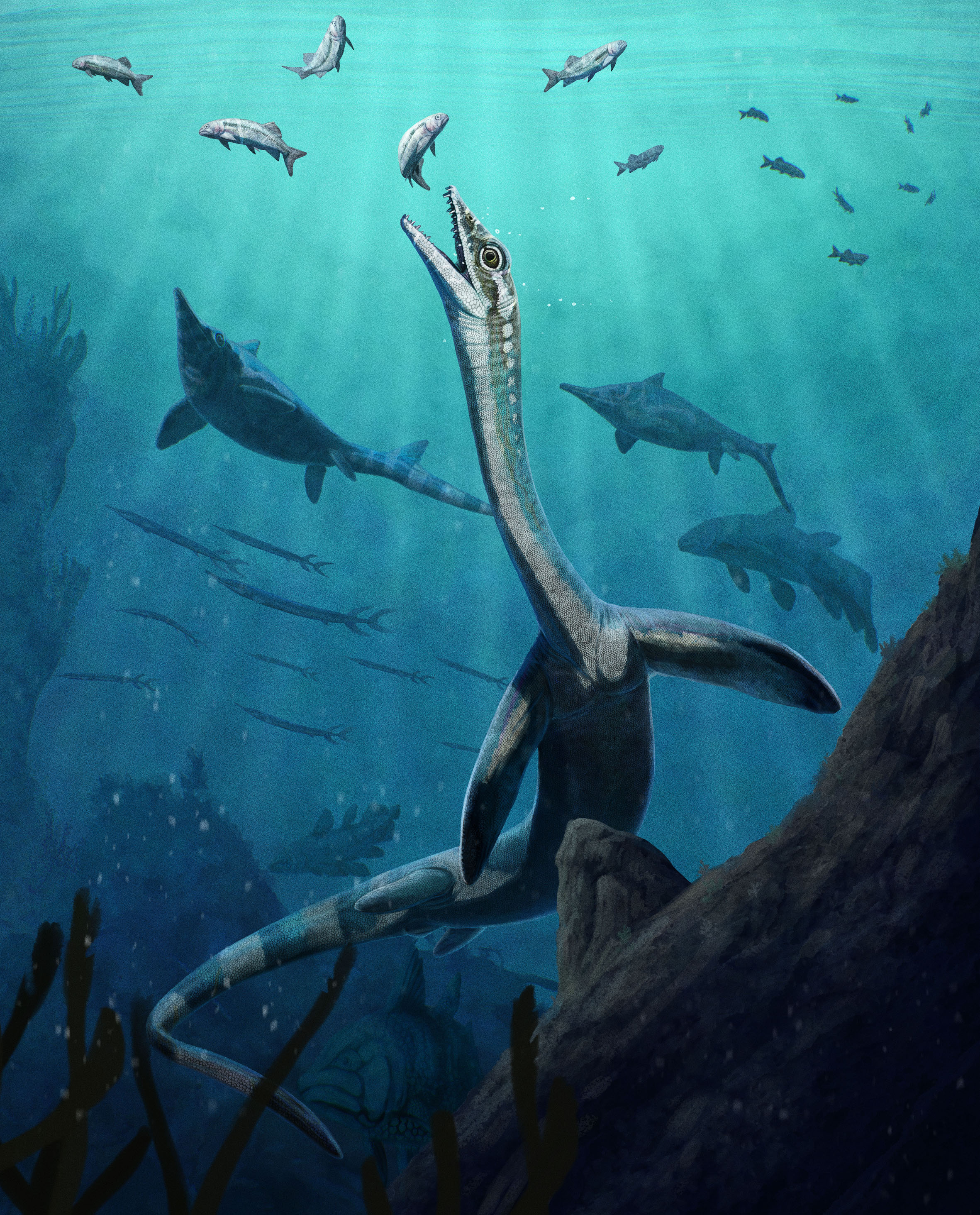
“Austronaga was adapted to a fully aquatic life, and at best only came out on land to lay eggs,” said Fraser. “Even that is doubtful: we know that a closely related species, Dinocephalsosaurus, gave birth to live young.”
It is just one of a whole range of extraordinary animals that lived in this part of the world during the Triassic Period.
Along with the ichthyosaurs, it shared the waters with predatory nothosaurs, bizarre turtle-like Sinosaurosphargis, large bi-valve-crushing placodonts, and the supremely weird hammer-headed reptile Atopodentatus.
“The specimen was excavated from Luoping County in Yunnan, and it is a scintillating discovery,” Fraser continues. “Just one more of the weird and wonderful denizens of the Sea of Tethys. It seems that these Chinese deposits still have many more secrets stashed away!”
The study describing this fossil in full has been published in the journal Science Advances.