Nature
 PUBLISHED
 2
2


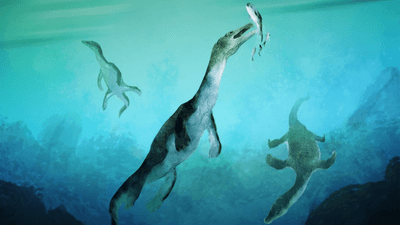


The fossil vertebra of a polar sea monster has been discovered that dates back 246 million years. Known as a nothosaur, the marine reptile lived just as the dinosaurs were getting started, and the fossil is the oldest of its kind ever found in the Southern Hemisphere.
The ancient fossil is a single vertebra that was excavated at the foot of Mount Harper on the South Island of New Zealand. That location is particularly interesting, as until now evidence of reptiles’ early migration into the oceans was only known from the Arctic island of Spitsbergen, northwestern North America, and southwestern China. It therefore provides a unique opportunity to dive into the history of sea reptiles in the Southern Hemisphere.
The fossil itself is not new, having first been discovered back in 1978, but only with new analyses are we appreciating its significance. It belonged to a nothosaur, a sauropterygian relative of plesiosaurs that grew to around 7 meters (23 feet) long and used four paddle-like limbs to move through the water.
“The nothosaur found in New Zealand is over 40 million years older than the previously oldest known sauropterygian fossils from the Southern Hemisphere,” said lead author Dr Benjamin Kear from The Museum of Evolution at Uppsala University in a statement. “We show that these ancient sea reptiles lived in a shallow coastal environment teeming with marine creatures within what was then the southern polar circle.”

When the animal was alive, what we now know as New Zealand occupied the southern polar coast of an ancient super-ocean called Panthalassa. Typically, the oldest nothosaur fossils have been found along what would’ve been Panthalassa’s northern margins, so this discovery switches up what we thought we knew about where these animals originated and how they spread.
“Using a time-calibrated evolutionary model of sauropterygian global distributions, we show that nothosaurs originated near the equator, then rapidly spread both northwards and southwards at the same time as complex marine ecosystems became re-established after the cataclysmic mass extinction that marked the beginning of the Age of Dinosaurs,” explained Kear.
“The beginning of the Age of Dinosaurs was characterised by extreme global warming, which allowed these marine reptiles to thrive at the South Pole. This also suggests that the ancient polar regions were a likely route for their earliest global migrations, much like the epic trans-oceanic journeys undertaken by whales today.”
“Undoubtedly, there are more fossil remains of long-extinct sea monsters waiting to be discovered in New Zealand and elsewhere in the Southern Hemisphere.”
Grab your hammers, lads. We’re going nothosaur hunting.
The study is published in the journal Current Biology.