Nature
 PUBLISHED


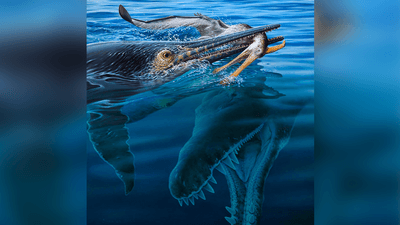


What did ancient animals eat? Well, a new study has found a "turducken" of three species all interlinked by their dietary habitats.
At one end is a pterosaur species, taken out of the air to be eaten by a deep sea monster in the form of the ichthyosaur, Platypterygius australis. In turn, the ichthyosaur skeleton sports massive bitemarks from the pliosaur Kronosaurus queenslandicus, revealing the complex interplay between these three large species.
This study marks the first record of an ichthyosaur, a dolphin-like ancient marine animal, consuming a pterosaur.
The middle species in this three-way chomp-fest is the ichthyosaur P. australis. This specimen is estimated to be 6-7 meters (20-23 feet) long and was found in the Toolebuc Formation, Richmond, Queensland, Australia.
The specimen possesses deep visible bite marks across its vertebrae, most likely caused by a large pliosaur. The team thinks it was most likely to have been the region's largest marine predator, K. queenslandicus, which could have grown to over 10 meters (33 feet) in size.
"I was amazed by the size of the ichthyosaur, and shocked to see it littered with bite marks and partially exposed pterosaur remains behind the skull," said Dr Matt White, Research Associate at the University of New England and lead author of the study, in a statement.
The bites themselves are conical and thus more likely to have come from a pliosaur as theirs do not resemble the bitemarks made by sharks. Several of the bones are crushed or spilt, in a way that indicates the pliosaur was chomping down on the ichthyosaur.
However, the damage to the beak, or rostrum, and the skull is more likely to be the result of the animal falling than direct bite injury caused by the predator.
"This discovery enriches our understanding of these ancient marine reptiles and illustrates the complex interactions that shaped their prehistoric aquatic environment. The public fossicking areas near Richmond have yielded thousands of fossils over the years, including dinosaurs, birds, turtles, polycotylid, plesiosaurs, pliosaurs, pterosaurs and other marine reptiles,” said White.
Beside the fossil of the ichthyosaur are four remains believed to be stomach contents, including pterosaur elements, fish ribs, and shell fragments.
The team acknowledge the possibility that the current caused the pterosaur fragments to mix with the ichthyosaur remains; however, they consider the stomach contents a much more likely explanation, given how scarce pterosaur remains are.
The team even suggested that this could have been the animal’s last meal.
The study is published in the journal Gondwana Research.