Nature
 PUBLISHED
 1
1



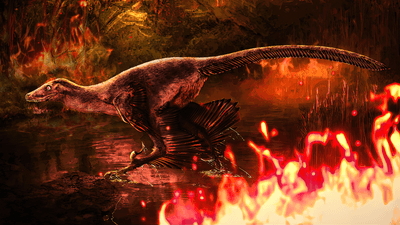


We know from their fossils that Earth was once ruled by dinosaurs. We also know that they abruptly disappeared from the fossil record around 66 million years ago.
So how did all the dinosaurs, all around the world, die in the same event? A new study suggests they were “charbroiled” to death.
The dinosaurs' demise
Historically, there were competing theories as to what killed the dinosaurs. For example, the Deccan volcanism hypothesis suggested that massive lava flows and toxic gases in India led to catastrophic climate disruption.
But it wasn't until 1991 that the “Alvarez hypothesis”, which attributed the fall of the Age of Dinosaurs to the Chicxulub asteroid, gained widespread acceptance.
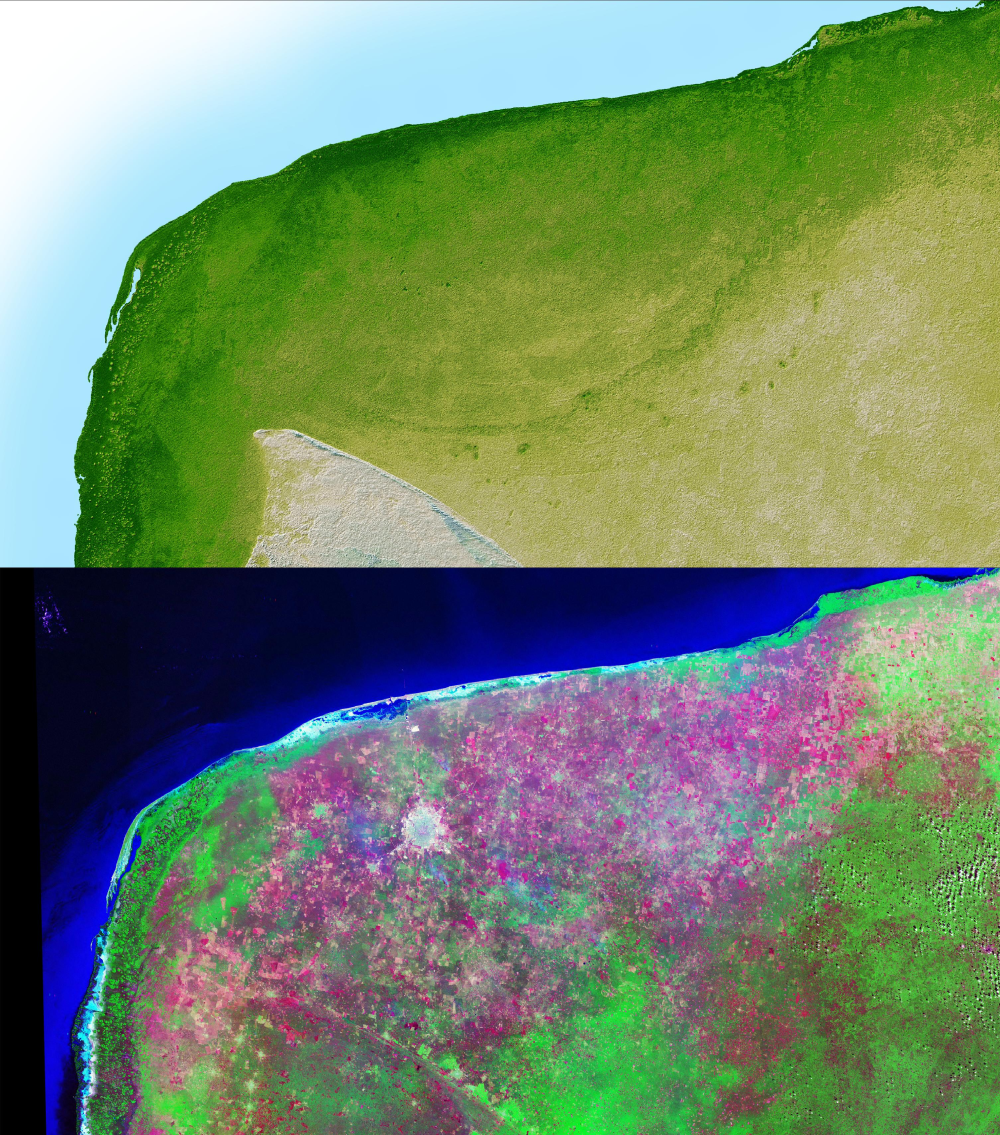
A surprisingly recent discovery given how long we’ve been studying dinosaurs, but then again we only unearthed the impact crater site in 1978. A 2020 paper further cemented that it was the asteroid that did it.
Still, questions remain as to what, exactly, made Chicxulub so devastating on a global scale. Questions that have been addressed by a new modelling study that identified one key contributor to the tsunami of death unleashed on Earth that day: dust.
It might be hard to imagine that something so powerful as Tyrannosaurus rex could be brought to its knees by dust. But then again, this wasn’t just any dust.
While everybody always asks what happened to the dinosaurs, no one asks what happened to poor old Chicxulub? And it seems that this might be key.
An asteroid's end
When the 10-to-15-kilometer (6-to-9-mile) asteroid crashed into the Yucatan Peninsula, Chicxulub was completely vaporized, sending a plume of former-asteroid dust up into the atmosphere.
But unlike the terrestrial material emitted by the impact, this dust didn’t immediately come back down to Earth.
Instead, the dust from the asteroid spread out like a blanket across the entire planet.
To understand what impact that dust layer would have had, the team brought in cloud expert Alexandria Johnson.
They then ran simulations, factoring in Chicxulub’s dust and the heat emitted by the ~1,000 cubic kilometers (239.9 cubic miles) of rock, dirt, and organic matter that was released from the Earth following the impact as it re-entered the atmosphere.
This information was then combined with climate and radiative-transfer models to estimate how strongly it would have influenced the planet's temperature.
Terrible, terrible timing
It was a very bad time for an insulating layer to appear in the atmosphere. Down on the ground, the kinetic energy from the impact had been converted to heat. Now, that heat had nowhere to go.
The team's modelling suggested that surface temperatures on Earth would have remained lethally high – about 17 times that known to be 100 percent lethal to humans – for the first one to two hours following the impact.
Heat enough to ignite grass, pine needles, lichen, and wood. Time enough to kill anything that couldn’t hide underground or underwater.
“With the dust cloud trapping thermal radiation, it was like the surface and everything on it was being charbroiled,” said lead author Brandon Johnson of Purdue University in a release. “And that’s what killed the dinosaurs and all the other animals.”
“It’s not the blast wave from the impact or the fireball — those don’t go very far. It’s the global ejection of this vapor plume material that makes this a global extinction event.”
“Without the dust cloud, it would have been bad. It would have killed a lot of creatures. But it wouldn’t have been a planetary catastrophe.”
Surviving isn't always winning
Had anything on the surface lived to see it, that landscape would have been dark except for the red glow of wildfires.
What critters did survive would’ve emerged from their hiding places, but even then these animals faced long-lasting health effects as all that dust came drifting back down to Earth.
They had a second chance at life on Earth, but one that came at the cost of prolonged suffering.
“The 2.5-micrometer dust we studied here is the same size as the smoke particles we worry about with wildfires,” said Alexandria Johnson. “It gets in people’s lungs and even in our bloodstreams, which is why it’s such concern for public human health.”
“So even if critters were to survive the charbroiling, they would likely have had lasting health effects from these particulates as well. But when you look at the time scales of the cooking versus the inhalation risks, the cooking is much faster.”
Yeesh.
The study is published in the journal JGR Biogeosciences.