Nature
 PUBLISHED
 1
1




What you’ll discover in this article
- A Tyrannosaurus rex known as Gus has sold at auction for $50.1 million to an anonymous buyer.
- Private sellers often loan specimens to museums, but there is no requirement for them to do so and losing access means losing their scientific value.
- Natural History Museum, London dinosaur specialist Professor Susie Maidment told IFLScience, “A specimen in a private collection could be sold, access to it removed, or destroyed, so there is no guarantee that future palaeontologists will be able to access it to check the original findings. Consequently, reputable scientific journals will not publish research carried out on privately owned specimens. They are lost to science.”
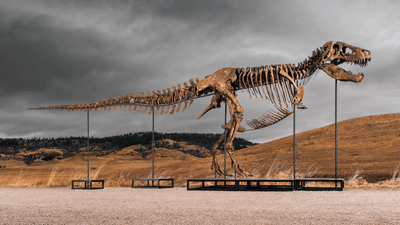
Sixty-seven million years ago, Gus the T. rex was fighting for his life – just ask the bite marks on his skull (thought to have been made by another T. rex, ouch). Today, he’s just sold to an anonymous private buyer for $50.1 million.
It’s a big number. But then, it could be said that a specimen as complete as Gus is priceless, packed full of information that can teach us about ancient animals, their environment, and behaviors.
The bitter irony of it is all that value could be lost if Gus ends up in somebody’s living room.
A very special dinosaur
Gus is an exceptional specimen, thought to be around 61 percent complete in terms of bone count, placing him among the most complete T. rexes ever found. Rare bones in the mix include belly ribs known as gastralia, humeri, a wishbone (furcula), a complete pelvis, and two well-represented feet.
“Having something of this level of completeness is a palaeontologist's dream, as they get a lot more information than they would normally have available,” said Professor Paul Barrett, a dinosaur specialist with the Natural History Museum (NHM), London, to IFLScience.
Unfortunately, even an institution as prestigious as that can’t stretch to the prices recent high-profile dinosaur sales have reached. It may surprise you to learn that museums actually spend comparative peanuts on new specimens (according to NHM London's annual report, just £23,000 [around $31,000] on 15 purchases last year). Instead, they rely heavily on donations, exchanges, and fieldwork discoveries.
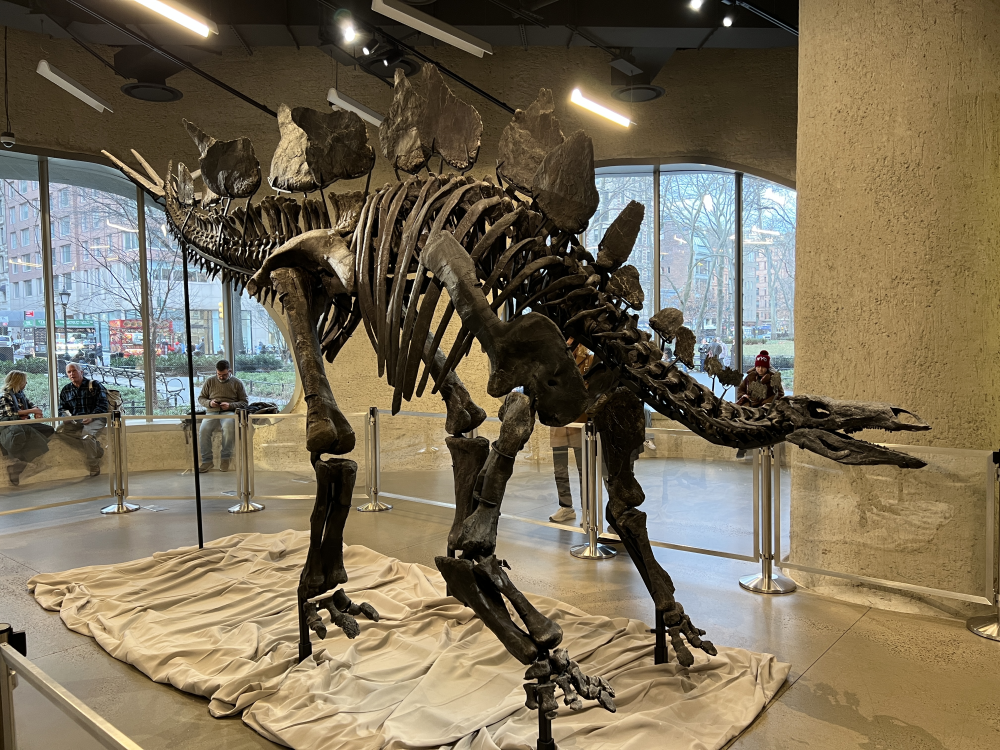
Compare that to the record for a dinosaur sale at auction set last year by Apex, a stegosaur that went for a whopping $44.6 million at auction - $10 million more than the previous record-holder, which was a T. rex named Stan.
Hold my beer, said Gus.
“I'm surprised but not shocked that Gus has set a new price record,” said Professor Steve Brusatte of the University of Edinburgh to IFLScience. “$50 million is a lot of money, and I can't think of many museums that could ever afford that price tag.”
The true cost of auction
At $50.1 million, Gus almost doubled the estimated sale value ahead of auction as he was purchased by an anonymous buyer who was bidding over the phone. It’s not unheard of for private buyers to loan their specimens to museums, granting scientists and the public access to our planet’s ancient past, but it doesn’t guarantee the specimen will stay there forever.
“Museums hold the specimens in perpetuity,” said Barrett. “So, generations of scientists can go back to the specimen, again and again, to check the observations that other people have already made.”
There is this risk that essentially they then become invisible to the scientific record and the information that they might contain vanishes with them.
Prof Paul Barrett
“[Future scientists can] apply new technologies and new techniques that haven't yet been invented to those same specimens to test different ideas about it or to find new things out that simply weren't achievable before. From a scientific point of view, we call that reproducibility.”
Reproducibility is a critical part of the scientific process. It filters out flawed methodologies and hidden biases by ensuring that independent researchers reach the same conclusion. Thing is, reaching it requires having access to whatever it is you’re studying.
“If those specimens end up in private hands – though some private owners are very keen to work with scientists – it does make that long term future of the specimen much more difficult,” said Barrett. “There is this risk that essentially they then become invisible to the scientific record and the information that they might contain vanishes with them.”
Who do dinosaurs belong to?
If at this point you find yourself spluttering, "How can they do that?!" You’re not alone.
Who gets to “own” dinosaur fossils and therefore make decisions about them is a subject that’s hotly debated. Not least because there’s no global consensus on how they should be handled after discovery.
Find a dinosaur in Brazil and it automatically belongs to the state. In the UK and US, a dinosaur is yours so long as it’s found on your land. They are the extreme ends of the dinosaur fossil ownership scale, but you’ll find everything in between, with laws varying sometimes even within the same country.
A valuation of $50 million is profiteering off natural heritage that should be available for everybody to see, not locked away in a rich person’s house.
Prof Susie Maidment
When you think about it, it's rather odd for a dinosaur's geographic location to seal its fate. After all, the world looked very different when these animals went into the ground.
“Dinosaurs didn't respect national, or even continental, boundaries as we understand them today, and neither did many other fossil organisms,” said Barrett. “But we live in the reality that these fossils are found in places that now belong to somebody or have some sense of ownership over them.”
We can’t prevent people taking ownership of what they find, and in some respects we shouldn’t want to. After all, following a lifelong fascination with fossils, it would seem mean not to give Phil Jacobs his flowers for finding the snout of a 150-million-year-old pliosaur on a beach along the Jurassic Coast.
A fossil hunter taking ownership of and requesting remuneration for their efforts in retrieving and preparing a fossil isn’t so much the issue, says Barrett. After all, if people weren’t trying to find fossils then scientists might never get to study them. But that exorbitant price tag? Now that is a problem.
How much for that dinosaur?
There was a time, Barrett says, when you could get your hands on a sauropod like Diplodocus for around $1 million. Still a big number, but it was a more realistic representation of the very real cost of fossil extraction and preparation.
“Amateur and commercial palaeontologists deserve to be recompensed for their work in finding, excavating and preparing fossils,” Professor Susie Maidment of NHM London told IFLScience. “But a valuation of $50 million is profiteering off natural heritage that should be available for everybody to see, not locked away in a rich person’s house.”
Why that million increased 50-fold for a smaller – and therefore easier to extract – specimen lies in the recent trend in record-breaking auctions.
“Auctions are largely driven by bravado and testosterone rather than real value, as we know from decades of experience from fine art where it's more to do with the aspect of competition or the desire to own an object rather than the object's real value,” said Barrett.
“These kinds of auctions are strongly distorting the price structure that we might get for any kind of commercial value for these objects.”
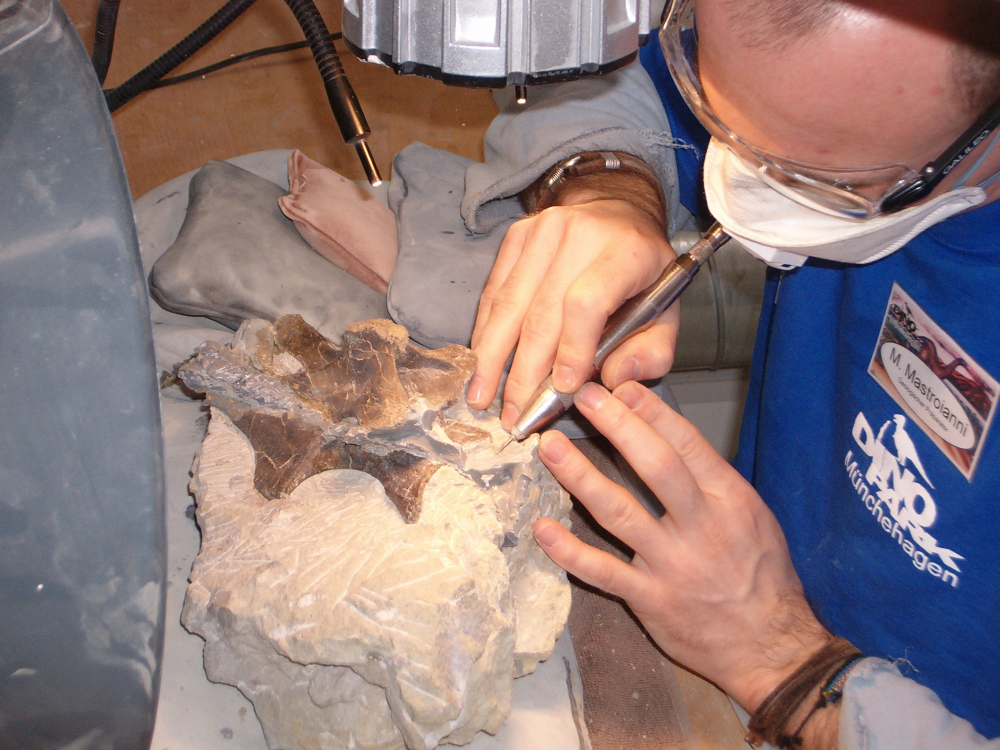
With high value comes the risk that fossils like Gus might become just another way to diversify your portfolio. According to Maidment, dinosaur specimens are increasingly being sold like pieces of art to private individuals – regarded as assets rather than natural heritage.
And promises of letting scientists come visit your dinosaur? It’s just not enough.
“While many private collectors say that they will make their specimens available to scientists, this misses the point,” says Maidment. “Palaeontology is a science and therefore has to be repeatable.”
“A specimen in a private collection could be sold, access to it removed, or destroyed, so there is no guarantee that future palaeontologists will be able to access it to check the original findings. Consequently, reputable scientific journals will not publish research carried out on privately owned specimens. They are lost to science.”
Given the costs, it’s hard to defend the high-profile sales of dinosaurs. However, equally difficult is finding a globally appropriate solution.
Can’t we just ban sales?
Fossil collecting is a spectrum. It doesn’t have to involve 61-percent complete T. rexes to qualify. It can range from the child finding their first ammonite on a beach, to people for whom finding and selling fossils represents their main source of income.
A blanket ban could, therefore, cause real harm to a lot of people in its efforts to block the bidding habits of the 1 percent.
"I find it very uncomfortable as a relatively privileged, well-off person telling someone that they cannot do this and they cannot gain that income to send their children to school or put food on the table because I have some philosophical objection to it,” said Barrett.
“Whereas then you go through a series of other kinds of transactions that gradually increase in value to the ones we're talking about today, where you have these kinds of trophy specimens that are going to billionaires potentially as interesting conversation objects, or things that they might have in their giant corporate headquarters, or their shopping mall, or their house, as opposed to someone who's digging in Morocco or Madagascar and trying to earn a few more dollars to make a living.”
If this is the new reality, and dinosaurs are commodities that fetch these prices, then we could find ourselves in a world where dinosaurs are tokens to be collected by the oligarch crowd, and museums are priced out of dinosaur research.
Prof Steve Brusatte
Balancing the interests of humans with those of science is something that crops up in all kinds of conservation, from protecting the seas without impacting fishers, to working with poachers to find alternative sources of income.
Complex issues such as the stewardship of natural history rarely have simple answers, but it’s a topic we’re going to have to address as a global community if we’re to make sure that dinosaurs – those toothy giants that have inspired everything from Jurassic Park to Barney – continue to be something for the many, not the few.
“If this is the new reality, and dinosaurs are commodities that fetch these prices, then we could find ourselves in a world where dinosaurs are tokens to be collected by the oligarch crowd, and museums are priced out of dinosaur research,” said Brusatte.
“And that would be a huge shame, as dinosaurs like Gus belong in museums, where they can be conserved, studied by scientists, and most importantly, exhibited to the public so they can inspire children and families.”