Nature
 PUBLISHED



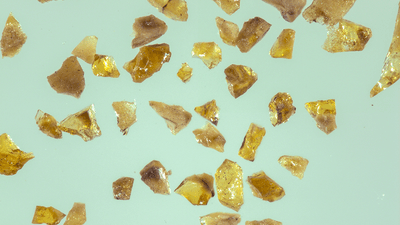


Previously, the oldest amber dated to around 330 million years old, from plants that lived during the Late Carboniferous. Microscopic pieces of amber have now been found that push back the date by at least 65 million years.
Amber is formed from fossilized resin. This sticky substance is to plants what platelets are to people, helping them heal from damage caused by fires, insects, or other wear and tear. However, to be able to produce resin in the first place, a plant needs to have both a means of secreting it and of making it.
Even older microscopic [amber] may remain undiscovered in organic-rich sediments.
Cihang Luo
For a long time, amber was only found associated with what are known as seed plants, which are basically most of the trees and shrubs that you see around today.
But the discovery of ancient amber made by seed ferns in 2022 changed that. Now, this new discovery comes from a time before seed plants even existed, raising questions about what, exactly, was producing it.
Amber can be especially useful to researchers because as it hardens, it can trap material inside. This can be insects or even dinosaur parts, helping researchers learn more about the ancient ecosystems the amber came from.
“The real surprise was not simply finding resin-like particles”
The discovery came as scientists were looking through bits of coal from the Hujiersite Formation in northwest China dating to the Middle Devonian, around 385 million years ago.
At this point in time, vertebrates were yet to leave the water, and the land was dominated not by modern plants alive today, but a mix of unusual groups long since extinct.
This included things with complicated names like progymnosperms and cladoxylopsids. As coal itself is formed from plant material, it can help researchers learn more about what exactly was growing in the environment.
But it turned out that it wasn't the coal that caught the team's attention.
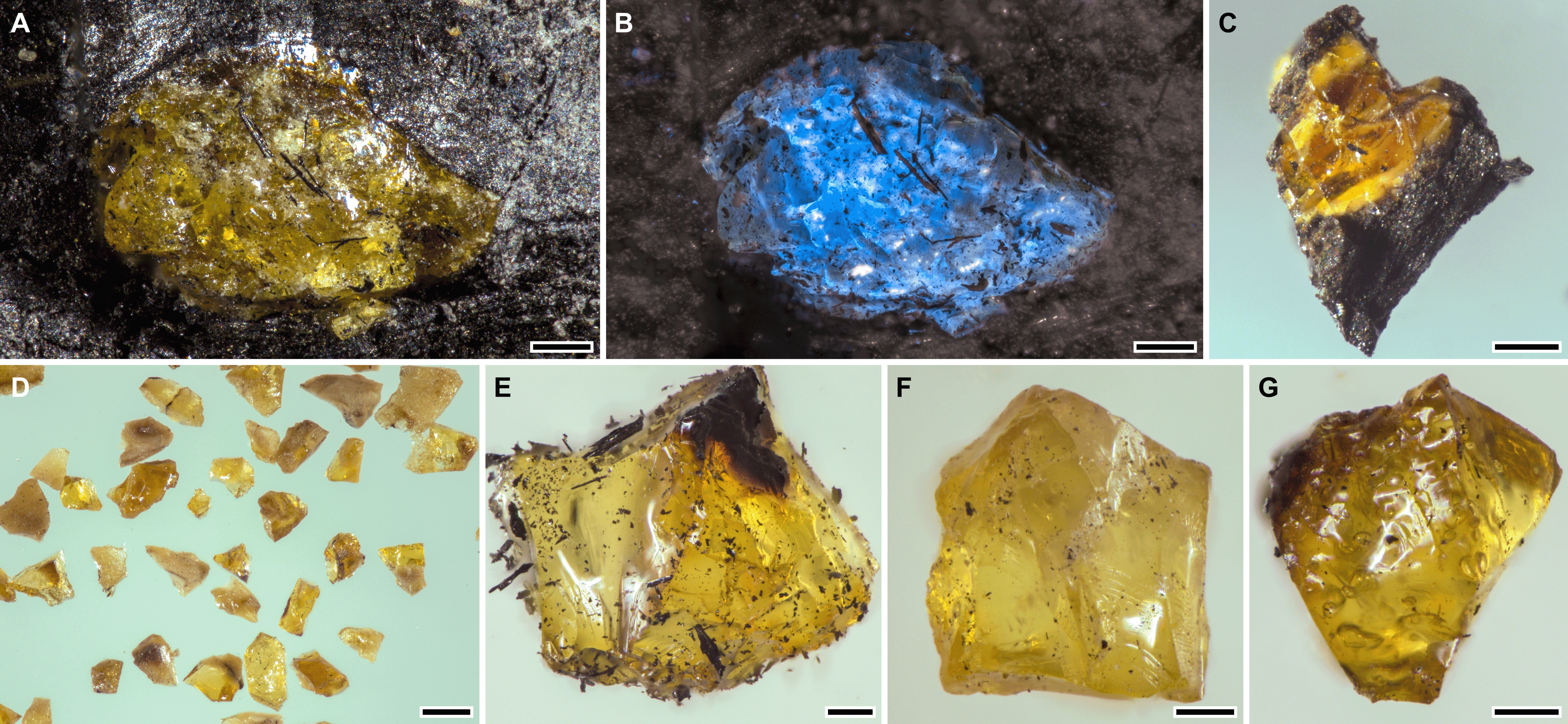
“While examining this unusual Devonian coal, we noticed extremely small particles with distinctive fluorescence,” explains Cihang Luo, the first author of the paper, to IFLScience.
“We then conducted a targeted search using ultraviolet light and carefully extracted the particles from the coal with stainless-steel needles under a stereomicroscope.”
“The real surprise was not simply finding resin-like particles, but being able to isolate them and demonstrate through infrared spectroscopy and GC-MS/MS analyses that they were genuine amber.”
The amber discovered is mostly microscopic, with most pieces measuring between 0.1 to 0.5 millimeters long, and the largest around 1.5 millimeters. But even these tiny pieces are enough to confirm that this is the earliest amber record.
Analysis of the fragments revealed chemical components that suggest the amber came from 'conifer-type' plants.
“We cannot yet identify the source plant with confidence because no amber has been found directly connected to diagnostic plant tissue or a preserved secretory structure,” sais Luo. “The most plausible candidates in the Hujiersite Flora are progymnosperms and tree-like lycopsids.”
The progymnosperms are now extinct, but were the ancient ancestors of all coniferous and flowering plants, while the lycopsids survive today in the form of clubmosses.
Rather than producing this amber in response to hungry insects, the team thinks that the plants were instead defending themselves against frequent wildfires or infection by plant-parasitic fungi. While this is now the oldest amber ever found, the researchers also think it's possible that even older specimens could still be out there.
“One important point is that our study documents the earliest known discrete amber pieces that can be isolated and independently verified through chemical analyses,” says Luo.
“It does not necessarily mean that no still earlier plants produced resin. Even older microscopic occurrences may remain undiscovered in organic-rich sediments.”
The paper is published in Science Advances.