Nature
 PUBLISHED
 3
3


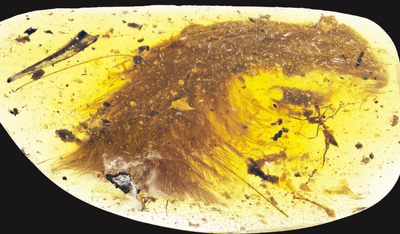


It’s rare enough to find a plant encased in amber, rarer still to find part of a dinosaur – so imagine paleontologists’ surprise when they discovered this feathery "flower" was in fact a feathery tail that once belonged to a juvenile theropod.
The fascinating case of mistaken identity began back in 2015 when Lida Xing stumbled upon a hunk of amber at a market in Myanmar. Believed to contain plant material, the 99-million-year-old fossil was already polished ready to be sold as a trinket – until Xing noticed something was amiss, and suggested that the Dexu Institute of Palaeontology buy it.
Upon closer inspection, it became apparent that entombed in the amber was no plant, but the feathered tail of a young coelurosaur – the clade containing all theropod dinosaurs more closely related to birds than to carnosaurs, which includes Velociraptor and Tyrannosaurus.
Xing even traced the amber back to its place of origin – Kachin State, Myanmar – by tracking down the miner who had originally dug it out.
In a 2016 study, Xing and co-authors used CT scanning and microscopic observations to peer inside the orange blob and study the specimen trapped inside.
"The new material preserves a tail consisting of eight vertebrae from a juvenile; these are surrounded by feathers that are preserved in 3D and with microscopic detail," study co-author Ryan McKellar said in a statement in 2016.
"We can be sure of the source because the vertebrae are not fused into a rod or pygostyle as in modern birds and their closest relatives. Instead, the tail is long and flexible, with keels of feathers running down each side." In other words, we can be sure these are dino feathers and not those of a bird.
“This is the first time we've found dinosaur material preserved in amber," McKellar told BBC News at the time.
Since then, we’ve come within a whisker of finding more Mesozoic monsters trapped in amber: in 2020, it was reported that the hummingbird-sized skull of a “dinosaur” had been discovered. But in yet another case of mistaken identity, it was snatched away from us a little over a year later, when it was revealed to actually be a strange new species of lizard.
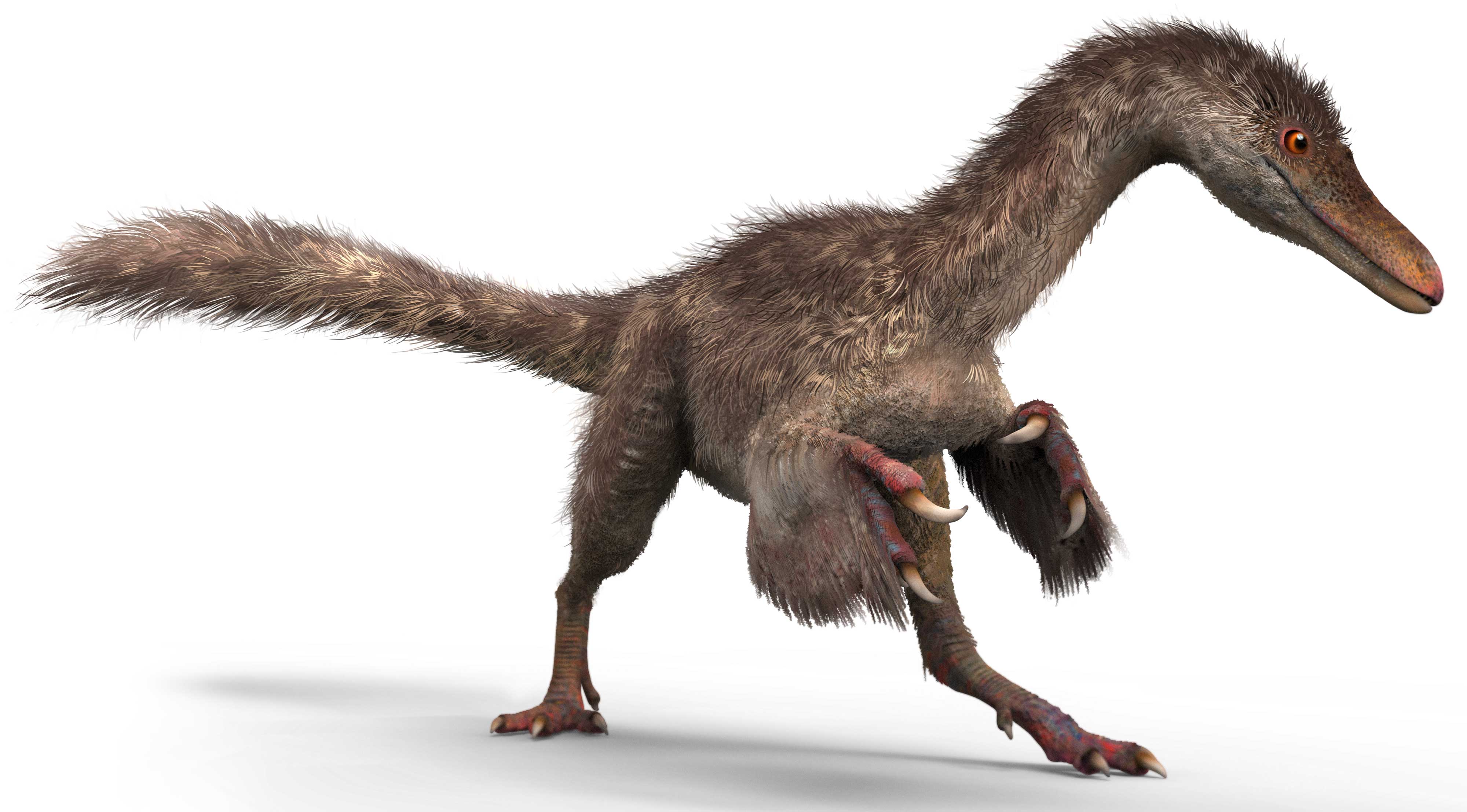
Back to the feathers: analysis suggested they were chestnut-brown on top with a pale or white underside. They also lacked a well-developed central shaft, which hints that the barbs and barbules of modern feathers – the two finest tiers of branching – evolved before the shaft.
A closer look at the tail stump revealed that the soft tissue layer around the bones retained traces of ferrous iron, a relic left over from hemoglobin (found in blood) that was also found in the sample.
It’s possible, the study’s authors admit, that the dinosaur could have become trapped in resin while still alive – and died as a result.
"It's amazing to see all the details of a dinosaur tail – the bones, flesh, skin, and feathers – and to imagine how this little fellow got his tail caught in the resin, and then presumably died because he could not wrestle free," Professor Mike Benton said to the BBC.
It’s an unfortunate way to go – but at least he was spared the indignity of being labeled a plant and turned into jewelry.
This narrow escape is just one example of many: last year, for example, a pretty agate “rock” that had been sitting, unassuming, in the Natural History Museum, London’s Mineralogy Collection for 140 years was revealed to be a dinosaur egg.
If we’ve learned anything from these palaeontological blunders, it’s that it always pays to have a second look.
An earlier version of this article was first published in August 2024.