Nature
 PUBLISHED
 1
1




Listen up: we’ve got something extremely important to get off our chests. There’s an historic injustice that needs to be corrected, and we cannot stay silent any longer.
For many years, we humans have been too quick to throw around animal-related insults. IFLScience has already debunked the whole “goldfish have short attention spans” slander, and today we’re seeking justice for our feathered pals.
“Birdbrain” is typically used to describe someone who has demonstrated limited intelligence. This is deeply unfair, because real bird brains are seriously capable and impressive.
Here are just a few reasons why.
Puzzle-solving, grudge-holding, math-doing: corvids are unstoppable
No discussion of the intellectual capabilities of birds could begin without acknowledging the corvids.
This group, including crows, ravens, and jays, encompasses some seriously smart cookies. Crows have shown they can use tools. They have incredible memories and can learn by watching each other – we thought only humans could do that. They perform “funerals” (kind of) for their dead and have been shown to hold grudges for longer than a human.
To top it off, crows have also mastered statistical inference and geometry. It may be time to rewrite the definition of “birdbrain” to mean “seriously impressive polymath”, don’t you think?
Songsters and linguists
If we were to play a quick word association game, what would come to mind when you hear “bird”? We’re willing to be that one of the options, at least, is “song”.
The way that songbirds learn to sing their signature tunes is a fascinating neurobiological feat that continues to teach the scientific community important lessons about how we humans master spoken language.
Both humans and songbirds, research has shown, achieve vocal learning via a two-step process in the brain using very similar circuitry.
These circuits involve motor neurons in the brainstem that control the movement of the vocal production apparatus – in humans, that’s our larynx, and in birds, it’s a similar structure called the syrinx.
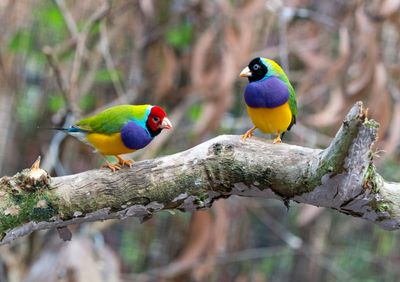
Some birds, like zebra finches, are what are called closed-ended learners. They have one song that they master when they’re young, and then they can’t learn a new one. This is because once the learning phase is over, their brains effectively switch over to new circuitry to reproduce the same song over and over again.
(We feel it’s important to note here that zebra finches also have favorite colors).
Scientists, including Dr Anna J. Simmonds in a 2015 paper, have proposed that this is similar to how humans learn to speak our first language as babies. Once we’ve mastered many of the sounds and shapes of the language, still as young children, our “vocal learning” circuit is superseded by one that allows only for vocal reproduction.
This, the theory goes, helps explain why learning to pronounce a foreign language in adulthood can be so tricky.
One of the leading figures in this research field over the years has been Dr Erich Jarvis of The Rockefeller University. He told Quanta Magazine in 2018, “The vocal-learning pathways in humans and these bird groups came from a preexisting structure that has similar connectivity and similar functions – it’s just that instead of controlling muscles for the hands or eyes or feet, this pathway controls muscles that produce sound.”
“Because it had similar ancestry, even though it evolved independently, it inherited similar traits from the surrounding motor areas.”
Aside from capturing the interest of neuroscientists, birdsong has vital functions for the birds themselves.
Beyond attracting mates, hearing the right song at the right time has the power to alter a developing bird’s physiology before it hatches, as is seen in zebra finch parents who perform “heat calls” to warn their young of warm climates.
For roosters, their morning crowing isn’t just a handy (or annoying, depending on your point of view) alarm call – it’s an important social ritual that maintains their literal “pecking order”.
And tiny, three-day-old chicks have even shown an impressive mastery – shared with humans – of a linguistic phenomenon called the “bouba-kiki effect”, wherein they associate the sound “bouba” with rounded shapes and “kiki” with spiky ones.
Pigeons: master navigators and actual war heroes
This author will take any opportunity to celebrate the humble and unfairly maligned pigeon.
In terms of their neurological prowess, did you know some studies suggest they can dream? What about the study that found pigeons approach tasks in a way that’s not too dissimilar from how AI does?
If that hasn’t convinced you of their merits, how about the fact that they’re actual war heroes? An impressive 32 pigeons have been awarded the Dickin Medal for their gallantry in military conflict since the honor was introduced in the UK during World War II, placing them second only to dogs.
One of their key roles in conflict has been carrying messages, something they’re able to do because of their renowned homing abilities. For this, they rely on being able to sense the Earth’s magnetic field – and yes, okay, humans can do that too, but nowhere near as well.
Researchers are still homing in (sorry) on exactly how birds’ magnetoreception works; their brains are almost certainly involved, but also their eyes, beaks, and even livers. The authors of a 2026 study wrote, “We propose that in homing pigeons, superparamagnetic macrophages in the liver are required for finding magnetic direction.”
In a class of their own: the parrots
Rounding things out, because we honestly could go on all day, are the parrots.
You know some can talk – but when was the last time you stopped to think about how truly impressive that is? Alex the African gray managed to master 100 words during his lifetime, including his utterly heartbreaking signoff before his untimely death in 2007: “You be good. I love you. See you tomorrow.”
Einstein, another member of the same species, is said to have increased this feat to 200 words before she, too, passed away earlier this year at the age of 38.
On the other side of the world, New Zealand’s iconic keas are continually impressive representatives of parrotkind.
Take Bruce, for instance. Despite lacking half a beak, he’s the undisputed ringmaster of his circus (yep, that’s really the collective noun) at Willowbank Wildlife Reserve. Just look at him go.
Keas are so intelligent, in fact, that it’s actually brought them into conflict with humans, leading to some pretty creative solutions.
Back in 2018, these mischievous birds were causing all sorts of bother on New Zealand’s roads by moving cones around – possibly for the fun of it, and possibly in a cunning attempt to get cars to slow down and offer them a snack.
The solution, as reported by the Guardian at the time, was an ingenious roadside gym, offering all the stimulation an intellectually curious parrot could desire and preventing them from starting up their own civil engineering projects.
A bird so intelligent that it becomes a literal menace to society? Surely that’s all the reason you need to erase “birdbrain” from your vocabulary.