Nature
 PUBLISHED


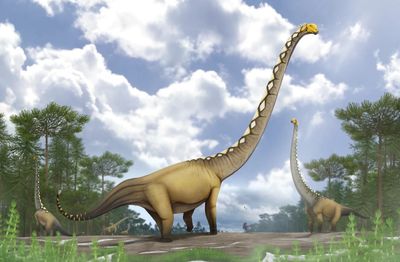


A new species of dinosaur unearthed in Thailand was head and shoulders above the rest.
Say hello to Uragasaurus kalasinensis, a newly described sauropod dinosaur from northeastern Thailand. This makes it the 15th species of dinosaur to have been found in the country, adding to the growing picture of what the region was like 143 million years ago.
“This discovery represents the first formally named mamenchisaurid from Thailand and expands the known geographic distribution of the clade in Southeast Asia,” write the authors.
Despite its large size in life, the species has only been described from a single vertebra discovered in the Phu Kradung Formation. At the time the dinosaur was alive, this region would have been a lake-dominated floodplain crisscrossed by numerous rivers.
Regardless of its scrappy nature, the fossil was distinctive enough on its own for the researchers, led by Apirut Nilpanapan of Mahasarakham University, Thailand, to not only be sure it once belonged to a sauropod, but to name it as a new species altogether.
“The new [species] is based on a well-preserved anterior dorsal vertebra exhibiting a distinctive combination of characters, including a unique Y-shaped configuration,” the researchers write.
They named it Uragasaurus kalasinensis, with “Uraga” coming from the Sanskrit word उरग, meaning “snake” or “serpent”, in reference to its long neck, and the species name referring to Kalasin Province, where the specimen was found.
Sauropods are known for their massive size, with four pillar-like legs, long necks, and counterbalancing tails. Yet this new species took things to the extreme, because it also belongs to a rather extraordinary group of sauropods known as the mamenchisaurs.
This group contains species such as Mamenchisaurus sinocanadorum, which had an abnormally long neck of up to 15 meters (49 feet), with the neck making up nearly half of the dinosaur's entire length.
What it was about this group that meant they evolved such proportionally long necks is not fully understood.
“It looks like these necks were probably to do with enhanced feeding like in other sauropods, but it could have had more than one role,” Professor Paul Barrett, an expert in sauropod evolution at the Natural History Museum, London, said back in 2023.
“It could have also been to do with sexual display or used for neck-butting contests between males fighting over mates and territory, similar to how giraffes behave today. But we can't say for sure. At this point, it's pure speculation as to why they evolved necks of this length.”
Mamenchisaurs used to be thought of as a distinctly East Asian group, with many of the early species having been described from China. It was even suggested that as China was a large, isolated island during the Jurassic, perhaps the evolution of sauropods happened slightly differently here.
But over recent years our understanding of these ancient giants has shifted.
Remains of Wamweracaudia from Tanzania show mamenchisaurs were also present in east Africa, while fossils unearthed in Russia indicate they made it up into Siberia. This confirmation from Thailand has now pushed their distribution further south into Southeast Asia.
The study is published in Scientific Reports.

 1
1