Nature
 PUBLISHED



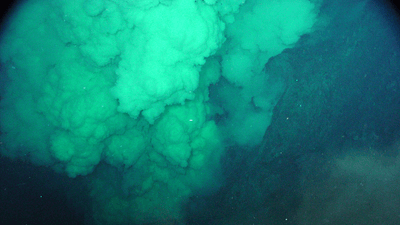


An underwater volcano off the coast of Mayotte, an island lying between Madagascar and Mozambique, erupted in 2018. According to new research, it may have spewed out magma dating back to Earth's earliest geological eon, during which we think the Moon was formed in a collision between Earth and a planet called Theia.
In May 2018, the island of Mayotte trembled with a series of earthquakes, eventually leading researchers to discover an underwater volcano now dubbed Fani Maoré. While all underwater volcanoes are "pretty awesome, actually," this one may be of particular interest.
If the work is correct, the team has their hands on lava from a magma source that had already formed by the time Earth was just 100 million years old.
The oldest rocks found on Earth so far date to around 4.03 billion years ago. That leaves the first 500 million years of Earth's history unaccounted for, with rock from that time presumed to have sunk into the mantle and been recycled.
This makes Earth's earliest geological eon – the Hadean – difficult to study, though by looking at the hard mineral zircon, which can survive this recycling process and end up back on the surface, we can gain some clues about what happened during this time.
"Very little is known about this early chapter in Earth’s history, as rocks and minerals from that time are extremely rare," earth scientists Hanika Rizo and Jonathan O’Neil explain in a piece for The Conversation. "This lack of preserved geological records makes it difficult to reconstruct what the Earth looked like during the Hadean Eon, leaving many questions about its earliest evolution unanswered."
According to the giant impact hypothesis, the cataclysmic collision with Theia would have occurred around 4.5 billion years ago and is thought to have turned the Earth into a global ocean of magma, reaching the core-mantle boundary deep within our planet.
The first mineral to crystallize within our planet, which now had extra material and a Moon for its inhabitants to eventually gawp at, was bridgmanite, now thought to be the most abundant mineral in Earth's lower mantle, followed by another called ferropericlase.
It has been a long, long time since that first geological eon, and it hasn't been clear whether minerals that formed during that time would still be detectable in some way, or whether the intervening mixing and churning of the mantle would make them unfindable to us all these years later.
The new study suggests, yes, it might be possible. To figure out the age of their samples, the team focused on the isotope neodymium-142 (142Nd), which forms from the decay of samarium-146, an isotope with a half-life of around 92 million years.
That sounds like a long time (and it is), but because there was a finite supply of samarium-146 on Earth, there should be no new sources of neodymium-142 within Earth's mantle. Therefore, if you find an excess of neodymium-142 in your lava sample, the magma source it came from must have formed very early in Earth's history and avoided being mixed with the rest of our planet's mantle.
"The short half-life of the 146Sm–142Nd system offers a unique possibility to detect silicate differentiation events that occurred during the first 500 Myr of the Earth," the team explains. "However, the potential variability of the 142Nd/144Nd ratio is not large. Some Archaean samples preserved in continental settings show excesses and deficits in 142Nd up to 20 parts per million (ppm), testifying the active decay of 146Sm."
Looking at the sample, the team did indeed find an anomaly: a small but significant excess of neodymium-142.
"Here we present new high-precision Nd isotopic measurements in present-day volcanism that identify heterogeneities dating back to the Earth’s earliest history," the team writes in their paper. "We report significantly positive 142Nd anomalies in lavas from the submarine Fani Maoré volcano in the Comoros archipelago."
Finding magma that formed 4.54 billion years ago would be remarkable enough by itself, but the team believes it may be further evidence that the mantle isn't as mixed as we once thought.
Modeling different scenarios – where the source was shallow or a deep plume from the mantle – the team found that in the shallow scenario, 28-90 percent of the material would need to be from the Hadean Eon to account for the anomaly, which they suspect is too high to be realistic.
However, the deep source scenario only required around 9-11 percent of the material to be from that early period of Earth, making it much more plausible.
"These anomalies require the preservation, in the mantle, of material depleted in light rare-earth elements (REE) and formed within the first 100 million years (Myr) of Earth’s history," they added. "We suggest that this material is mainly composed of bridgmanite that crystallized from an early Earth magma ocean."
"This Hadean bridgmanite may be more widespread in the present-day mantle than previously expected, raising new questions about its survival over billions of years of plate tectonics and vigorous mantle convection."
Further work is needed, but if this team is correct, humanity has found material that formed soon after the collision that formed the Moon, as well as an extra geological puzzle to work our way through.
The study is published in Nature.