Nature
 PUBLISHED
 1
1



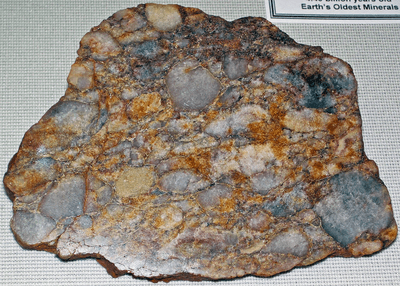


The oldest crystals formed on Earth contain signs that continents existed during the Hadean Eon and were being subducted into the mantle more than 4 billion years ago. If true, this would not only force a rewrite of how the early Earth looked and moved, but extend the period when life had a chance to appear.
The oldest rocks on Earth are a contested 4.16 billion years old, but there are minerals that are even more ancient. These are microscopic crystals known as zircons that were part of very early rock formations that have since been eroded; the tough zircons are their only surviving legacy. How widespread these zircons were within the first 500 million years of Earth's existence is unknown; the only place they have survived 4.4 billion years of geologic activity is Western Australia’s Jack Hills.
Such small crystals, displaced from their ancient rocks, can’t answer many of the big questions about the world at the time. However, a study of their chemistry indicates geology wasn't following the same script everywhere.
Zircons trap certain elements while excluding others, and those they capture give an indication of the magma in which they formed. “They’re tiny time capsules and they carry an enormous amount of information,” said Professor John Valley of the University of Wisconsin-Madison in a statement.
Valley is part of a team that compared the chemistry of Jack Hills zircons with those from South Africa’s Greenstone Belt, formed towards the end of the Hadean Eon, which ended 4.03 billion years ago. The two have compositions different enough to require some explanation, particularly their ratios of niobium to uranium and scandium to ytterbium.
“What we found in the Jack Hills is that most of our zircons don’t look like they came from the mantle,” said Valley. “They look like continental crust. They look like they formed above a subduction zone.” Modern subduction zones involve one tectonic plate being forced beneath another, dragging it down into the mantle.
Today, we would expect crystals formed an ocean apart to be different, but that's not the case for the early Earth, which is thought to have been so hot from bombardments of space rocks that it was covered by a magma ocean. Models of how this would develop as it cooled generally produce a rigid shell, which geologists call a “stagnant lid”. Only later, these models suggest, did this lid break up into tectonic plates that moved against and under each other, building up the continental crust we live on.
One possibility is that there’s an error in the analysis done on one set of crystals, but Valley doubts that. “I think the South Africa data are correct, and our data are correct,” he said. “That means the Hadean Earth wasn’t covered by a uniform stagnant lid.”
Other inner-Solar System bodies like Venus and the Moon still have stagnant lids. Even Io, which is rife with volcanic activity, has one, all of which tends to favor the idea Earth once did as well. However, some geologists doubt the idea, or at least suspect the stagnancy ended much earlier than the common estimates of 3.8 billion years ago. In recent years, evidence has started to accumulate in their favor.
This doesn’t mean modern plate tectonics were already underway when the Jack Hills zircons were formed up to 4.4 billion years ago. Instead, Valley and coauthors propose a model in which mantle plumes, like those that drive oceanic island formation, partially melted the base of the crust, setting up a process that drew rocks from the surface downward. These surface materials were rich in water delivered by comets, and they would change the chemistry of the mantle they mixed with. “The water causes melting and that forms granites,” said Valley.
Heavy as granites are compared with biological materials, they’re less dense than the rocks that dominate oceanic crust. The difference causes the granite-rich continents to float above the sea floor.
“This is evidence for the first continents and mountain ranges,” said Valley. “It’s not plate tectonics, but you have surface rocks sinking down into the mantle. We can have both a stagnant-lid-like environment and a subduction-like environment operating at the same time, just in different places.”
Even the most stagnant of stagnant-lid models allows for parts of the lid to be drawn into the mantle. However, the authors note: “Subduction is fundamentally different from stagnant-lid processes such as sagduction.” In sagduction only the bottom of the plate, lacking any water, is circulated, where subduction includes surface rocks, some of which are hydrated.
Some proposals for the origins of life suggest it took place around volcanic vents on the sea floor; others favor lakes on volcanic islands. However, if there were continents at the time, even relatively small ones, that would make for greater opportunities than small and inherently unstable oceanic islands offer.
“We propose that there was about 800 million years of Earth history where the surface was habitable, but we don’t have fossil-evidence and don’t know when life first emerged on Earth,” Valley said.
The study is published in Nature.