Nature
 PUBLISHED





I’m standing in the dinosaur archives of the Natural History Museum, London (NHM), with huge bones on shelves all around me, and palaeontologist Professor Paul Barrett is showing me what turns out to be the lower jaw of the first known Tyrannosaurus rex specimen. Its dark, shiny teeth remind me of another large set of teeth I had seen recently.
Those belonged to a massive pliosaur discovered on England’s Jurassic coast. You may have seen it in the news: a huge skull removed from a precarious cliff face 12 meters (40 feet) up.
It’s the teeth that really grab you, poking outside the jaws like its mouth just can’t contain them, and I was surprised to learn from Christopher Moore, one of its discoverers, that the teeth weren’t found attached – they were mostly found nearby, and they had reattached them in the preparation process.
Basically, they glued them back in.
I know this is a legitimate palaeontological process, but I can see how purists might question the intervention. At what point does helping a fossil along in its presentation cross the line into augmentation – or even forgery – intentional or not?
Are all fakes forgeries?
I still remember the look of confusion on a friend’s face when I explained the NHM’s famous Dippy the Diplodocus was a cast of about six different dinosaurs.
“So, it’s fake?” they’d asked.
“No…?” I replied.
I then had to explain the unlikelihood of finding the complete remains of a 26-meter (85-foot) animal, miraculously with all 292 bones intact, 145 million years after it died. By making casts of different individuals, you can eventually, hopefully, make up a full dinosaur. And, often, that’s what you’re seeing in museums.
Anyway, all this flashed through my mind before I, perhaps unwisely, asked Barrett if the museum had any fake fossils that he knew about.
He tried not to look affronted, pointing out that the museum did not take in fakes and had thorough techniques and processes in place to ensure that didn’t happen. Although, he conceded, there have been times when researchers have been looking at specimens collected and realized some parts definitely didn’t belong together.
“That’s not so much to do with people faking it dishonestly. That's more to do with just people forgetting when they put that skeleton there 50 years ago,” he said.
Behind the scenes of any museum are hundreds of thousands of specimens that have waited decades - or even centuries - to be catalogued, described, and studied with modern techniques.
This has resulted in a few surprise reveals that a prize collection may not actually be what we thought.
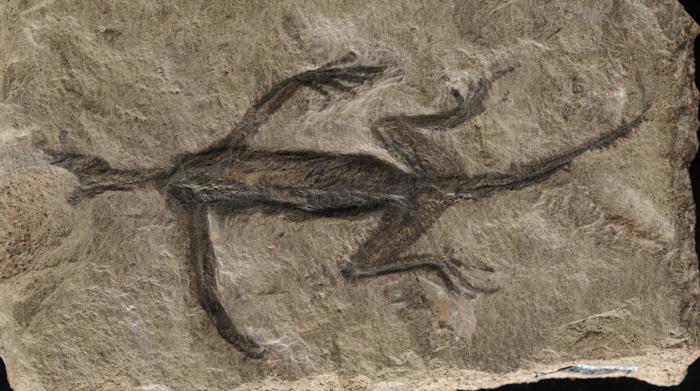
This happened recently, when postdoctoral researcher Dr Valentina Rossi, whose work specializes in the preservation of pigments and soft tissues in fossil vertebrates, got her hands on what was thought to be a rare example of the fossilized skin of a 280-million-year-old reptile, only to find the “soft tissue” was in fact black paint.
The fossil ended up not having the scientific value they had thought, but Rossi decided it still had a value in reporting it to have conversations like the one we end up having, highlighting and discussing the issue of fossil forgeries.
Are fake fossils a problem now?
Fossils are valuable; that’s something most people can agree on. Whether it's their contribution to scientific knowledge, vital in helping us understand the history of life on Earth and our place in it, or you want to blow $50.1 million on a nearly complete T. rex just because you can.
But where there is value, there is usually someone looking to make a quick buck. So, how can you tell the genuine article from a fake?
The majority of palaeontological forgery discoveries these days are historical specimens tucked away in dusty collections suddenly dragged, squinting, into the bright light of the 21st century.
The specimen Rossi and her team were studying was a small lizard-like reptile from the Protorosauria group, discovered in the Italian Alps in 1931 and housed in the Museo della Natura e dell'Uomo, Padua, Italy. Rossi sampled the skin and, while analyzing it with a scanning electron microscope, realized the soft tissue was too granular and there was no order to what she was seeing; it couldn’t be soft tissue.
On closer inspection, the dark areas were discovered to be black paint and the shape of the animal had been carved for a more defined look.
Though shocked to discover the forgery, Rossi was quick not to assign blame to anyone for the fact that this was only discovered now.
Access to specimens has many limitations, she points out. If a specimen is unique, you don’t want to destroy it, and so you might not want to sample it, and transportation to another facility for study may be difficult.
If the original collection notes are sparse, it is also difficult to tell if there was malicious intent to deceive or if collectors just did things differently – and slightly less rigorously – 100 years ago.
“I discovered, for example, that it was really normal, more than a century ago, to paint over rocks, to paint over historical objects, to make it either more pleasing to the eye or just [show] I can solve this better, or people are going to recognize me in society as an expert,” Rossi told IFLScience.
“We don't want to do a witch hunt on who did this and why. Unfortunately, the act was done. We can hopefully think that this was not malicious, you know, it was just a way to maybe make whatever fossil was found [more pronounced]."
Reading up on the history of how the profession has changed, not just the way modern scientists meticulously – and, importantly, these days, ethically – collect specimens and document discoveries, but how museums are making efforts to place their collections in historical context, was a positive experience for Rossi.
Especially those that include how they were acquired, even if the circumstances are unsavory.
“I think that's a nice twist that; sometimes these things don't get into the publication. We talk about science, but I think this is an important aspect, that museums are working really hard with scientists to understand their collections, their history, placing them in context.”
So, the who and the why of fossil forgeries may be less interesting to palaeontologists than the how you identify them.
Rossi noted that in the world of art forgeries, the remarkable skill of forgers has to be matched by the ingenuity of the sophisticated technologies experts use to uncover them.
The technology palaeontologists have access to now – chemical analysis, X-rays, CT scanners, infrared spectrometers, microscopic analysis, to name a few – is light-years from just 30 years ago when Jurassic Park first hit the screens, let alone a century ago. And 21st-century forgers know that.
The real money-maker in fossil forgeries these days is not to fool scientists, but the public.
Strategies for faking fossils
I asked Barrett how he would fake a fossil. Again, he looked at me strangely, and I hurried to reassure him I was not putting together an IFLScience side-hustle. I was curious, though, as an expert, what he thought would be the easiest to do.
“There are two strategies,” Barrett said. “You either fake something that's really rare, really well, so that you get a lot of money for it, or you fake something that's really common that people aren't going to look at too closely before they buy.”
“I'd fake something that was simple and easy, because I lack the artistic skills to do anything really good,” he added, laughing.
The most common trick that “more dubious fossil dealers” do is to augment an existing but not particularly valuable fossil, like an ammonite or trilobite, which can be found all over the world.
“You just need a bit of a real fossil and then kind of carve a shape around it to make it look more complete than it actually is. That’s probably the lowest impact way of doing it," Barrett explained.
“It's partly playing on people's biases, as well as just making it look like a thing. Because it's not always what it looks like. It's what people think it should look like."
Thanks to this expectation, forged fossils are big business on eBay or even at fossil fairs, where people are expecting to find, well, fossils that look like (their idea of) fossils.
.jpg "An illustration of a piece of amber with a fly in it, a fossil sharp tooth, a fossil fern in rock, sheels, and a fossils ammonite.")
Another bias forgers use is perceived provenance.
Two of the big markets for selling fake fossils are China and Morocco, both of which are known for their rich treasure troves of real fossils. If you know, for example, that many Spinosaurus fossils have been found in Morocco, then you may be less likely to question the surprisingly well-preserved Spinosaurus teeth that eBay seller realfossils4u insists were found in the Kem Kem river system of Morocco – despite the fact that the export of fossils from both Morocco and China is illegal.
If it looks too good to be true – too cheap to be true – then it probably is.
Dr Valentina Rossi
Rossi notes that forged amber is also on the rise. Amber is fossilized tree resin and while yes, it can be found with the odd 100-million-year-old creature trapped inside, it is just as easy to melt down modern tree resin called copal and when it's soft and sticky, stick a bug in there.
So, anyone hoping to top their own cane with a perfect piece of amber containing a preserved creature à la John Hammond, beware of where you buy it: “Sometimes you get these things at fossil fairs or in shops, where they give you a piece of amber from India and there is a little ant stuck in it. Yeah, that's modern resin with a modern ant in there,” Rossi said.
How to spot a fake in the wild
Both Barrett and Rossi agree fossil fairs are a Wild West for those looking for authenticity. “If it looks too good to be true – too cheap to be true – then it probably is,” Rossi shrugged.
So, can you arm yourself with some top tips to combat being hoodwinked by a dubious dealer? Thankfully, the answer is yes. There are ways to help you identify a forgery from a real fossil.
Sight
Does it look like a real fossil or is it too crude? Is the shape, texture, or color wrong? Conversely, is it too pristine or too complete, does it have all its bones or features like crests included, when that wouldn’t have survived the fossilization process? Use a hand lens to look closely at the surface of the fossil; the surface texture of bone is quite distinctive from the surface texture of a piece of plaster or wood.
Touch
Is it cold or warm to the touch? Fossil bone is stone and should be cold, whereas plaster and other materials are warmer. On the other hand, real amber should be warm to the touch. Can you give it a little scratch with a nail? If it peels, then it’s likely been painted to augment it. Is it heavy? Fossils may feel heavier than you expect for their size – they are essentially rock where the original organic material has been replaced by minerals. If it’s suspiciously light, put it back.
Sound
Give it a little tap. Again, fossils are made of stone, so they are solid, and the sound waves will disappear almost immediately. If there is more of a ringing noise where the sound reverberates, or a clunky hollow noise, it’s likely not solid.
Taste
One way to tell fossil bone from other materials is to lick it. Yes, that’s a real thing. Touch it to your tongue and a real fossil should stick to it with a little bit of moisture, while rocks, wood, etc will not.
Provenance
Can a seller tell you where it came from, when it was found, and by whom, putting it into context? If not, why not?
There are other ways, but they are perhaps best left to the experts.
“I had a professor at University College Cork who used to give a seminar for undergrad students about history and palaeontology, and the history of forgery,” Rossi told IFLScience.
“He once told me that he basically rocked up into a shop, they were selling a lot of those trilobites and amber. He had a lighter and a needle, and was like, ‘Do you mind if I test this?’ And the [shop owner] was like, 'No, no, no, no, no, no, you can't!' So that was kind of a flag, you know. All you need is a lighter; just show the lighter… and depending on the reaction you get, you know, brilliant.”
This Curious Questions feature first appeared in Issue 36 of our digital magazine CURIOUS. To access exclusive CURIOUS content first and receive the quarterly digital magazine, become an All Access Member.