Nature
 PUBLISHED


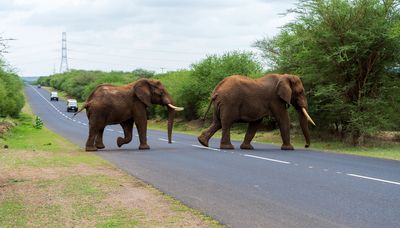


As human settlements expand and new infrastructure is built, this often crosses into land used for farming, or in some cases unbuilt land. This can create moments of human-wildlife conflict as habitats are broken up. In southern Africa, rapid expansion has brought people into contact with savanna elephants.
A new study aims to look at the factors involved, what might happen in the future, and whether anything can be done to mitigate it.
Southern Africa holds roughly 290,000 savanna elephants (Loxodonta africana) as their numbers begin to slowly recover from poaching. The human population in this region is also growing year on year, leading to expansions of settlements and agriculture, thus putting the humans and elephants into the same spaces more often.
To work out what is likely to happen as a result, researchers used a dataset from 2004-2020 from Namibia, Botswana, and smaller areas in Angola and Zambia, showing elephants' distribution in relation to crop raiding – the most common form of human-elephant conflict (HEC).
The team used this data to assess HEC across 38 communities, all with a rapid growth rate.
The models focused on crop raiding incidents, and took account of seasonal changes, landscape characteristics like roads, and percentage cover estimates for built areas, cropland, grassland, and tree cover. Water sources were also included in the dataset, such as rivers. Historic climate data was also used to look at patterns in the wet and dry seasons.
By combining all of these facts and results the team were able to make future projections about HEC.
They found that a rising human population and increases in cropland and building cover lead to higher levels of crop raiding when other factors are equal.
Seasonal data also showed that elephants are more likely to come into conflict with humans in the wet season.
“Our analysis found that growth of human populations and land uses are the primary drivers of future HEC changes, with climate-driven water deficits potentially influencing the movement of elephants out of core areas and into nearby agricultural areas,” explain the authors.
“Applying these models to projected land use, population, and climate under future coupled climate-development scenarios, we find that the area at high risk of HEC increases by 33 to 100 percent by 2085 with corresponding rises in event frequency.”
By identifying the drivers of HEC and the characteristics of high-conflict areas, measures can be taken to decrease the amount of HEC incidents – protecting human lives and livelihoods while also conserving the elephant population that has taken so long to recover.
The study is published in PNAS Nexus.