Nature
 PUBLISHED
 2
2


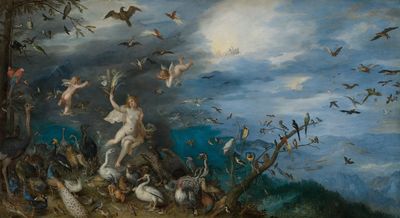


In 1611, the Flemish painter Jan Brueghel the Elder finished his epic allegorical painting Air. In it, he depicted the Muse of Astronomy, Urania, reclining on a cloud as a menagerie of feathered birds surrounds her.
But while studying the animals in the picture, one researcher spotted something far more intriguing: in the top right corner, there appeared to be a bat carrying a bird in its mouth.
For most people, this might not mean much. But for the ecologist Pedro Romero-Vidal it set his mind racing, because the predatory behavior of bats catching and eating birds in mid-flight had only been officially recorded in 2025.
It turns out that people have known about this rather unexpected behavior for a lot longer than that.
From cave paintings to Roman mosaics, for thousands of years humans have been recording the natural world around them in their art. This has provided an incredible record of what animals and plants past civilizations knew about, but one that has been historically overlooked.
“Everything that wasn’t created from inside the natural history academy has been overlooked historically,” Miguel Clavero, a researcher at Estación Biológica de Doñana and co-author of the study looking at the painting, told IFLScience.
“We assume there are no records about animal distributions prior to the 1950s because there were no scientists recording them. But you go to a geographical dictionary, and you have literally hundreds of thousands of records that you can use to model distributions and so on.”
“So we’re learning to get information from those overlooked sources, and for sure artworks are one of the important ones.”
This is where paintings such as Air come in. Brueghel is known to have paid great attention to the animals and plants he depicted, with many species easily recognizable. And this gives an amazing snapshot of the 1600s.
This is absolutely fascinating work to do.
Miguel Clavero
For example, the painting shows European species, such as swans, pelicans, and hoopoes, but also African grey parrots and grey crowned cranes, Indian peacocks, the Southeast Asian Raggiana bird-of-paradise, and Central and South American turkeys and macaws.
This can be used to highlight just how extensive trade was between all these far-flung locations and Europe. It can also be used as a record of past knowledge of animal behaviors. This is where the bats come in.
Based on the accuracy of the birds, the researchers can be fairly confident in the identity of the bat in the painting, which they’ve identified as a greater noctule bat. This is the exact same species that was the subject of the modern paper describing the bird-eating behavior for the first time.
.png "Painting Air by Jan Brueghel the Elder with a bat in the top right hand corner highlighted in a green square; the right panel shows the bat close up")
But the main question that hangs over many of these interpretations of historic paintings is how much the artists actually knew, and how much was artistic license. In this case, it's actually slightly more complicated.
“It is it is not straightforward, because in this particular case we are quite sure that it is artistic license because the painter could not have observed a bat carrying a bird in its mouth, because bats do not do that,” says Clavero. “The bats have to produce echolocation with their mouth to fly, so if they cannot produce the sound, they cannot fly.”
“We don’t know how Brueghel made the connection between noctule bats eating birds, but he didn't paint any bat. He painted exactly the bat species that does this.”
It seems likely then that when Brueghel traveled to Italy, he heard about this behavior, or at least saw the feathered remains of a bird on the floor, and decided to add it to the painting he was working on.
“This is absolutely fascinating work to do and fascinating discoveries to make,” says Clavero. “When you make them, it is so exciting.”
The study is published in the journal PNAS.