Nature



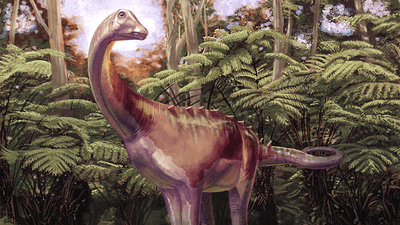


A fossil first discovered in 1985 has now been scientifically described as that of a dinosaur. This makes it the first-ever dinosaur fossil found in Antarctica, and it's likely that the fossil belonged to a member of the largest dinosaurs ever to walk the Earth: the titanosaurs.
Antarctica has one of the poorest fossil records of any of Earth’s continents, with what little that has been discovered coming from just a few islands. The new specimen in question was found during a British Antarctic Survey in 1985 on the Ulu Peninsula of north-western James Ross Island.
However, at the time the team that collected the specimen wasn't quite sure what it was, and so it was stored away in the geology collection of the British Antarctic Survey in Cambridge, UK, for the next 40 years.
In fact, the 86.2 million-year-old specimen was accompanied by field notes written by geologist Dr Mike Thomson that suggested that the specimen could be the "vertebra of large reptile".
"It's only when you start thinking 'what's in this drawer', that sometimes you come across something and you think, 'Ah, this looks interesting'," Dr Mark Evans, the collections manager at BAS, told the BBC.
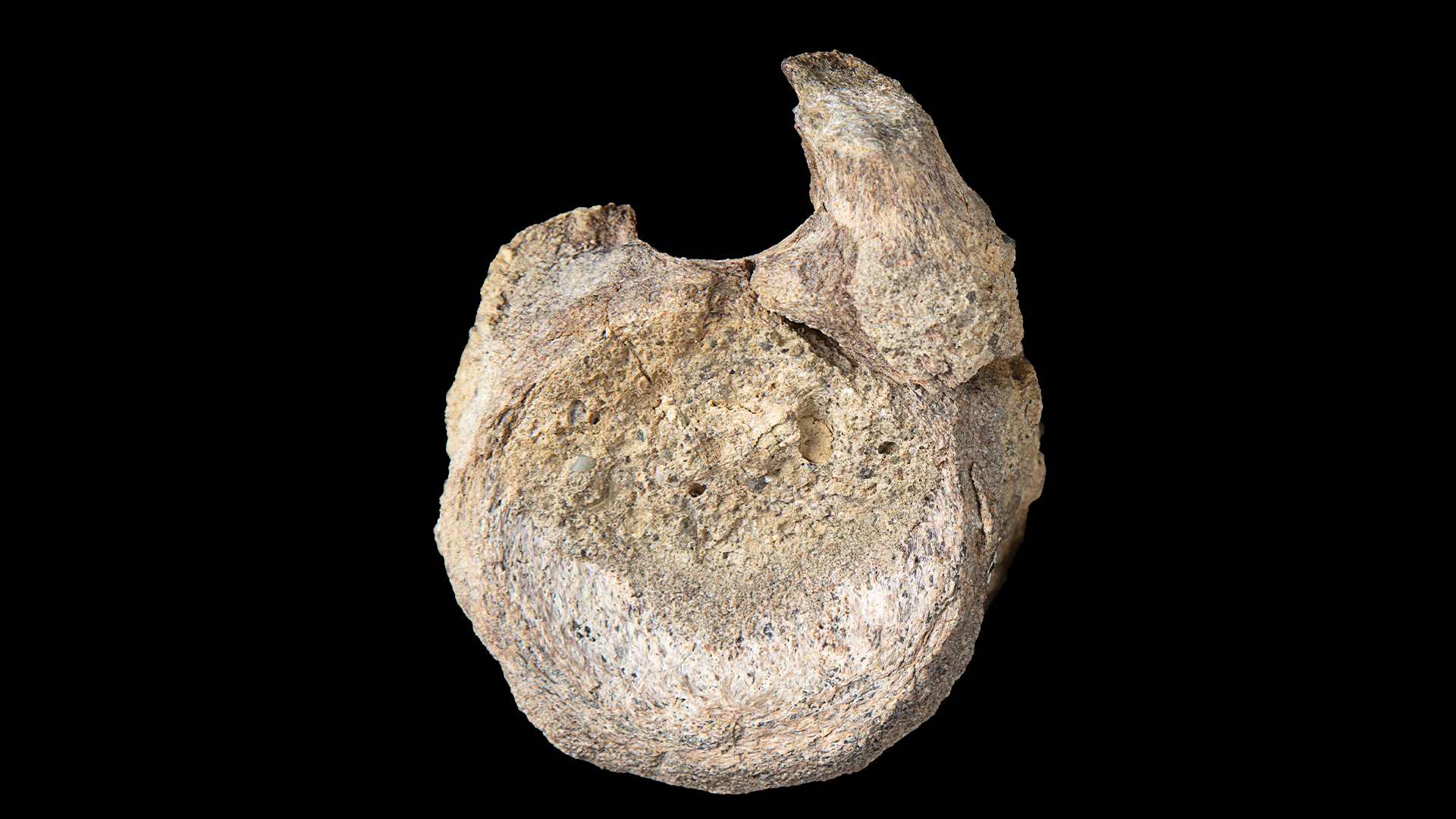
Evans contacted Professor Paul Barrett from the Natural History Museum, London (NHM), to take a closer look at the bone.
“At first glance this appears to be an unremarkable fossil," said Barrett in a statement sent to IFLScience, "but it holds an important place in the history of Antarctic exploration as the first dinosaur fossil found on the continent."
The bone is just a small section of what is thought to be the tail of a titanosaur, the largest dinosaur species to walk on planet Earth. However, the single specimen makes it hard to judge the exact species it came from.
The team suggests it was a small titanosaur, although it still would have measured 6-7 meters long (19-23 feet). But whether the species the bone came from was small, or if the animal was a juvenile when it died, is unknown.
Many unknowns revolve around Antarctic fossils, including The Thing, a giant egg structure that is also proving a mystery to researchers.
“It was overlooked because I think it was misidentified while under harsh field conditions, but it is a sauropod and it’s only the second sauropod bone from the entire continent,” Barrett told the NHM.
The new identification of the fossil means it represents the first non-avian dinosaur fossil discovered in Antarctica, with a partial skeleton of an ankylosaur found the following year in 1986.
During the Cretaceous Period, the team thinks that titanosaurs would have been able to cross into Antarctica via a landmass connecting to South America. At this point in time, the two continents would also have been connected to Australia and New Zealand. But while there are titanosaurs from New Zealand, there are no known titanosaurs from Australia. This poses the question of how they got to one country without going through the other, leading the team to come up with a new route.
“The Antarctic Peninsula, including James Ross Island, would seem to have been the most likely eutitanosaur dispersal route from South America to Zealandia," explain the authors in the paper.
“At the time, New Zealand was, weirdly, quite a long way away from Australia,” explains Barrett. “It was closer to southern South America and the Antarctic Peninsula than it was to Australia, just because of the way the continents have moved around.” This means the titanosaurs could have crossed into Antarctica via this route, skipping Australia entirely.
The paper is published in Acta Palaeontologica Polonica.