Nature
 PUBLISHED


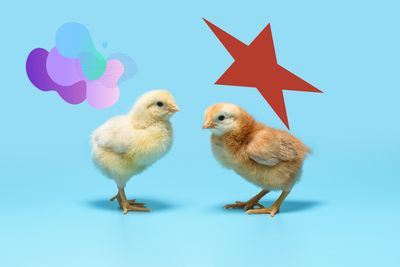


Regardless of your cultural background, your personal experiences, or your mother tongue, you will almost certainly associate the nonsense word "kiki" with a spiky, jagged shape, while "bouba" seems to fit perfectly with a rounded, blobby one. Practically every person on Earth makes this association – and, as it turns out, so do freshly hatched chicks during their very first days of life.
The bouba-kiki effect is a psychological phenomenon where humans consistently map specific speech sounds and other sensations to specific visual shapes. In classic experiments conducted across diverse cultures, people overwhelmingly pair "bouba" with rounded forms and "kiki" with sharp ones.
The idea is that our brains possess a universal way of linking sound and sight. It suggests that, regardless of language, we “feel” certain sounds as inherently sharp or soft, mapping the auditory world onto the visual one in a remarkably repeatable way.
But this fascinating phenomenon may go even further than human perception. In a new study, researchers wanted to see just how fundamentally primal the bouba-kiki effect really is by testing it on baby chickens.
Psychologists at the University of Padova in Italy placed three-day-old chicks in an enclosure where food was hidden behind a decorated panel. The young birds quickly learned to walk around the panel and associate it with a rewarding meal.
The chicks were then presented with two panels, one decorated with a blob-like shape and one decorated with a spiky one. As they chose where to go, the researchers continuously looped the sound "bouba" or "kiki” over and over again. When "bouba" was played, the chicks tended to head towards the rounded shape. Conversely, when "kiki" echoed through the tank, they gravitated toward the spiky panel.
One-day-old chicks were then subjected to another experiment involving two video screens that displayed moving objects. Just like the other experiment, the chicks were more prone to go towards the spiked shape when the speakers were saying the word "kiki" and vice versa.
"The results demonstrate that a brain predisposed to human language is not necessary to create associations between sounds and shapes," Maria Loconsole, first study author from the Department of General Psychology at the University of Padova, said in a statement.
So, what can we make of this? The study doesn't suggest that chickens are on the verge of writing Crime and Punishment, but it does hint that vertebrate brains share ancient pathways that help us process the world in a very similar fashion.
An accompanying commentary article to the study puts it like this: "These results reveal that the boubakiki effect is rooted deep in vertebrate phylogeny, suggesting that birds and mammals – and by inference, their reptilian common ancestor – are born with a predisposition to map certain kinds of sounds with certain kinds of visual stimuli. This inborn bias could help animals coordinate sensory information between the two modalities to build unified representations of physical entities."
However, this does not necessarily mean that non-human animals possess language or symbolic thought in the way humans do. The origins of that incredible and complex ability, as ever, remain a bit of a mystery.
“Even if the basis for the bouba-kiki effect is phylogenetically ancient [...], it is but a single manifestation of the near-boundless human capacity for iconicity that transcends any particular medium of communication. Therefore, although the study of innate cross-modal correspondences such as the bouba-kiki effect may uncover general principles of sensory perception, a broader framework of iconicity is needed to illuminate the origins of language,” the commentary authors added.
The study is published in the journal Science.