Nature
 PUBLISHED


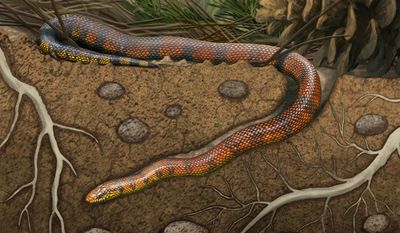


One of the biggest questions in the evolution of snakes is pretty fundamental. Did the elongated reptiles first evolve to slither along the forest floor, burrow through the soil, or maybe swim through the water?
This has been a surprisingly tricky question to answer, because all three scenarios could plausibly result in a lizard-like ancestor losing its legs and becoming stretched out.
“[U]ncovering the origin of snakes remains challenging due to their poor fossil record and profound anatomical transformations that accompanied their ecological diversification,” write the authors of a new study trying to solve this.
Peering into the brain of an ancient snake
But now a new species of fossil snake from Brazil is helping to answer this.
Called Tametara mirim, it dates to roughly 85 million years ago, when the dinosaurs were still very much doing their thing. It is also thought to be one of the oldest known fossil snakes, helping researchers fill in the diversity of these reptiles early on in their evolution.
Crucially, however, it is also preserved in exquisite three dimensions. This makes it the first articulated fossil snake known from Brazil, and has allowed the team to reconstruct it in incredible detail, including a fully 3D picture of its brain.
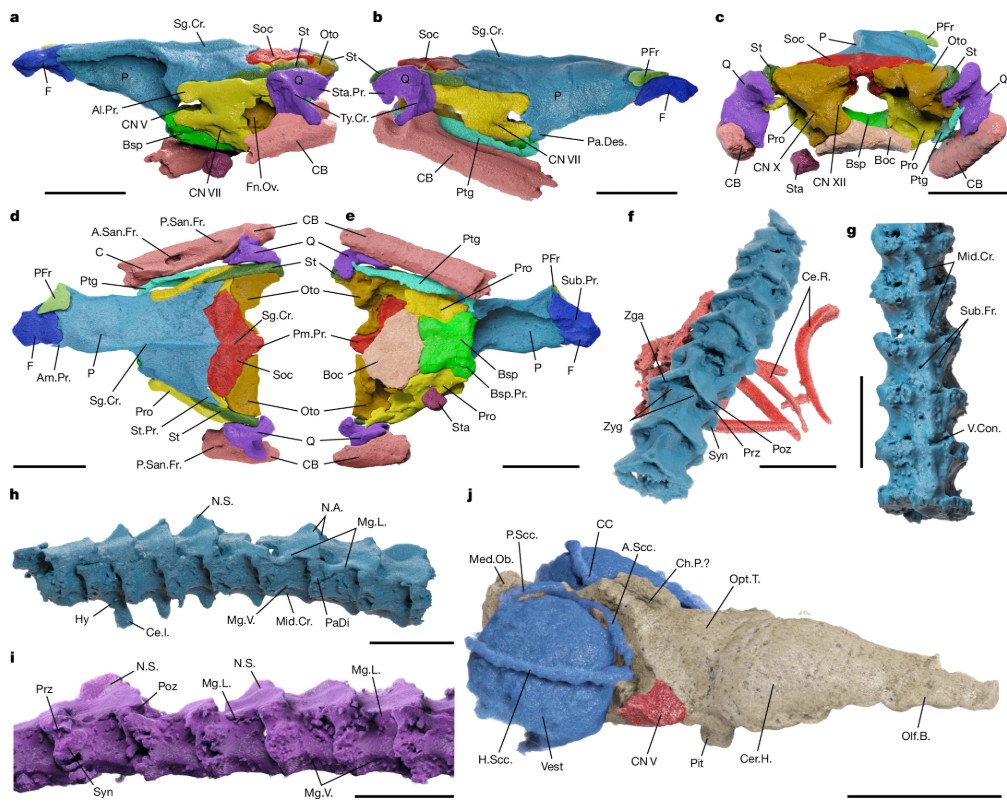
By looking at this brain cast, known more technically as an "endocast", in addition to reconstructed cranial nerves and its inner ear, the scientists were able to compare it to both previously known fossil snakes and their living relatives.
What they found was a surprising amount of diversity.
“We show that it is possible to accurately predict ancient ecologies from preserved morphological data in fossils, and that tells us snakes attained a remarkably wide ecological and neuroanatomical diversity by the Late Cretaceous, around 80 million years ago,” Dr Tiago Simões, the lead author from Princeton University, told the Natural History Museums of LA County.
Both? Both is good
But Simões and his colleagues could take this one step further. They found that the brain shape and its microstructures could be used to predict the kind of life the ancient snakes lived.
From this, they could tell that Tametara was likely a burrowing snake, while a previously described fossil snake from Argentina called Dinilysia was more at home slithering along the surface.
This new knowledge, combined with other early fossil snakes that seemingly led a marine-based life suggests that from the very start of their evolution, snakes were taking advantage of multiple types of habitat.
“The ancestral condition for all snakes was not one strongly adapted to a single habitat,” continues Simôes. “Rather, it was a transitional one, lying in the interface of fossorial and ground-dwelling environments.”
Perhaps, then, it wasn't a simple either or question about what the earliest snakes were doing. Instead it seems they were moving into any environment in which their body suited, which included on the ground, underground, and in the sea.
The study is published in Nature.