Nature
 PUBLISHED


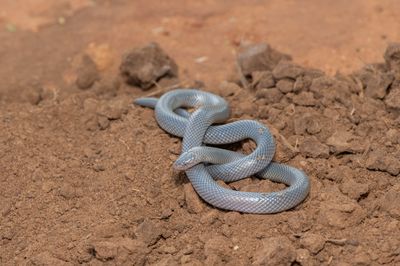


Snakes have a variety of cool adaptations depending on the species and the habitat in which they live. Some have evolved to live in the trees while others spend time in harsh desert climes – however, what is universal to them all is the fact that all snake species are legless. But how and why did this evolve?
It is thought that snakes lost their legs around 100 to 150 million years ago in the fossil record. However there is still some debate about whether the ancestors of these snakes were land-living or if they had a more aquatic lifestyle.
One idea is that the ancestors of modern snakes lost their limbs to be better adapted to living inside burrows. The researchers behind a 2015 paper looked at the stem snake Dinilysia patagonica, which lived in the Cretaceous period, and suggested that because of the structure of its inner ear, the snake had more in common with burrowing reptiles than it did with aquatic species. This therefore suggests that snakes lost their limbs via burrowing ancestors rather than swimming adaptations.
“How snakes lost their legs has long been a mystery to scientists, but it seems that this happened when their ancestors became adept at burrowing,” said Hongyu Yi, of the University of Edinburgh’s School of GeoSciences, in a statement at the time. “The inner ears of fossils can reveal a remarkable amount of information, and are very useful when the exterior of fossils are too damaged or fragile to examine.”
In boa constrictors and pythons, the remains of hindlimbs can be seen in tiny leg bones called vestigial limbs that are found near the cloaca. Less primitive species have lost even these ancient reminders completely.
The mechanism behind this might come down to a gene called PTCH1. A study published in 2023 looked at 14 genomes from 12 snake families and found DNA missing from three parts of the PTCH1 gene. This gene is responsible for limb development, and mutations within this gene could explain why the legs of snakes began to disappear.
“These results imply that the PTCH1 deletion can alter its function, which inhibits limb digit growth by altering the expression of genes in the limb buds. Therefore, we suggest that deletions within the Toxicofera are involved in the evolution of the skeletal system and limb loss, and this might represent an exaptation in snakes and limbless lizards,” the authors wrote.
There are other genes and enhancers related to limb loss in snakes. One of the genes involved is known as the Sonic hedgehog gene – when its enhancer is turned on, like a genetic switch, the Sonic hedgehog gene is turned on during limb development, creating the beginnings of hands and feet.
“The results tell us that python limb development progresses much further than we knew before. They make embryonic legs but the cells don’t complete the process of skeletal development,” said Martin Cohn, PhD, a professor of molecular genetics and microbiology in the University of Florida College of Medicine, in a statement.
Despite being lacking in the limb department, snakes have managed to colonize every continent on earth except Antarctica and there are thought to be over 4,000 species, making them the second-largest group of reptiles after lizards.