Nature
 PUBLISHED
 2
2


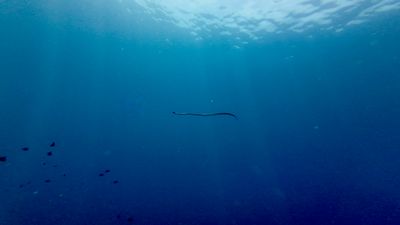


Truly giant animals are often mentioned as species that roamed the Earth in the time of dinosaurs, and while these creatures reached staggering heights, the largest animal ever to live is alive now in the form of the blue whale. What swimmers and sea goers might be grateful for, however, is that another impressively big creature that may have dominated the planet's oceans in times gone by is no longer here. Meet Palaeophis colossaeus, the largest sea snake ever to have lived.
P. colossaeus is known only from its comparatively enormous vertebrate, which suggest that it could have reached lengths between 8.1 to 12.3 meters (roughly 27 to 40.4 feet). “Palaeophis colossaeus is a very large snake with vertebrae that are larger than any known living species,” explain the authors of a paper published in 2018 that describes the reptile.
It is thought that this giant snake lived in the ancient seas during the Eocene epoch, about 56 to 34 million years ago. Given the size of the snake and the watery lifestyle it is thought to have lived, this indicates that the seas that it swam and hunted in were much warmer than the tropical oceans of today. In particular, the snake is thought to have inhabited the Trans-Saharan Seaway, an area that covered parts of what is now the Sahara Desert, in a warm shallow marine environment.
The size of the creature also suggests that it was a top marine predator, although with only vertebrae to go on, it is hard to know what it ate for certain. However, if its skull was “highly kinetic,” the 2018 study authors write, “the size of food consumed could be so large as to permit consumption of almost any known contemporaneous species.” That might have included large fish such as sharks or even crocodile-like reptiles known as dyrosaurids.
If the thought of a sea snake the length of a bus swimming after you isn't worrying enough, be glad that the mighty Titanoboa, the largest snake ever, at around 13 meters (43 feet) long, is also extinct. Today, the longest living sea snake is the yellow sea snake (Hydrophis spiralis), which has a maximum recorded length of almost 3 meters (10 feet).