Nature
 PUBLISHED


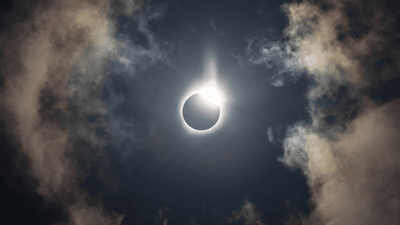


Have you ever gathered round to watch an eclipse? You can’t look right at it, obviously. So, everyone’s there with their funny goggles and pinhole projectors or, in a pinch, colanders.
We're all filming our cats and dogs and zoo animals, too. Just to see if they do anything strange.
It’s all a bit weird when you think about it. A bunch of naked apes getting oh-so excited about our precious Sun having its life-preserving light briefly extinguished by the passage of our Moon (can you tell we're excited about August 12?).
It’s perhaps unsurprising, then, that some scientists have been eager to explore whether a solar eclipse has much of an effect on animals. Funny thing is, it’s quite possible that the animals that act the strangest are actually us.
A strange day at the zoo
Studying animal behavior during a solar eclipse isn’t easy. Not least because they are such rare meteorological events.
It requires a lot of coordination to have the right conditions, experimenters, and participants in place for the precise moment in which the Moon blocks the Sun. Still, there are a few studies that have managed it.
One 2020 paper observed animals in the Riverbanks Zoo in South Carolina, USA, back in 2017. It found that around 75 percent of animals observed displayed some kind of behavioral change during the eclipse.
The most common was animals thinking it was nighttime and heading off to bed. Some animals got anxious, there were baboons huddling, and a Komodo dragon started skittering about uncharacteristically fast. Then, there were the Galápagos tortoises.
Not only did they buck the trend in becoming more active during the eclipse, and even looking up at sky, but two started shagging right before totality. Impeccable stuff.
A later 2026 paper reported a similar study at the Zoo de Granby in Canada in 2024, but this time without the crowds of humans. It found that, actually, most of the animals didn’t change much at all.
There was a slight switch-up in the macaques that climbed to a high point until totality had passed, and some zebras exhibited signs of stress, but otherwise not much to report. It sort of makes you wonder whether the weirdest thing in that other zoo study wasn't the eclipse at all, but the visitors.
Well, another 2026 paper taps into this.
Citizen scientists, assemble
While the study also involved people observing animals during an eclipse, it was actually investigating something else. The authors wanted to explore the relationship between observing a total eclipse in nature, awe, and science identity.
The results revealed that something interesting was happening to the humans while they conducted the study. Many felt a sense of awe that was stronger in participants who witnessed totality rather than just a partial eclipse.
Those participants who identified changes in animals – wrongly or rightly – also reported a stronger feeling of awe and inspiration. This coincided with a stronger feeling of science identity, and that they had contributed meaningfully to the research.
So, are we the common denominator here? Dr Adam Hartstone-Rose, who worked on both of the 2026 papers, certainly seems to think so.
“The animals that do the strangest thing during an eclipse, by far, are the people,” he told A-Z Animals. “I think that’s actually an explanation for some of the anomalous behavior that we see in animals, too.”
Kind of figures when you see everyone out with their colanders.