Nature
 PUBLISHED




There’s a lot of adaptation involved in working on an oil rig. Weeks at sea. Turbulent weather. And then there's the squeaky voices.
Yes, while much of oil rig work sounds like something between an action movie and a ghost story, there is one group of workers that must do some very serious stuff while sounding a lot like Donald Duck.
They're known as saturation divers, and their jobs are wild.
Islands at sea
The existence of oil rigs is pretty incredible when you think about it. Vast structures out in the unforgiving sea somehow erected by a bunch of apes. It took some serious science, technology, engineering, and math to get them functional, and it takes a hell of a lot more to keep them that way.
For a terrestrial species we're pretty good in the ocean. We've figured out how to breathe underwater, and how to equalize safely so that we can go a long way down and come back up without suffering the dreaded "bends".
The condition occurs because pressure causes more nitrogen to dissolve into a diver’s blood and tissues. If the pressure drops too quickly during an uncontrolled ascent, the dissolved nitrogen forms bubbles rather than being safely removed by the lungs. It’s for this reason scuba divers are taught to swim to the surface at a safe speed.
For some, however, diving doesn't just mean a jolly jaunt down to where the fun fish are hanging out when you're on holiday. For some, it's a career that can entail spending up to a month living under extreme pressure.
These divers are known as saturation divers, and they work at depths anywhere between 90 and 300 meters (300 to 1,000 feet) below the sea. Descending and ascending such distances daily isn’t logistically or medically wise, so instead they move into saturation chambers.
Life inside a saturation chamber
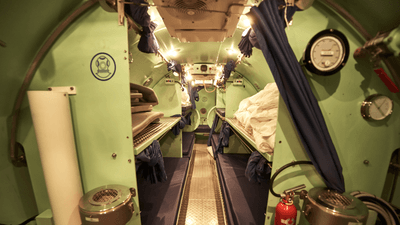
Saturation chambers are like metal cabins completely sealed off from the outside world. They're often housed on ships known as Diving Support Vessels and enable a group of workers to live at a consistent pressure measured in atmospheres.
That pressure varies depending on their chosen depth, but it will mirror what they'll experience when they descend into the ocean in a diving bell and go for a swim in the deep sea – an alternate world they can occupy for up to 28 days at a time.
Keeping these divers alive involves feeding that saturation chamber air as it remains sealed off, but nitrogen again causes a complication. At such pressure, gases are compressed, increasing the risk of divers experiencing something known as “nitrogen narcosis”, also known as the martini effect.
It brings about a similar sensation to breathing the laughing gas nitrous oxide and can progress to hallucinations and poor decision-making that could contribute to fatal accidents. AKA, not something you want during complex construction work.
Breathing made easy
To overcome this, nitrogen is swapped out for a mixture of helium and oxygen known as Heliox. Yes, that's helium as in the same gas that keeps your birthday balloons flying high. And yes, that means everyone breathing it experiences the same voice changes we do when we huff on our birthday balloons (something that can and has killed people, FYI).
The Donald Duck voice is the result of two things; one, the way helium influences the resonance of vocal cords and two, the hyperbaric chamber they are living in. The distortion can be so great that the chambers require helium speech unscramblers so the people up top can understand them.
While the amount of helium is carefully measure, even it can cause problems in the most extreme dives. Some saturation diverse have experienced high-pressure neurological syndrome (HPNS), something that, oddly enough, can actually be alleviated by introducing a bit of nitrogen to the mix.
A delicate art, then, but one without which the world would look very different. After all, saturation divers aren’t limited to working on oil rigs.
Saturation diving has enabled us to work on everything from deep-sea fiber-optic communication cables to submarine rescue missions and even scientific research. It can take us to a different world that would otherwise have been out of reach – the goofy voice is just the price of entry.