Nature
 PUBLISHED


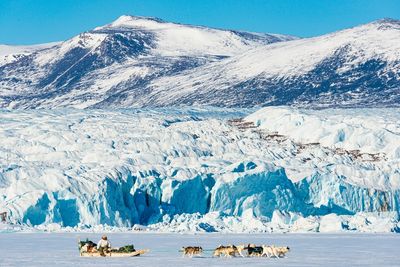


Scientists tracking changes to the Qaanaaq Ice Cap in northwestern Greenland have reported the loss of ice that would reach almost to the roof of a three-story building over 13 years. The report coincides with the announcement that Switzerland’s glaciers are experiencing the second-worst annual ice loss on record.
Satellites have allowed us to estimate changes to the mass of entire ice sheets, but for more precise measurements of specific locations, there is still no substitute for getting out on the ice itself.
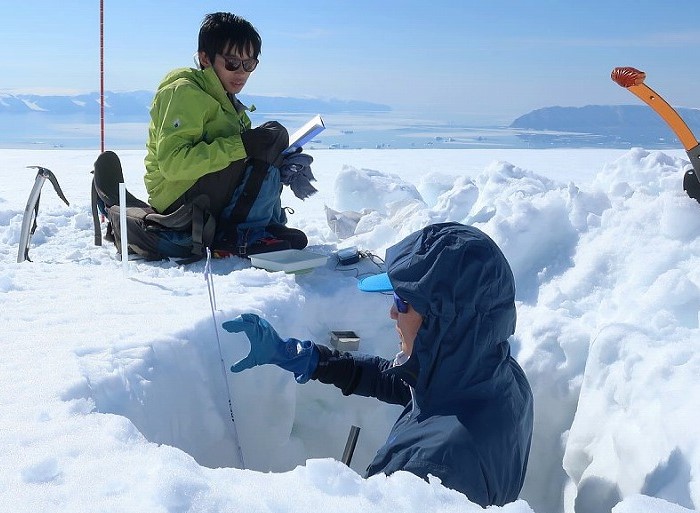
Professor Shin Sugiyama of Hokkaido University and colleagues measured the height of ice at six locations on the Qaanaaq Ice Cap, one of the most remote locations in the Northern Hemisphere from human interference. They drilled poles into the surface of the ice to measure changes, like an old-fashioned flood-measuring sign, but with GPS trackers attached.
The measurements were repeated frequently from 2012 to 2025. Other measurements, including local air temperatures, were made at hundreds of other locations across the cap.
Ice loss was extreme over this period, averaging 8.7 meters (29 feet) with worse loss at lower altitudes. Worse still, the rate of ice loss accelerated during the course of the study as summers became warmer, and snowfall could not keep up.
Rising temperatures were not the only reason for the extreme loss of ice at lower altitudes, with the glacier slowing down so that less ice flowed down the mountain to replace what was being lost. Similar phenomena have been observed in other places as the world heats up. Darkening by glacial microbes is also thought to have been a factor at mid altitudes.
"The most difficult part of the study was continuing these measurements for 13 years. This record fills an important data gap in northwestern Greenland and provides a foundation for future glacier research in the region," Sugiyama said in a statement.
During the pandemic, Greenlanders collected measurements when international researchers could not make the trip. In return, the information obtained is important for those who live nearby to understand what is happening to their homeland.
Since ice shrinks when it melts, the ice loss generated 2 billion cubic meters of water, equivalent to a layer of water 8 meters deep spread over its entire area.
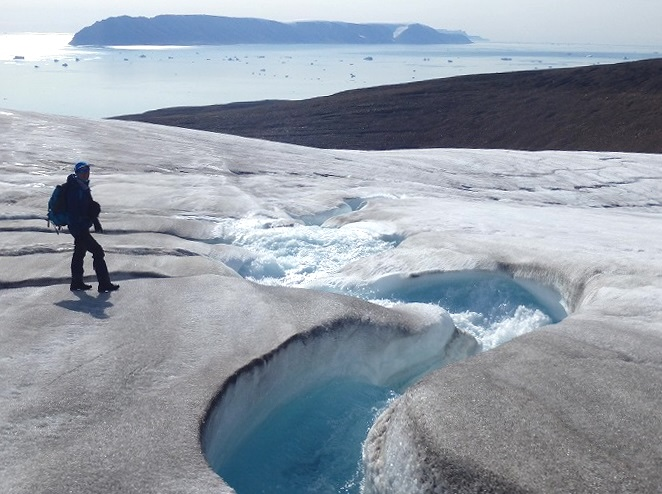
Qaanaaq is known to have been losing ice for more than a century, but for most of that time it must have been much slower.
The complete loss of Greenland’s ice would raise global sea level by more than 7 meters (23 feet), displacing hundreds of millions of people who live in coastal areas. Glaciers and ice caps (GICs) alone represent a much smaller threat; only 4 percent of Greenland is defined as falling into either category. (Ice caps are distinct ice masses with areas smaller than 50,000 km2 (19,000 mi2), so most of Greenland is considered part of an ice sheet.)
However, in the period 2018-2021 and estimated 14 percent of Greenland’s ice loss was from GICs, making them the primary targets to study the entire island’s eventual fate.
“The contribution is expected to increase in the future because the GICs are considered more sensitive to temperature change than the Greenland ice sheet,” the authors write, so when it comes to ice loss this century, their contribution will be crucial.
Greenland’s other GICs are also losing ice, but sometimes more slowly because greater precipitation has gone some way towards balancing higher summer temperatures. Although the trend is towards ice loss throughout Greenland, on an annual basis there is no significant correlation between melting in different parts of the giant island.
A global phenomenon
Glacier loss is happening closer to home as well. All glaciers gain ice during the winter, and shed it through a combination of summer heat and moving to latitudes where they melt. Glaciologists have been tracking the day each summer when Switzerland’s glaciers have lost all the snow that accumulated the previous winter, calling it Glacier Loss Day.
This year, Glacier Loss Day fell on June 29, with a long, hot summer ahead to shed centuries-old ice. This is the second earliest date recorded in the 27 years monitoring has gone on. Dr Matthias Huss of Glacier Monitoring in Switzerland (GLAMOS) called this “Three months too early, compared to a healthy state" to Agence France-Presse.
GLAMOS attributes the earliness of this year’s Glacier Loss Day to a combination of poor snowfalls last winter and the series of heat waves Europe suffered in spring and summer.
Huss added that at the Rhone Glacier, where he had been researching, “There was one meter of ice melted in the vertical direction – one meter of melting within just the last 10 days". Although this is not directly comparable to the annual loss at Qaanaaq without knowing how much snow accumulated last winter, it shows how rapidly repeated events could eliminate the source of one of Europe’s great rivers.
Huss predicted that 20-30 small Swiss glaciers will disappear entirely this year, probably never to return.
Since this is a global phenomenon, researchers have built the Global Glacier Extinction Explorer, allowing you to see when every glacier in the world is predicted to disappear under different warming scenarios.
The Explorer has some counter-intuitive predictions, with some glaciers anticipated to last slightly longer under high warming scenarios than medium ones, and many glaciers are expected to survive to 2100 under all scenarios. Nevertheless, there are plenty of alarming examples, particularly in North America. Between 2041 and 2055, around 4,000 glaciers are expected to disappear each year.
The Qaanaaq study is published as open access in the Journal of Glaciology. The methodology for the Global Glacier Extinction Explorer is open access in Nature Climate Change.