Nature
 PUBLISHED
 1
1



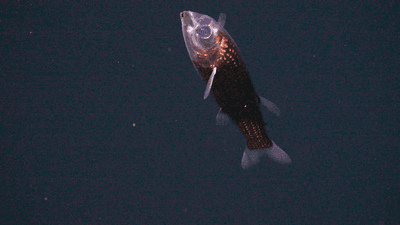


There exists a place on Earth where life gets so weird you would think you were swimming with aliens. In the Twilight Zone, where almost no sunlight can reach, living organisms have adapted to life in the dark by evolving all sorts of weird body plans.
For some, that means having a see-through head.
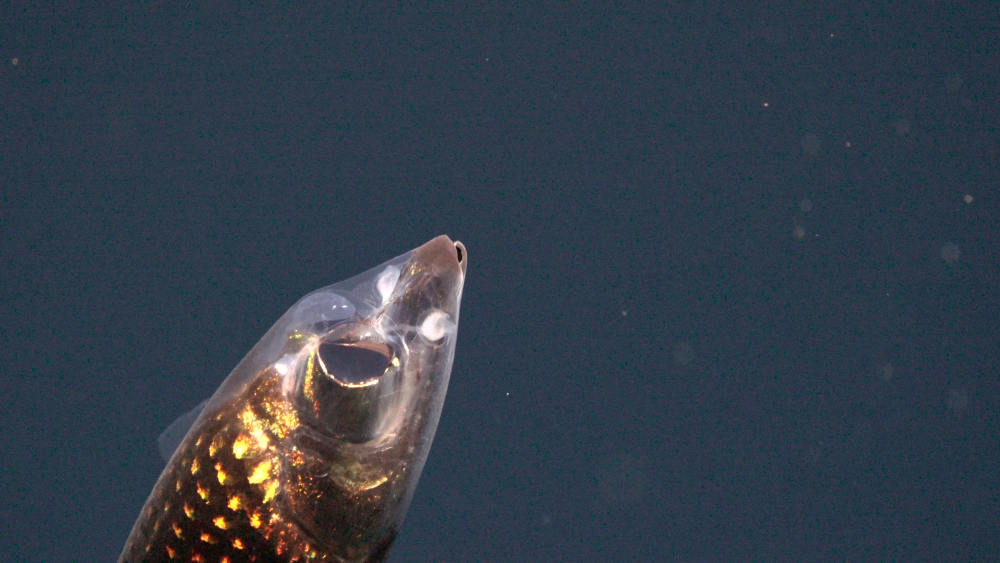
Meet Winteria telescopa (aka the binocular fish, aka the jelly-faced spookfish), a species of barreleye fish with truly peculiar peepers. We get a great view of them thanks to this fish’s translucent head – something recently captured in the first-ever footage of this fish alive in its natural environment.
It demonstrates how, unlike most fish that have laterally placed eyes providing a more panoramic view of the ocean, these fish have opted for tubular eyes. They sit parallel to each other aligned with the fish’s body, and this one has clearly got its eyes on something.
It’s thought this alternative take on eyeballs enables them to see even the tiniest flicker of sunlight or bioluminescence in their environment. A fine way to find food when you live in near-perpetual darkness.
With eyes bigger than its little mouth, these barreleye fish are only on the search for modest prey items like crustaceans and siphonophores. There’s no time to be choosy in the Twilight Zone.
This fish was filmed at a depth of 710 meters (2,329 feet) – or about as deep as a megaskyscraper is tall, says the Schmidt Ocean Institute. They captured the footage using the remote-operated vehicle SuBastian.
A long way down for a little robot, but the barreleye can go deeper. The extremes of their range are thought to range from 400 to 2,500 meters (1,312 to 8,200 feet), plunging into the Midnight Zone where no sunlight can reach at all.
Footage like this represents a leap in our understanding of these fish, as before now we’d only had specimens caught in fishing nets to go off of. These finds, while sometimes leading to the ichthyological discovery of the century, usually get damaged on their way up to the surface.
So, to see it healthy and (I’m going to assume) happy in the wild is a great moment for science.
Now if you’re thinking, “I’ve seen a video of this fish before, ACTUALLY,” then oh, sweet summer child. You’re probably thinking of the barreleye Macropinna microstoma that was filmed by the Monterey Bay Aquarium Research Institute in 2021.
As you can see, it is similarly jelly-faced and with equally barrel-like eyes, but it is in fact a different species. Better luck next time, comments section...
W. telescopa wasn’t the only alien Schmidt were blessed with during their expedition to explore the Doldrums Megatransform and Fracture Zone, about 1,290 kilometers (800 miles) off the northeast coast of Brazil. They also spotted two elusive bigfin squids (Magnapinna).
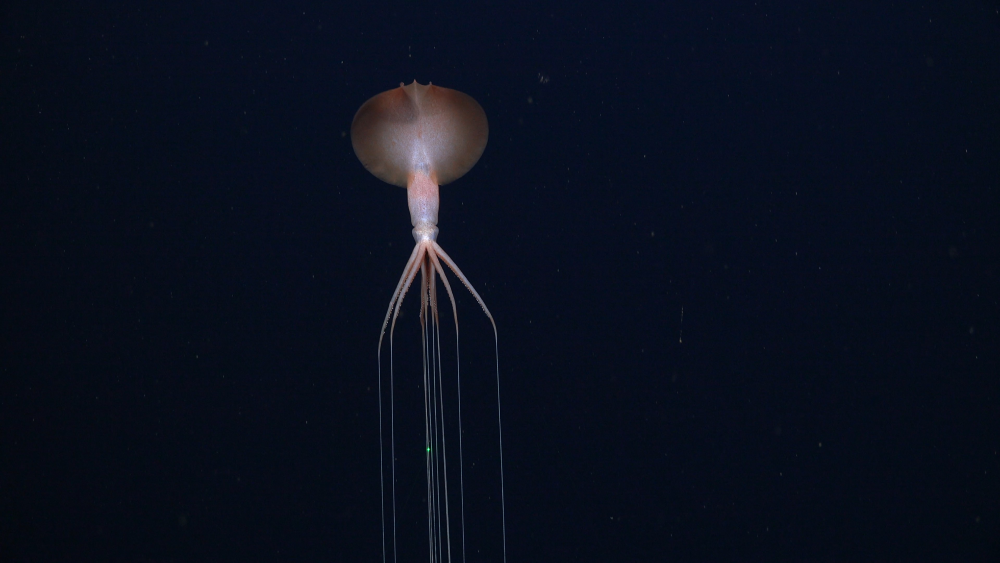
These squid are the deepest-dwelling squid known to science, and they’ve adapted to life in the deep by evolving thread-like tentacles that can be up to 8 meters (26 feet) in length.
All the better for snagging yourself a deep-sea snack, my dear.
The month-long expedition to the mid-Atlantic Ocean took 35 days and mapped almost 147 kilometers (91 miles) squared at 1-meter (3.2-foot) resolution as part of the first AUV The Childlike Empress's science mission.
It discovered two new hydrothermal vent fields and uncovered new-to-science insights on crustal fluid circulation, which centers around how seawater enters the Earth’s crust and then exits back out into the ocean.
All that and a bit of world-first footage? Not a bad 35-days at the office, eh.