Nature
 PUBLISHED


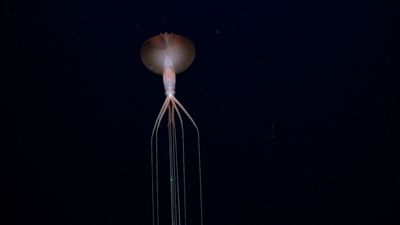


In the pitch-black depths of the Atlantic, a rare double sighting of one of the ocean's strangest squids has been captured on camera — and this time, in stunning clarity and slightly more flattering light.
The footage (below) was recently shot by the Schmidt Ocean Institute in the middle of the Atlantic Ocean in a region known as the Doldrums Fracture Zone, which lies just north of the equator. It’s a truly fascinating part of the planet where tectonic plates meet, forming a chain of submarine volcanic mountains that stretches for more than 16,000 kilometers (miles), harboring plenty of geological and biological surprises.
At a depth of around 4,300 meters (about 2.7 miles), researchers controlling the ROV SuBastian spotted two giant Magnapinna, also known as bigfin squid.
These elusive squids are exceptionally difficult to come across – just a few dozen recorded sightings have ever been made – so filming two at once is quite exceptional.
The unusual creatures belong to the genus Magnapinna, which means “great fin” in Latin. The name alludes to the large, heart-shaped fins that sit on top of their head and help them move around the ocean.
Their other defining features are a set of spindly tentacles that dangle from their bodies for several meters. The largest known bigfin squid was 6.4 meters (21 feet) in total, with tentacles that were 6.1 meters (20 feet) long.
There are just three described species – M. atlantica, M. pacifica, and M. talismani – but it’s possible there are more out there in the ocean, as yet undiscovered. As their name hints, they can be found across the globe into different oceans, each home to its own, slightly different species.
Since they are so rare, very little else is known about them.
Bigfin squids gained notoriety thanks to a viral clip film in November 2007 at an oil drilling site in the Gulf of Mexico. The clip of the squid went viral, partially thanks to the greenish lighting, grainy camera quality, and jerky filming that gave the video a deeply creepy, otherworldly, alien mood.
However, in this new footage, which is much clearer, it’s possible to see that Magnapinna isn’t quite as menacing as other clips have suggested.
“Even in the Atlantic Ocean, where plate boundaries have been studied for decades, there are still places where the first close look can reveal something entirely new,” Dr Aaron Micallef, Chief Scientist of the Doldrums expedition and senior scientist at MBARI, said in a statement.
“This expedition showed that even in one of the most remote corners of the ocean, our planet remains alive, dynamic, and full of surprises.”