Nature
 PUBLISHED


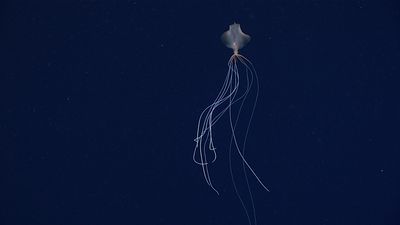


With their extraordinarily long tentacles and elusive behavior, bigfin squids are arguably one of the most alluring animals of the deep sea. Sightings of live individuals in the wild are extremely rare, but an increasing number of observations have been made in recent years thanks to advancements in deep-sea exploration technology.
Bigfin squids belong to the genus Magnapinna, which means “great fin” in Latin. There are just three described species – M. atlantica, M. pacifica, and M. talismani – but there are likely to be many more out there in the ocean, as yet undiscovered.
Their name alludes to the large, heart-shaped fins that sit on top of their head and help them move around the ocean.
How Big Is the Bigfin Squid?
Along with their big fin, their defining features are the spindly tentacles that dangle from their bodies for several meters. The largest known bigfin squid was 6.4 meters (21 feet) in total, with tentacles that were 6.1 meters (20 feet) long.
Where Do Bigfin Squid Live?
Bigfin squids live throughout the world's oceans, from the Atlantic to the Pacific, but only at extremely deep depths.
They have been documented at depths of 6,212 meters (20,381 feet), making them the deepest-dwelling species of squid known to science.

In fact, it’s the first known squid to inhabit the hadal zone, the deepest region of the ocean that starts at 6,000 meters (19,685 feet) below the water's surface. These zones comprise 45 percent of the ocean's depth range but only 1 percent of the seafloor area, as they're only located within oceanic trenches far below the rest of the seafloor.
When Were Bigfin Squid Discovered?
Rumors of their existence have existed for centuries. One of the first times they were documented was in 1883 when an individual washed up in the Azores, a Portuguese archipelago in the mid-Atlantic. Its poor condition made it difficult to describe, but it most likely belonged to the species M. talismani.
Magnapinnidae wasn’t formally described until 1998 when scientists came across two dead juvenile specimens. One was found floating around the eastern Pacific Ocean, while the other was recovered from the stomach of a lancetfish.
Footage of Bigfin Squid
The first video of a bigfin squid was thought to have been captured in the Gulf of Mexico in January 2000. Around this time, more footage of a bigfin squid was also recorded in the waters around Hawai'i.
It turned out that deepsea explorers had previously captured encounters with bigfin squids before, the earliest being in 1988, but they were unaware of what they had caught on camera.
In the past few decades, just 20 or so observations of living bigfin squid have been made by scientists, leaving many aspects of their behavior and life to be a complete mystery.
One interesting video observation of a bigfin squid was shot in 2017 when researchers were filming from a remotely operated vehicle at a depth of 3,056 meters (over 10,000 feet) in the Great Australian Bight. Remarkably, the Magnapinna squid became caught in the thruster turbulence of the drone submarine, causing it to spin uncontrollably in a vortex current.
Perhaps the most famous video of a bigfin squid can be seen above and was filmed in November 2007 at an oil drilling site owned by Shell in the Perdido region of Alaminos Canyon in the Gulf of Mexico. The clip of the squid went viral, no doubt thanks to the dim lighting and jerky filming that gave the video a deeply creepy mood.
The Many Unknowns of Bigfin Squid
Bigfin squid have never been seen consuming food, so it’s unknown how they hunt prey and eat. With their skinny, seemingly impractical tentacles, it’s hard to even speculate how they might do so.
Interestingly, scientists have only managed to get physical samples of juvenile bigfin squid, although they have gathered video observations of adults – or at least what scientists presume to be their adult form. As such, little is known about their life cycle.
Scientists also don't know how prolific these animals are. Are they actually rare? Or is their apparent scarcity just a reflection of how little of the world's oceans we have explored?