Nature
 PUBLISHED


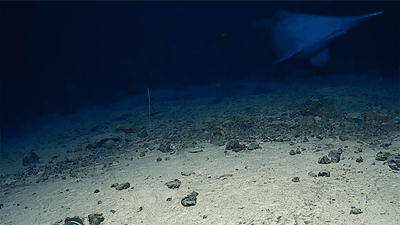


One of the ocean’s most mysterious sharks has been filmed in its natural habitat for the first time. Known as the goblin shark (Mitsukurina owstoni), we had previously only seen specimens that had been hauled to the surface. Now, new footage shows it in all its deep-sea glory, challenging ideas about how these elusive animals live.
The goblin shark was first discovered in 1898, deep in the waters off Japan. Today, they still lurk in the darkest pockets of the ocean with a global distribution spanning the Atlantic, Indian and Pacific Oceans, largely occupying the depths of the benthopelagic zone.
You probably don’t need to see the goblin shark to know that it’s not exactly winning beauty contests. With a peculiar, flattened snout and protruding jaws that can fire out of its face at extreme speed, it’s quite a confronting creature through the lens of a terrestrial animal.
The thing is, life is very different in the deep sea, and the goblin shark’s unique aesthetic is a reflection of that. With the fastest jaws in the ocean (or, at least, of its sharks), it can project its gnashers out of its face, firing like a slingshot that extends between 8.6-9.4 percent of its total body length. This means it can snatch prey that would have otherwise been just out of reach.
Video credit: Clip 1, Ocean Exploration Trust, Nautilus Live. Clip 2, Minderoo-University of Western Australia Deep-Sea Research Center and Inkfish – featured in A. Judah et al., 2026 Fish Biology via Steve Auscavitch
It’s a highly effective hunting strategy, one that occurs at speeds of roughly 3.1 meters (10 feet) per second. Even fast-moving prey doesn’t stand a chance, despite goblin sharks having slow swimming speeds.
We know this because divers have studied specimens hauled to the surface that were then placed into tanks to be filmed. Not exactly a great way to study an animal’s natural behaviors, which is why it’s so exciting that we have now observed them in their deep ocean habitats for the first time. Better yet, we’ve seen them on two separate occasions and in two places; observations thought to encompass both sexes.
The first observation was made during an E/V Nautilus expedition that was exploring deep-sea ecosystems near Jarvis Island in the Central Pacific in 2019. The remotely operated vehicle (ROV) Hercules captured the footage at a depth of 1,237 meters (4,058 feet). It was a solitary male around 3.43 meters long and, using growth parameter estimates, which the researchers state are somewhat speculative, likely in the region of 51.5 years old.
The second sighting occurred on the slope of the Tonga Trench in 2024. This observation extended the known depth range of M. owstoni by 697 meters (2,287 feet), from the previous known maximum of 1,300 meters (4,265 feet). The imagery wasn’t perfect but the scientists couldn’t spot any sign of claspers – specialized fin-like protrusions that help males to mate – so they believe this individual was a female.
These findings show the goblin shark in a new light for the first time, providing a snapshot into their secretive lives in the deep sea. This kind of information doesn’t just add to the intrigue of marine animals, but can be pivotal in shaping effective conservation strategies to protect wildlife – even if we don’t see it very often.
“In this brief communication, we presented the first in situ observations of M. owstoni in its natural habitat, two new range extensions in the Pacific, and a depth range extension, including for the Order Lamniformes,” concluded the study authors. “These observations increase its geographic range further into the Pacific, and its vertical depth range by 697 meters.”
“This work also confirms in situ habitat use of a Central Pacific seamount, and near-trench slope habitats in the Western Pacific. Amidst global impacts on chondrichthyans, and increasing anthropogenic risks to deep-sea species, further solidification of biogeographic ranges and habitat preferences is helpful for informing conservation management, especially for species with intrinsically vulnerable life histories such as M. owstoni.”
The study is published in the journal Fish Biology.