Nature
 PUBLISHED





What you’ll discover in this article
- The tusk of a narwhal is actually a very long tooth, and has a similar structure to that of humans, although it lacks enamel.
- Scientists have long noted that these tusks always spiral in the same direction, but until now no one has been able to figure out why.
- Professor Henrik Birkedal told IFLScience that they think their discovery of a double spiral “allows the tusk to grow straight.”
For centuries, narwhals have fascinated people. Their extraordinary tusks have been carved into scrimshaw, used as medicine, and even traded as unicorn horns. But these enigmatic whales of the Arctic have just given up one of their longest-standing secrets.
The tusk of a narwhal is a single, giant tooth that erupts out of the whale’s jaw and grows through the lip to reach up to 2 meters (6.6 feet) in length.
Like normal teeth, it is formed from collagen fibrils, but “unlike human teeth, they don't have enamel in the tusk,” Professor Henrik Birkedal, from Aarhus University, explained to IFLScience.
“On the interior side of the tusk there is dentine, which is what our teeth are made of,” he continued. “And then on the outside is a layer called the cementum, which is in our teeth what is used to cement the tooth into the jawbone.”
It has long been observed that the tooth has a spiral structure. But intriguingly, it always spirals in the same direction. This is unusual because in other animals that have twisted components, like snail shells, for example, there is often a mix of left-handed and right-handed twists.
“As far as we understand, they are always turning the same way,” says Birkedal. “We thought this was really surprising and wanted to try to see if we could understand why.”

How the tusk got its twist
The team of researchers from Denmark, Sweden, Switzerland, France, and Greenland were able to use new technology to look into the microstructure of the narwhal's tusk.
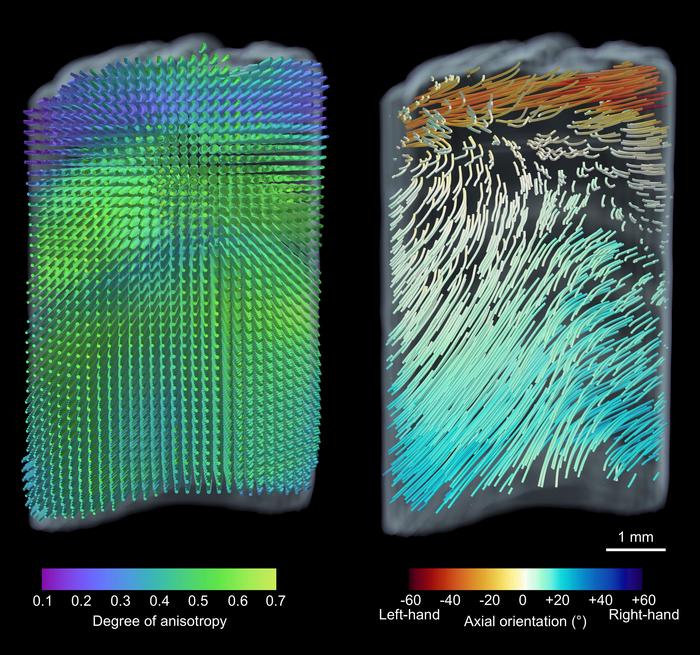
They used a technique called small scattering tensile tomography. This works by sending X-rays through the tooth and then measuring how they scatter, allowing the researchers to map the interior of the tooth in three dimensions in the atomic, nano-, and microscales.
“This allowed us then to measure the orientation of the collagen fibril, and we could then map the predominant orientation across a tusk,” Birkedal explained. “Thereby we could see how the collagen fibrils turned inside the tusk with micron scale resolution.”
If you just had a spiral going one way, there would be a tendency that it would deviate a little bit and maybe curl.
Professor Henrik Birkedal
What they discovered was entirely unexpected. While on the outside of the tusk the cementum turns one way, they found that the dentine on the inside turns in the opposite direction.
They found that while the building blocks of the tusk were predominantly orientated along the tooth’s longitudinal axis, they regularly deviate at tiny angles to allow it to create the distinctive twist.
Why do narwhal tusks spiral?
So now the researchers have figured out how the tusks grow in this spiral pattern, the next logical question was why.
“Our hypothesis is that it allows the tusk to grow straight,” explains Birkedal. “If you just had a spiral going one way, there would be a tendency that it would deviate a little bit and maybe curl.”
“But if they’re growing from the interface between these two tissues and they’re growing in opposite senses, that would allow it to grow straight.”
Incredibly, these two alternate spirals actually counteract each other even in death.
“It has a tension inside, which we could see,” said Birkedal. “If you take a tusk and then you cut it lengthwise, then it would actually start to turn because the [inner] dentin layer is thicker than the [outer] cementum layer.”
“It will actually turn almost 180 degrees because there is a release of this torsional tension that’s kept within the structure.”
While doing this work, the team also noticed something else intriguing. It appears that the tusks might also record the environmental conditions in which they were formed. With the teeth growing continuously for the animal's entire 80-year life span, they could therefore give researchers an incredible insight into the life history of these enigmatic whales.
The study is published in the journal Nature Communications.


 1
1