Nature
 PUBLISHED





If you were to dig directly beneath your feet like an ambitious mole, burrow through Earth's crust, and somehow survive the journey through the red-hot mantle and core, where do you think would you pop up?
Nope, the answer probably isn't China.
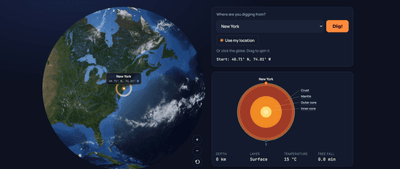
Well if you want to find out, you should get to know ThroughEarth.com. Simply tell the free-to-use website where you're digging from, and it will promptly show you the exact opposite point on a globe, around 12,742 kilometers (7,918 miles) away.
As you make the journey, an animation takes you through the crust, the mantle, the core, and out the other side. You can also find plenty of other information about Earth's interior and geology, such as the extreme temperatures you'd experience and how long it would take to freefall that distance.
Like many great endeavors, the project began with a child's curiosity.
“The original idea actually came from a very ordinary moment with my kids,” Martin Krpelan, the brains behind the website, told IFLScience
“We were at a playground, and we started talking about what would happen if we could dig a hole straight down into the ground — where would we eventually come out? It was basically a children's question, but it stuck with me.”
Earth is very, very watery
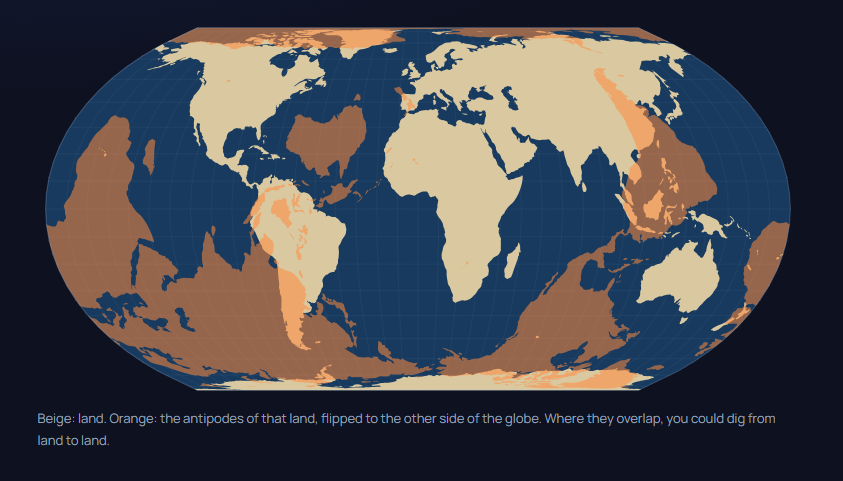
Despite what you may have heard in school, if you dig straight down from the US or anywhere in North America, you won't emerge in China.
Instead if you dug from Los Angeles you'd turn up in the middle of the Indian Ocean, around 1,530 kilometers (950 miles) from the nearest land. Start in London, and you'd appear in the South Pacific Ocean, around 740 kilometers (459 miles) from New Zealand.
If you wanted to pop up in Shanghai, you'd actually have to start somewhere in Argentina.
In fact, only 15 percent of the world's land has land on the opposite side, so there's a very good chance that no matter where you start you'll "land" somewhere in the ocean.
What's the math behind the map?
ThroughEarth's interactive platform is based on data from Natural Earth and uses the iconic NASA image Blue Marble. As for the math behind it, Krpelan says it's "surprisingly simple. "
“The antipode of a point on Earth is calculated by flipping the latitude and shifting the longitude by 180 degrees: latitude becomes -latitude, longitude is shifted by 180° and normalised back into the -180° to 180° range,” explained Krpelan.
“The interesting part is everything around that calculation. ThroughEarth also looks at the geography around both points and determines whether the opposite location is land or ocean. That's what makes it possible to show things like the fact that only around 15 percent of the world's land has land directly opposite it,” he continued.
Could we ever travel through planet Earth's interior? Probably not
The deepest hole ever drilled by humans is the Kola Superdeep Borehole in Russia. Measuring a pathetically puny 12,263 meters (40,230 feet) deep, this is a mere 0.2 percent of the distance to the core, let alone out to the otherside.
We'll probably never get to the center of the Earth ourselves, so thankfully we have ThroughEarth to spare us the grueling journey of extreme heat and pressure.