Nature
 PUBLISHED



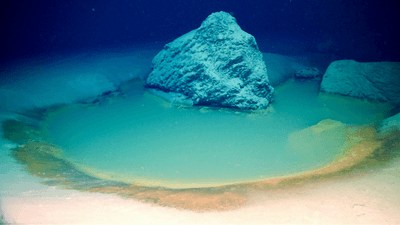


While exploring the deep depths of the Red Sea, marine geoscientists have found an “extinct” brine pool that could help us explain not only how these extreme environments form, but potentially even how life itself evolved and what could exist on Europe or Enceladus.
Rewind back to 2022, and researchers reported the discovery of an ultra-saline brine pool at the bottom of the Red Sea, which they named NEOM after the futuristic city Saudi Arabia was planning to build. Dubbed “pools of death” when similar pools were first discovered in places like the Gulf of Mexico, the name turned out to show our animal bias.
Because although the lack of oxygen and extreme salinity are deadly to macroscopic life, such as fishes and worms, these brine pools host plenty of microorganisms, and as such they’ve even been proposed as models for the places where life might have first evolved.
Now the same team who found NEOM have also discovered a former, or “extinct”, brine pool 90 kilometers (50 miles) south of NOEM in a formation known as Hume Deep.
Lessons from the past
Although no longer ultra-saline, this new pool still contains metal-bearing deposits that show signs of being enriched by salt-loving microbes. The authors describe this as “evidence that rift-shoulder pools are ephemeral on millennial timescales,” but create a lasting legacy.
Metals including iron, potassium and copper have been found to be greatly enriched at brine pools. This is attributed to “interactions between sediments, seawater, and hydrothermal fluids,” the paper reporting the extinct brine pool notes.
However, at NOEM, the authors discovered evidence that these are not the only factors, with metal-processing microbes enriching the mineral deposits, in some cases more than 100-fold.
The Hume Deep pool therefore offers the team a chance to see what such deposits look like after the changes to the local ocean currents cause their salinity to return to something closer to normal, allowing them to track the evolution of these unusual environments.
Dating a death pool
The team were able to date periods of the extinct pool by using uranium-thorium dating on fossils of animals thought to have been killed by straying into the lethal waters.
This showed that the metal deposition lasted at least 14,000 years, before stopped around 2,000 years ago, a blink of a geologic eye. In addition to metal concentrations similar to those found at NEOM, the seafloor was also stained in a way that indicates the past presence of microorganisms that could survive the ultra-saline conditions.
The exact trigger for the formation of brine pools is not known, but it's thought that it occurs in locations that were once above sea level, after salty lakes evaporated they left behind higher salt concentrations in the rocks.
Because these regions concentrate minerals, there is now growing interest in these pools from mining companies. The minerals concentrated at these sites include things like copper, the price of which has spiked in recent years. Mining these regions would be expensive, and many are concerned about the environmental risks too.
However, it’s also possible many rich mineral deposits on land are actually the product of ancient brine pools, and so knowing the conditions that create them underwater could make them easier to find on land.
The origin of life on Earth... and elsewhere?
The authors acknowledge the Red Sea brine pools are too small to host minerals of much value, but propose that previous geologic eras sometimes suited the formation of larger ones.
Moreover, the brine pools are thought to resemble the oceans before the early Great Oxidation Event.
Some could be similar to the hydrothermal vents of the era that are the leading contenders for where life began. They could therefore off a window onto the environment that fostered the evolution of life on Earth.
More than that, however, as the conditions could also resemble those on moons like Enceladus, where it was recently shown that at least one Earthly organism could survive, making the pools excellent natural laboratories.
Knowing the full cycle brine pools undergo could prove useful to many fields of science.
The study is open access in AGU Advances.