Nature
 PUBLISHED




National Geographic’s new series AFRICA: Earth’s Wild Home is bringing one of the most beautiful and biodiverse parts of the world to our screens this fall. Packed full of first-time footage, it reveals ecosystems and animal behaviors that have stayed hidden until now, including some truly bizarre reptiles.
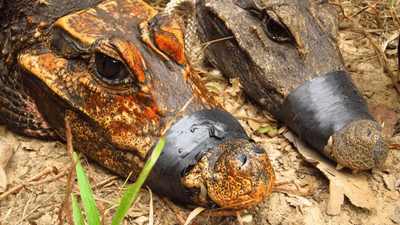
Head into the right cave in Gabon and you’ll find yourself chest-deep in guano, but among all the bat poop you’ll notice glittering orange eyes. Crocodiles dwell here that are unlike any others we know of on Earth.
Why? Because they chose to become troglobites.
Troglobites are cave specialists, living their lives in darkness. At one point they lived out in the open, but then they spotted an opportunity.
Caves offer shelter, water, and – as the rivers of bat guano in the Abanda Caves can attest to – they can even offer food. Each day when the bats leave the cave and then again when they fly back home to roost, it causes something of a traffic jam.
The swarm are masterful flyers but that doesn’t stop them from occasionally getting tangled and flopping on the floor, so says conservation ecologist Matt Shirley, who consulted on the series. And you know who’ll be waiting for those crashes with open-mouthed anticipation? The world’s smallest crocodile, Ostelimus tidraspis.
Known as the African dwarf crocodile, it’s found in Gabon, parts of Cameroon, and Nigeria. However, it’s only the Gabon population that decided to do something no known crocodile living anywhere else on Earth has done. It moved into a cave.
These animals have been in these cave systems for 10, 20, 30 years or more, and literally just sitting in bat guano the entire time.
Matt Shirley
It’s thought they made the transition to cave specialism around 3,000 years ago, and in that time they’ve undergone quite the transformation. They’re now the smallest of the dwarf crocodiles on Earth.
They're pretty cute, says Shirley, and totally naive to the danger of humans. While exploring the caves, he had mini crocs running up to him with wagging tails to see what was going on.
His first foray into the cave was a bit of a failure, resulting in ~10,000 disturbed bats pummelling into his face and body. Entering the cave at night proved to be the key to gaining access to the stiflingly hot cave system and the crocodiles found in there.
The caught crocs were covered in the stuff too. That's why it was so surprising to discover that some of them were bright orange underneath. We still don’t know for sure why that is, but Shirley has a strong suspicion.
“It's a hypothesis that remains to be tested for sure, but probably the best hypothesis from my perspective is that these animals have been in these cave systems for 10, 20, 30 years or more, and literally just sitting in bat guano the entire time,” he told IFLScience.
“Bat guano goes through a number of pH changes with the rainy season, non-rainy season, and how many bats from the colony, but either way, it's a highly caustic material.”
If you look at the head, some of the skin has eroded so thin you can actually see the skeletal features underneath it.
Matt Shirley
Anyone familiar with the leather-making process will recall how caustic solutions are used to tan leather. It seems that, in a similar fashion, the hides of the crocodiles are being eroded away by the caustic bat guano, which could explain why it’s only the larger older males that have this orange coloration.
And it gets even weirder.
“If you look at the head, some of the skin has eroded so thin you can actually see the skeletal features underneath it,” said Shirley. “So, it seems to be a very physical or chemical erosion process of the skin that actually does it.”
“But yeah, those orange ones are wild. I remember the very first time we pulled one out, it was like, holy cow, what have we been looking at?”
"Holy cow, what have we been looking at?" Is a strong theme across a series in which we see chimps fishing for algae and slurping it up like cotton candy while a very clever hyena catches his flamingo dinner sheepdog-style.
And then there’s the R-rated antics of some not-so-gentle giant tortoises. As series narrator and actor Wunmi Mosaku told IFLScience, “It’s a tortoise-eat-bird world out there.”
There’s no denying that Africa is unlike anywhere else on the planet, rich in culture, biodiversity, and landscapes so beautiful they'll make your eyes water. If you need some nature-based brain balm this autumn, it’s an absolute must-watch.
AFRCIA: Earth’s Wild Home premieres October 2, 2026, on National Geographic, and the next day on Disney+ and Hulu.