Nature
 PUBLISHED





Down in the deep ocean, it's pretty dark. Yet some species have evolved their own ways of producing light. This can be used to lure in prey, attract a mate, or even just put on a little show. However, for the kitefin shark, scientists have discovered that its sparkly belly makes it an even better predator.
The authors say their new study provides the best evidence yet that counterillumination – when an animal produces light on their underside – can be used to aid in predation, not just act as defensive camouflage.
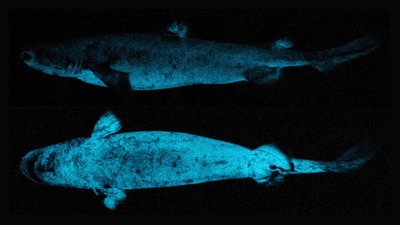
Kitefin sharks (Dalatias licha) are the world’s largest luminous vertebrates, measuring about 1.8 meters long (5.9 feet). The skin of the shark possesses millions of photophores, or light-emitting organs, which are spread all over its tummy, fins, and flank and produce a whole-body glow.
Most species in the deep sea glow from below to erase their silhouettes and camouflage themselves from predators that might be sneaking up from beneath. However, the shark’s strategy is slightly different. They want to blend in with the light coming from above to make them harder to see while hunting.
To test their theory, the team took 8 living kitefin sharks that were caught as bycatch and kept them in darkened tanks.
This allowed the researchers to measure how bright the skin of the sharks were and compare it to how bright the light is at depths of between 480 and 540 meters (1,574 and 1,771 feet) where the sharks typically inhabit.
The results showed that the shark's glow matched the intensity of the downward light coming from the surface of the water at the depths they were captured. It also found that the longest peak emission wavelengths reported among bioluminescent sharks were more green than dark blue.
It is thought that this might help the shark blend in with floating particles containing chlorophyll that might be swirling around the sharks.
It is not only the glow that matters though, but the angle too.
In animals that hide from predators, their glow “requires matching the downwelling light field at every angular direction from which a predator could view it” explain the authors. However, as the kitefin shark seeks to attack prey from above, it only needs to have a vertical angle of light emission to obscure its silhouette.
But even then, the shark is extra luminous, making the angle pretty broad. This lines up with the “searchlight hypothesis” that extra light emitted by the shark actually helps it spot prey in the depths.
“D. licha simultaneously suppresses its near-vertical silhouette as seen by prey below, and deploys laterally broad luminescence to illuminate the prey field,” explain the authors.
Earlier this year a species of glowing coral was found in a cave, with researchers hypothesizing that this might be a predator defense mechanism. They think that if a hungry predator disturbs the coral, it lights up to hopefully attract something even bigger to come and eat the attacker!
The study is published in iScience.