Nature
 PUBLISHED


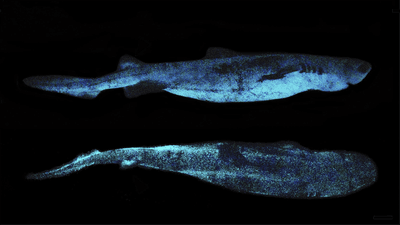


Bioluminescence is the word we use to describe animals that are capable of creating their own light. It involves a chemical reaction that releases energy as light, and it’s a big hit down in the twilight zone where light from the Sun can’t reach. We’ve found bioluminescent jellyfish, squid, and fish, but the largest luminous vertebrate known to science? That, my friends, is a glow-in-the-dark shark.
The kitefin shark was one of three “glowing sharks” described in a 2021 paper published in the journal Frontiers in Marine Science. Dalatias licha, as it’s known to science, was named alongside the blackbelly lanternshark (Etmopterus lucifer) and the southern lanternshark (Etmopterus granulosus). All three species are bioluminescent and produce a soft blue-green light thanks to specialized cells in their skin.
The sharks were hauled up from the twilight zone, which ranges between a few hundred meters to 1,000 meters (about 650 to 3,300 feet) below the ocean surface. The kitefin, at nearly 1.8 meters (6 feet) long, became the largest bioluminescent vertebrate known to science. Researchers were studying the sharks on board a deep-sea trawler, taking live sharks caught in the net and putting them in a seawater tank in a dark room. When it was the kitefin’s time to shine, it put on quite a show.
“I nearly cried when I saw it,” lead author Jérôme Mallefet, a research associate at the Université Catholique de Louvain in Belgium, told National Geographic. “It was so exciting.”
Exactly why the sharks have evolved to glow like this isn’t clear, but the researchers posit it could be for improving their hunting success. The luminescence could prove beneficial in illuminating the murky depths and revealing prey, or as a means of disguise when making its approach, but more research will need to be done to ascertain if either theory holds water.
“Bioluminescence has often been seen as a spectacular yet uncommon event at sea but considering the vastness of the deep sea and the occurrence of luminous organisms in this zone, it is now more and more obvious that producing light at depth must play an important role in structuring the biggest ecosystem on our planet,” wrote the study authors. “This first experimental study of three luminous shark species from New Zealand provides an insight into the diversity of shark bioluminescence and highlights the need for more research to help understand these unusual deep-sea inhabitants: the glowing sharks.”
Bioluminescence typically involves a reaction between oxygen and a group of small compounds called luciferins that’s catalyzed by the enzyme luciferase. In other animals, it comes down to stores of bioluminescent bacteria, but it’s not yet known how the sharks get their glow on. Analyses of their skin found no traces of luciferin or bioluminescent bacteria, but it could come down to hormones.
Bioluminescence is different from biofluorescence, which is when certain animals and plants fluoresce under ultraviolet light. Like the sound of that? You can help scientists find more.