Nature
 PUBLISHED


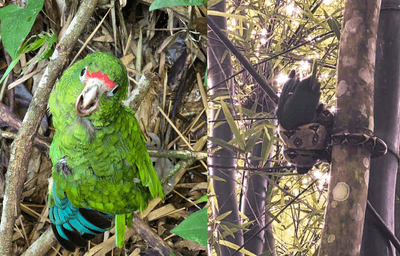


A biologist has captured the moment he helped to save a Puerto Rican parrot from falling victim to an invasive boa in the wild.
Raúl Correa, a Biological Science Technician at the US Fish and Wildlife Service (USFWS), was working in the Maricao forest when he heard a flock of Puerto Rican parrots (Amazona vittata) erupt with startled squawks.
He followed the calls and was led to a red-tailed boa (Boa constrictor) wrapping its girthy body around a parrot chick, high up in the forest canopy. Taking swift action, Raúl cut the bamboo stalk and freed the young parrot from the snake’s grip.
The parrot was kept under observation for one night, but it appeared to be in remarkably good nick, so it was happily returned to its flock the following day.
The snake, however, didn’t have such a fortunate fate. In collaboration with the University of Puerto Rico at Mayagüez, the USFWS explained in response to comments on social media, the chunky boa was captured, euthanized, and sent to a laboratory to study its diet.
This minor incident is a microcosm of a much larger problem facing the forests of Puerto Rico.
The Puerto Rican parrot, also known as the Puerto Rican amazon, is considered to be "Critically Endangered" under the IUCN Red List, with just a few hundred individuals left in the wild. Among their many threats, including habitat destruction and disease, invasive species are at the top of the list.
The invasive boa
Until very recently, the native boa (Chilabothrus inornatus) was the largest snake found in Puerto Rico, with the average specimen measuring between 1 and 2 meters (3.3 feet to 6.6 feet) in length.
That changed in the 1990s when a small but significant population of boa constrictors (another common name for red-tailed boas) – a slightly larger species – was introduced to the region, most likely through the wildlife trade.
Over the past few decades, the invasive boa constrictor has become an increasing ecological threat to native wildlife.
Not only do these constrictors consume the prey of native predators and prove extremely effective at decimating local populations, but they have also introduced viruses that could devastate other snakes.
"Experience has shown that island ecosystems are particularly vulnerable to snake invasions, and unfortunately Puerto Rico has no natural predators that can keep the numbers of these prolific snakes in check," Marcia McNutt, then-Director of the USGS, said in 2013
"Humans were responsible for introducing this scourge to the island, and are the only hope for mitigating the problem before it is too late for the native species," she added.
This is typical behavior for the boa constrictor, which is native to Central and Southern America. The species is causing similar problems up in the Florida Everglades, where they, along with other invasive snakes like the Burmese python, grow to huge sizes and prowl the swamps for unsuspecting prey.
It’s illegal to keep boa constrictors as pets in Puerto Rico because of this predicament, but as these latest images show, the invasive species still has a grip on local wildlife.