Nature
 PUBLISHED


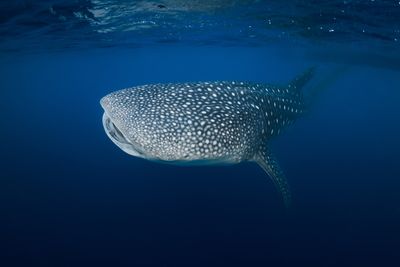


A whale shark swimming in the waters of the Caribbean and Gulf of Mexico has been recorded covering an astonishing 54,700 kilometers (34,000 miles) in 10 years, making it the longest record of any shark’s movement.
The animal in question is an 8-meter (26-feet-) long male called Milo, who for the last decade has been successfully tagged by scientists five times.
This has allowed the researchers to build up an unprecedented picture of the whale shark’s movements from 2017 as he travels around the ocean, freely crossing the waters surrounding the US, Mexico, Cuba, Haiti, and Bermuda, amongst others.
“Long-term studies like these are critical to better understanding the complete life history of these long-lived animals,” Dr. Guy Harvey, a scientist, conservationist and the founder of the Guy Harvey Foundation, told the Nova Southeastern University (NSU) who work together on tracking sharks throughout the region.
“Being able to retag an individual animal five times and follow it for almost a decade is unprecedented and will provide tremendous information to better understand and conserve this endangered species.”
It is even possible to follow Milo and his fellow tagged whales yourself on the NSU’s Guy Harvey Research Institute’s website.
An oceanic wanderer
The data shows how Milo has gone on a number of long-ranging trips around the Caribbean and Gulf of Mexico.
In 2018, for example, he swam right out into the Atlantic Ocean far past the island of Bermuda, while in 2020 he traveled amazingly far north, passing New York and reaching Atlantic waters in line with Massachusetts.
In 2019, 2021 and 2022, however, Milo favored the Gulf of Mexico as he swam off the coast of Mississippi and Louisiana before heading across to Texas and then back down to Mexico.
And yet, despite all these impressive oceanic wanderings, Milo always returned to the same place: the Yucatán Peninsula.
This is because even though the sharks are usually solitary animals, each year off the coast just north of Cancún they gather in what is thought to be one of the largest seasonal aggregations of whale sharks. In 2009 one aerial survey counted an astonishing 420 whale sharks in an area of about 18-kilometer square (7-mile square).
The sharks can spend months in these waters, feeding on zooplankton, shrimp, copepods and fish eggs. It is thought that the tropical upwellings bring nutrients from the depths into the coastal waters of the Yucatán Peninsula. They are often joined by other ocean giants such as manta rays.
The fragility of the oceans
The researchers can be certain that it is Milo they are repeatedly seeing not only because of the tag, but also due to his unique pattern of spots. These can be used just like fingerprints, allowing scientists to confidently identify the same individual sharks year after year.
“Milo has revealed just how flexible whale sharks can be, demonstrating the capability of enormously far-flung migrations way out into the Atlantic, yet equally content with ‘staying put’ for months at a time in small regions,” says Dr. Mahmood Shivji, Director of the Guy Harvey Research Institute at Nova Southeastern University.
“These sharks are clearly equally at home in the far offshore deep ocean as they are in shallow coastal areas, despite how different those environments are!”
As with many species, there are unfortunately concerns about their future survival. While in 2025 the number of sharks congregating off of Mexico was much lower than usual, this year has seen a return of numbers.
This is good news, but highlights the fragility of these environments and the care we must take to protect them.



 1
1