Nature
 PUBLISHED





China is the world’s biggest generator of wind energy by a long shot, and its capacity just keeps on growing and growing.
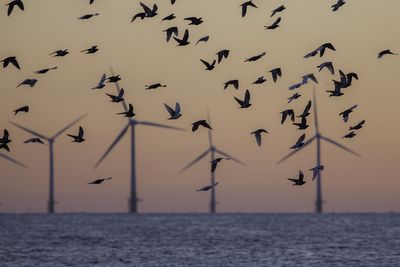
In its latest flex, the east Asian powerhouse has just activated an offshore wind farm in the South China Sea featuring 33 wind turbines of monstrous proportions, as well as 98 smaller ones to keep them company.
The China General Nuclear Power Group (CGN) announced that the Fanshi offshore wind farm officially went fully operational on September 24, 2026.
The 2-gigawatt project is located 81 kilometers (50 miles) south of the shoreline in Guangdong Province, South China, and consists of 131 wind turbines, including 33 ultra-large 18-megawatt offshore wind turbines.
These wind turbines are absolutely colossal
The scale and power of these 18-MW units are immense.
Each has a rotor diameter of 292 meters (958 feet), sweeping an area of approximately 66,000 square meters (710,418 square feet) with each rotation. A single spin can generate up to 43 kilowatt-hours of electricity, enough to power the average household in China for nine days.
These aren't the biggest turbines on record, though. Last year, the Dongfang Electric Corporation reportedly installed a 26-MW model in Shandong with blades that measure 153 meters (501 feet) in length.
With that said, the Fanshi offshore wind farm is remarkable for yielding the power of dozens of "ultra-large" wind turbines in a single commercial wind farm. No other offshore wind farm has this many turbines of this capacity all working together, according to the CGN.
Renewable energy into the power grid
Over the span of a year, the entire Fanshi complex is set to generate 6.6 billion kilowatt-hours of energy and will feed it into the grid of the Guangdong-Hong Kong-Macao Greater Bay Area, a loosely connected hive of cities on China’s southern coast.
This wealth of clean energy, CGN said, has the potential to reduce carbon dioxide emissions by approximately 5.1 million tons and offset 1.92 million tons of coal being burnt.
Speaking as Party Secretary and Chairman of CGN New Energy, Hu Guangyao stated that the Fanshi offshore wind power project is yet another step to help China achieve its “dual carbon” goals of reaching peak carbon by 2030, then total carbon neutrality by 2060.
Coal vs renewables
China pumps out more carbon than any other country on Earth, and some analysis suggests its emissions have slightly crept up in 2026. Simultaneously, it's investing heavily in renewable infrastructure, including some of the biggest wind farms and largest solar parks across the globe.
It looks like a complex, slightly muddled picture from afar, but the ongoing crisis around the Strait of Hormuz and its impact on energy security is expected to be another kick for China to move even faster towards renewables and electrification.