Nature
 PUBLISHED





What you'll discover in this article
- Across the globe, enormous aggregations of grouper come together to spawn each year under the full moon.
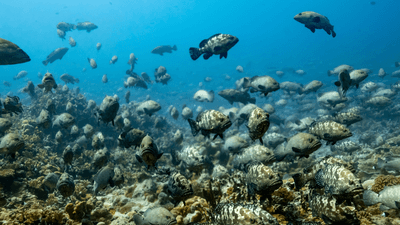
- In in Fakarava Atoll it marks one of the greatest wildlife specticals anywhere on Earth.
- Wildlife photographer Laurent Ballesta previously told IFLScience "it was quite something to be suddenly surrounded by hundreds of excited sharks patrolling the bottom in search for the hiding groupers."
It’s no secret that there’s some spooky goings on in the ocean. Think about the red-eyed sea spiders, “ghost” lobsters, and many-butted worms. Then there’s all the shenanigans that occur during the full moon.
This is when one of the greatest wildlife spectacles to be witnessed in the ocean occurs. It’s the spawning of giant grouper, and it sees thousands of predatory fish gather for a big gamete party under the full moon, begging the question: what do lunar cycles have do with it?
Turns out there are many benefits to this timing, both for staying alive and ensuring their chances of procreating.
Blame it on the moonlight
The grouper spawning occurs at different times of year depending on the species of grouper in question and the geographic location, but the largest of all the aggregations occurs in the Fakarava Atoll in French Polynesia.
Here, it’s estimated around 18,000 camouflage groupers gather each year. An event you’d think would be easy enough to capture, right? Turns out, you would be very wrong.
Someone who is very familiar with the complexities of filming grouper spawning is wildlife photographer Laurent Ballesta. In 2021, his image Creation scooped the grand title prize at Wildlife Photographer of the Year.
The product of half a decade of perseverance, it depicts the conception of a future generation of groupers represented as a billowing cloud of sperm and eggs that rise almost like a question mark. A fitting punctuation for one of Earth’s most perplexing annual phenomena.
Avid wildlife documentary fans may recall Ballesta’s appearance in Blue Planet II’s Coral Reefs episode, in which the “Making Of” section showed the grueling effort that went into filming the annual spawning event. Something that proved to be incredibly challenging for several reasons.
We were here for the spawning but had no idea before the dive that 700 sharks (my team and I counted them) were hunting the groupers at night.
Laurent Ballesta
Firstly, there’s the fact that a mass aggregation of fish attracts the attention of predators. That means Ballesta and his colleagues were up against swarms of grey reef sharks as they tried to find their fishy subjects.
The camera operators had to dive decked out in chainmail so that they were protected from the sharks that occationally got a little too interested in the electric currents surrounding their camera equipment.
“When we came to Fakarava for the first time in 2014, I had planned a 24-hour dive at 20 meters [66 feet] – no one had ever dived at night in the channel,” Ballesta told IFLScience in a 2021 interview.
“We were here for the spawning but had no idea before the dive that 700 sharks (my team and I counted them) were hunting the groupers at night. It was quite something to be suddenly surrounded by hundreds of excited sharks patrolling the bottom in search for the hiding groupers.”
Another complication is the fact that the entire event unfolds on a single evening, but not a set date. For this part of the world, we know it’s around the full moon in July, but that still leaves a lot of room for error.
Something the Blue Planet team discovered in their first year when they missed the event entirely.
But not to be put off, the crew returned a year later, this time with Ballesta’s Blancpain and National Geographic team in tow. In the end, the total footage, which spans less than an hour in the series, took five seasons of filming attempts.
The spawn of an individual fish is a matter of mere seconds, making the framing of Ballesta’s winning image all the more incredible.
And as for that question mark, I like to think it’s an accidental hat tip to the mystery that surrounds these fish – how do they know when to spawn, and why is the full moon the right time?
Celestial clocks
As we know, the phases of the lunar cycle are connected to the tides because of the way the Moon’s position acts on Earth’s gravity.
It’s thought that the tidal changes surrounding the full moon are what make this an optimal time for the grouper to spawn, says the Natural History Museum, London, because it sweeps away the fertilized eggs into the safety of the open ocean.
As for how the fish themselves know when the time is right, research into other grouper species has shown biological mechanisms through which light changes associated with lunar phases could regulate spawning activity.
They include the possible role of a group of light-sensitive proteins known as cryptochrome in the honeycomb grouper, a species that was tricked into spawning using artificial moonlight.
Though there’s a lot we have yet to learn about how these fish coordinate their sexy time with such specificity, it raises interesting questions about the influence of artificial light at night on wildlife.
A beautiful and baffling example of why we need the dark.