Nature
 PUBLISHED





At a research station in the rainforests of West Africa, in an area that few people get to explore, a team surveying birds made a incredible discovery.
Among the understory of the forest live forest elephants, pygmy hippos, and hornbills. But the area was also once home to another beautiful bird, a species that had not been seen for more than 10 years.
Could it still be living here, undetected, or had habitat loss curtailed the range of even the elusive Ghana cuckooshrike? A pair of researchers still held onto hope.
First ever video of the cuckooshike
Stephanie Bartlett and Paulo Ditzel, of the International Bird Conservation Partnership, were nearing the end of a sixth month expedition surveying birds across West Africa.
They were in the Taï National Park, in Cote d'Ivoire, where they’d even joked at the beginning of their expedition about the possibility of seeing a cuckooshrike, but their chances were pretty slim.
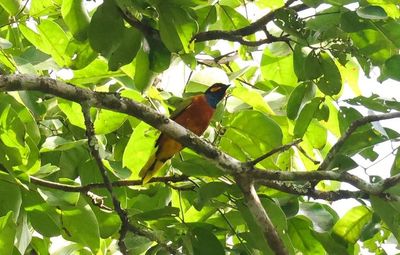
Then, one afternoon they decided to go for a quick look in the forest, when the researchers saw a brief flicker of movement in the canopy and the unmistakable flash of brightly-colored feathers.
Seizing the moment to snap a few quick photographs before the bird disappeared again, Bartlett even managed to record video of the bird. It turned out that they'd caught the first video footage ever to exist of the Ghana cuckooshrike.
Not only that, but the photos they took represent the first taken of the Ghana cuckooshrike in more than 10 years since it was last photographed in Ghana's Atewa Forest in 2013, and probably the best.
The cuckooshrike is a strikingly beautiful bird, and yet despite its extraordinary coloration had remained unobserved for so long. This is probably due to a combination of this reasons, including its habit of living in the canopy, but so little is actually known about the species it is hard to be certain why.
The bird's habitat is said to extend across the forests of Sierra Leone, Liberia, Cote d'Ivoire, and Ghana but deforestation and land use change has been shrinking the bird's range as logging and agricultural expansion for cacao trees increases.
Finding lost birds
The Ghana cuckooshrike is one of 126 birds that have been “lost” to science, which is broadly defined as not having had a confirmed sighting in a decade or longer.
The list has been compiled by the Search for Lost Birds, which is a collaboration between Re:wild, American Bird Conservancy, and BirdLife International and aims to rediscover these species. In addition to the cuckooshire, they’ve already had some successes.
After last being seen some 95 years ago, the rusty lark was photographed for the first time ever in Chad earlier this year after two birders stopped to observe an entirely different species. While the cuckooshrike is in good company after the yellow-crested helmetshrike was rediscovered in the Democratic Republic of Congo in 2024.
In 2022, a glittering species of hummingbird called the Santa Marta sabrewing was rediscovered and photographed in Colombia after last being documented in 1946 and once again in 2010.
“It’s so incredible to see photos and video of the Santa Marta sabrewing,” said John C Mittermeier, director of threatened species outreach at American Bird Conservancy in a statement at the time.
“It’s like seeing a phantom. When we announced the top 10 most wanted lost birds last year, we hoped that it would inspire birders to look for these species. And as this rediscovery shows, sometimes lost species re-emerge when we least expect it. Hopefully, rediscoveries like this will inspire conservation action.”
Here is to hopefully finding plenty more of the lost birds quietly going about their business away from prying eyes.


 3
3