Nature
 PUBLISHED


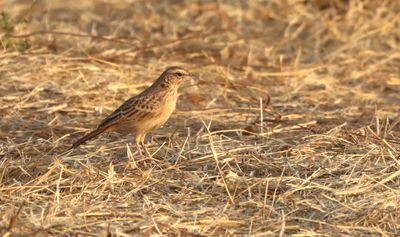


How do you lose a species? While some sadly go extinct, others are simply lost to the passage of time. They might never reappear, but a lucky few that can be spotted once more – such as in the case of the rusty lark, seen in Chad for the first time in 94 years.
The rusty lark (Calendulauda rufa) is a small brown bird that was poorly known from a few scant records across Niger, Chad, and Sudan. Specimens were collected in 1931 by the naturalist George Latimer Bates, but from then on only unconfirmed reports and whispers of the bird's appearance were heard. More recently a photo was taken in 2017, but after extensive evaluation it was confirmed not to be the rusty lark and so the species remained lost.
Enter French duo Pierre Defos du Rau and Julien Birard, who regularly travel to Chad and other African nations to research water birds – though being birders, they had been keeping their eyes peeled for any other interesting species.
“We had been practicing our larks in Chad for the last two years”, explained Defos du Rau in a statement.
After a 10-day trip ringing ducks at Lake Fitri, on the morning of February 2, the team had stopped hoping to see a Kordofan rufous sparrow in the Guéra region of the south-central part of Chad. While looking at a Horsfield's bushlark, Birard thought he’d seen something even more exciting.
The Kordofan sparrows were nearby, but in taking time to get the camera and microphone set up the birds had flown off. However, in place of the sparrows was a distinctly different-looking lark species. The pair snapped photographs at this range and a much closer 6-8 meter (19-26 feet) range a little while later.
These images represent the first ever photographs of a rusty lark to exist. After extensive comparison and ruling out other species it was confirmed that the species seen in Chad must be the rusty lark. The bird was even spotted again on February 15.
.png "A small brown bird, closer to the camera with a pale chest, whiter eye stripe and pointed beak.")
Despite not being seen for 94 years, the bird was never classed as extinct and is even listed with a stable population on the IUCN Red List under the classification of Least Concern. This is largely because the species is said to have a very large range and even be locally common in some areas. Part of what makes spotting this bird difficult is the security concerns and political unrest that make accessing these parts of the world to look for it more challenging.
The rusty lark is far from the first species to have been rediscovered after a lengthy gap. The Fagilde’s trapdoor spider was found again after a 92-year absence on the outskirts of a village in Portugal, while the absolutely adorable golden mole was found swimming its way through South Africa’s sand dunes for the first time since 1936.