Nature
 PUBLISHED


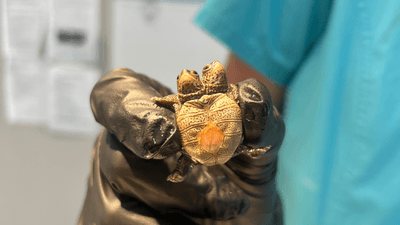


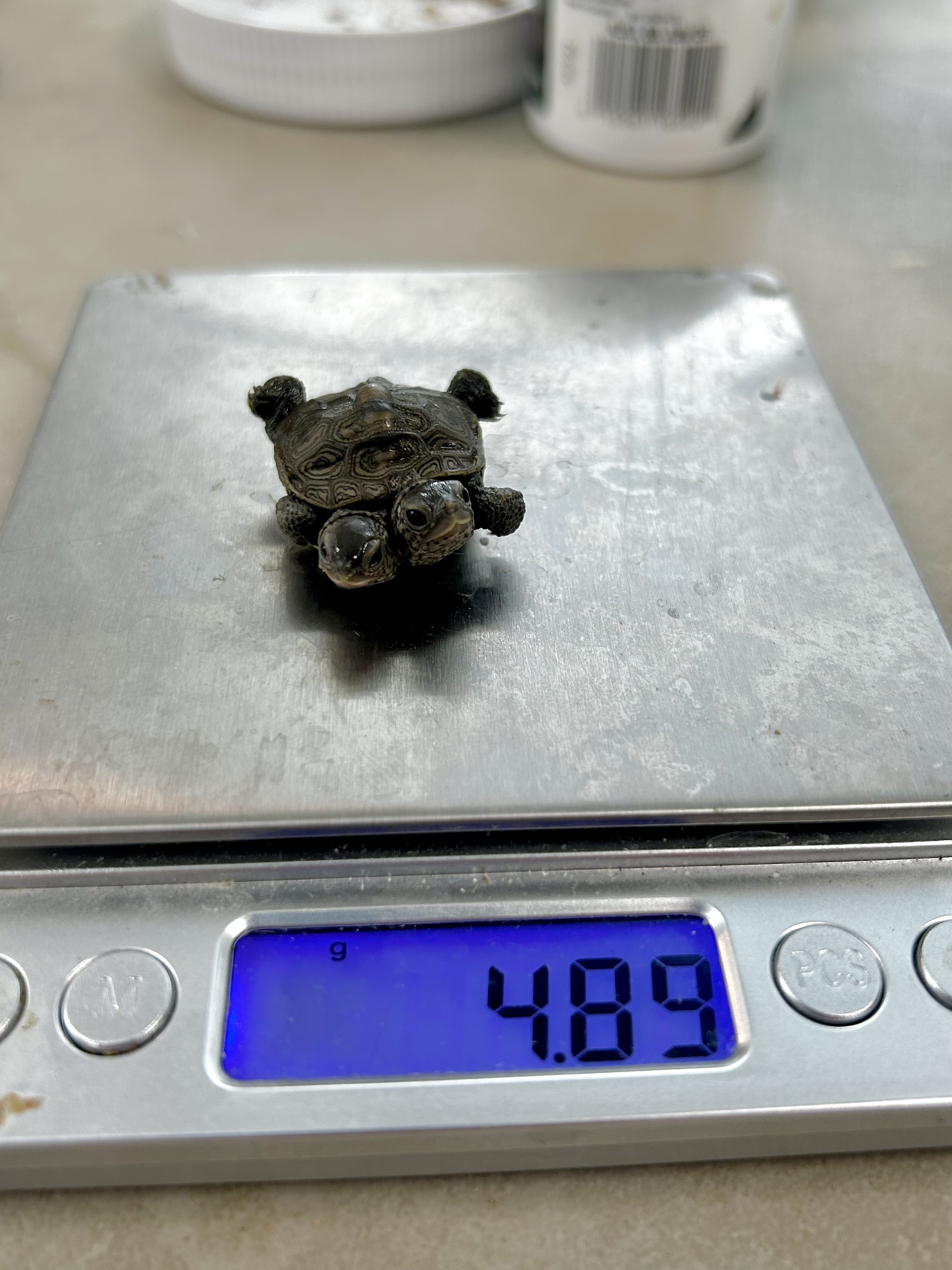
A tiny diamondback terrapin has hatched with two heads in a rare case of bicephaly.
The team at New England Wildlife Centers say the hatchling arrived at Cape Wildlife Center from a protected nesting site in Wellfleet via the Massachusetts Audubon Society. They will monitor the new arrival to learn more about how the heads and body work together.
Diamondback terrapins (Malaclemys terrapin) can live as long as 40 years in the wild despite only being around 12 centimeters (5 inches) long for the males and 27.94 centimeters (11 inches) long for the females.
They exhibit a marked sexual dimorphism – the females can be five times the weight of the males.
The little two-headed turtle still only weighs 5.2 grams (about 0.01 pounds), and the veterinary team are closely monitoring the animal’s appetite and behavior.
The turtles are found in coastal salt marshes around the northeastern US. There are seven recognized subspecies that all have the distinctive diamond pattern and concentric growth rings.
In the wild, the diet of these creatures is mostly invertebrates – crustaceans and mollusks – as well as plant material and algae. Some populations also are predators of the salt marsh periwinkle, a species of snail that can affect the growth of other plants. Thus, in these areas, the diamondbacks are often referred to as a keystone species.
“We’ve only seen two other bicephalic cases in the last five years, making this still an especially rare case for our team. While we’ve encountered this unusual condition before, every case gives us another opportunity to learn more about these fascinating animals’ anatomy and physiology,” the team explains on social media.
Bicephaly occurs during embryonic development when twins fail to separate, leaving one body with two heads inside an egg.
The main threat to this species in the wild is drowning in commercial blue crab traps, since the animals are attracted to the bait. Another large problem is the impact of coastal development and water pollution, since females are often struck and killed on roads.
Sea level rises caused by climate change could also impact the availability of nesting sites for this species.
In other bicephaly news... In June this year, Simon and Garfunkel, the crested gecko with two heads, was hatched to Rockstar Geckos. Each head was reported to have its own personality with the left being a bit more grumpy than the right.
Unfortunately, Simon and Garfunkel passed away in August after struggling to eat. Bicephaly and polycephaly can cause animals to struggle with this, especially in the wild.