Nature
 PUBLISHED



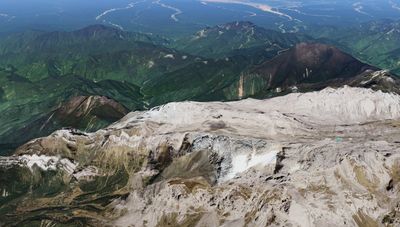


The “eternal snow” that once capped the mountains of tropical Papua, Indonesia, is set to disappear within as little as two years.
The only tropical glaciers in the entirety of Southeast Asia, they have been in steady decline for several decades. Since 1980, the island has lost four of its six patches of permanent ice as global temperatures have crept upwards.
“The ice will be gone: it’s not a question of if, it’s a question of when,” Klaus Thymann, a Danish explorer and mapper of the last surviving glaciers of Papua, told the Guardian earlier this year.
“And ‘when’ is coming very, very soon.”
Ice in the rainforest
For most of us, glaciers aren’t the first things to come to mind when we think of the tropics. Standing in a hot, humid rainforest and looking up to see the sparkle of ice among the mountains feels incongruous, but tropical glaciers can be found in the Andes, eastern Africa, and Indonesia.
The vast majority are in the Andes, which holds up to 95 percent of tropical glaciers. Found mostly in the mountains of Peru, they also extend north towards Ecuador and into Colombia.
In Africa, on the border between the Democratic Republic of Congo and Uganda, sits the Stanley Plateau glacier. Since 2020 it has lost a staggering 30 percent of its surface area, a decline that marks a serious threat to the water security of local communities.
When it comes to tropical Southeast Asia, glaciers are harder to find. But perched on the top of the Sudirman Range on the Indonesian portion of the island of New Guinea, known as Papua, is the last remaining tropical ice found anywhere between the Andes to the east and the Himalayas to the west.
The eternal snow of Papua
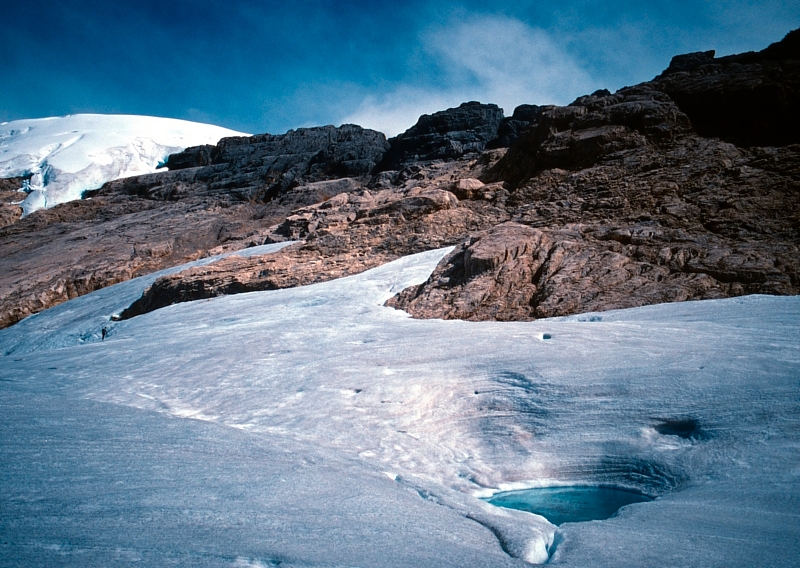
The Carstensz glacier of Papua sits on the sub-peak of Puncak Jaya, which rises to a height of 4,884 meters (16,024 feet). Known to locals as “eternal snow,” it has long held deep spiritual meaning and reverence.
Just 100 years ago, the entire mountain range had permanent ice spread across its four peaks, but now there are only two patches remaining.
Since the 1800s, the amount of ice on Puncak Jaya has decreased from roughly 1,900 hectares (4,700 acres) to a shocking 16 hectares (40 acres). Since 2002 it is thought to have declined by 95 percent.
“On a philosophical level, you take eternity – something that’s an abstract, human construct – and we are even now killing our own constructs,” Thymann told The Guardian.
“It raises some very interesting questions, I think, around the little speck we are in geological time, and what amount of chaos we’ve managed to do in such little time.”
It is fully expected that the remaining ice will disappear within the next couple of years.
The cause for this decline is the same as that impacting all other glaciers around the world. The warming of the climate caused by the burning of fossil fuels means the freezing point is shifting ever further up the mountain slopes, eventually reaching a point where there is no mountain left on which water can freeze.
It also means more precipitation is falling as rain instead of snow, melting the glaciers and eventually causing them to collapse. This is believed to have been a contributing factor in the catastrophic Nepal glacier collapse and subsequent flood in late August.
With the steadily growing El Niño in the Pacific Ocean, it seems there is little hope for this once eternal landscape.