Nature
 PUBLISHED
 5
5




What you'll discover in this article
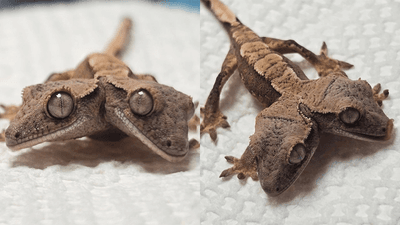
- A polycephalic crested gecko with two heads name Simon and Garfunkel was born at the end of June.
- "Each head does seem to have its own behavior," Tracie Kelley from Rockstar Geckos told IFLScience.
- Polycephaly isn't common, but it has cropped up across the animal kingdom in fish, mammals, and even ancient reptiles.
Genetic differences happen all the time in nature. For some it can result in unusual pigmentation, spots instead of stripes, or even a lack of color altogether. For others, like geckos, it can result in two heads.
Simon and Garfunkel are a two-headed crested gecko raised by gecko breeders Rockstar Geckos. Hatched at the end of June, the pair have been raised by the team, who have only seen this type of thing once before.
I'd guess that the right head is more dominant, but it's a bit hard to tell.
Tracie Kelley
The condition of having multiple heads is known as polycephaly, and typically occurs when twins start to separate in the womb but the process is not completed, called axial bifurcation.
Typically, in the wild, animals with polycephaly don’t survive very long, since they find it difficult to move around and eat.
For Simon and Garfunkel, the pair have the team taking care of them and seem to be progressing well, though it is still early days.
“Each head does seem to have its own behavior. The left head is a bit more grumpy. They do seem to argue about which way they want to go occasionally, but for the most part it isn't really an issue. I'd guess that the right head is more dominant, but it's a bit hard to tell,” Tracie Kelley from Rockstar Geckos told IFLScience.
The team has been providing weekly updates on the twins on their social media accounts and are grateful for all the interest that has been shown in the tiny pair.
“I think the biggest challenge in caring for them is probably assisting them with shedding. They don't always need help, but they're so small and fragile it takes a long time to make sure they're free of any retained shed.”
“We'd like everyone to know that we are very grateful for the love they've shown and for cheering on these little ones. We will keep updates coming,” said Kelley.
Geckos are not the only species that can have two heads.
In 2011, a two-headed bull shark was discovered in the Gulf of Mexico by fishers, while cats, snakes, and even cows have all been recorded.
The process isn't a new phenomenon either. A-125-million-year-old fossil was discovered in China, showing an extraordinary specimen of a hyphalosaur with two heads from the Jehol Biota fossil beds of Liaoning Province.
“In one word, mesmerised,” said Lomax. “I have seen a living two-headed snake before, and am fully aware of other, often rare examples of bicephalous animals, but having an actual fossil is next level,” palaeontologist, author, and science communicator Dr Dean Lomax told IFLScience previously.
“It is extraordinary. To think just how rare bicephalism is in the world today, combined with the fact that fossilisation is incredibly rare, this fossil is truly exceptional.”