Space and Physics
 PUBLISHED




What you'll discover in this article:
- Last year, humanity successfully created the first-ever artificial eclipse in space – brilliant, yes, but can it beat the real thing?
- Professor Jim Wild, President of the Royal Astronomical Society, told IFLScience that total solar eclipses provide unique opportunities to study regions of the Sun that spacecraft coronographs can't see.
- The Sun is not the only target eclipses allow us to study.
Total solar eclipses are one of those natural phenomena that are truly incredible to actually experience. Speaking as someone who has seen two total solar eclipses – and with next month's one booked in, I can call myself a bona fide "eclipse hunter" – descriptions do not do the experience justice.
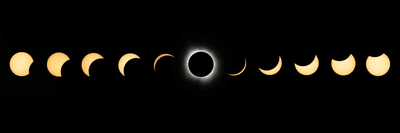
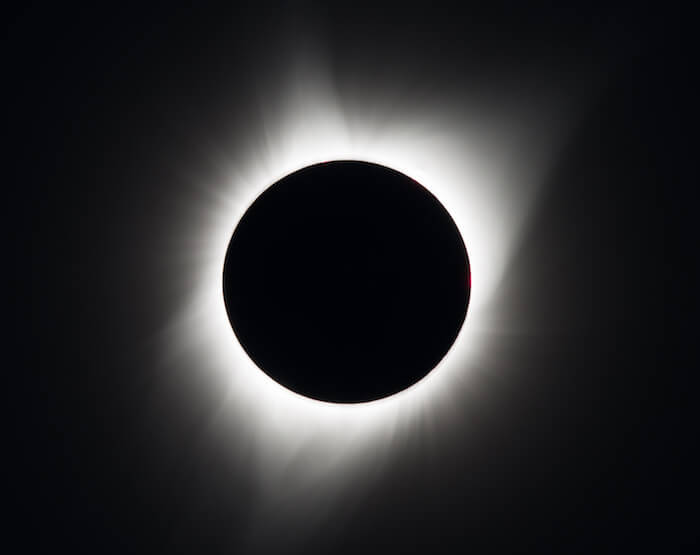
Beyond the beauty, however, there is also science to be carried out in a very brief window. A total solar eclipse – which happens on average once every 18 months – provides a rare opportunity to glimpse the solar corona, the Sun's atmosphere that we see as a wispy ring of light not being covered by the Moon.
By studying the corona, we may solve a long-standing solar mystery: why the corona is 200 times hotter than the surface of the Sun. We now have evidence supporting the idea of magnetic events heating it, but that's not the mystery solved. This is where eclipses come in.
How do we blot out the Sun?
While the corona is hotter than the Sun's surface (photosphere) at 1 million °C (1.8 million °F) compared to 5,500°C (9,940°F), it is a lot dimmer. The surface of the Sun is so bright that it outshines the sparse corona. To study the corona, we use an instrument called a coronagraph, which blocks the light of the Sun, but this has some disadvantages.
Even with modern space missions, total solar eclipses provide a unique opportunity to observe the Sun's innermost corona, a region that is difficult for spacecraft coronagraphs to see.
Professor Jim Wild
“In a more ‘traditional’ coronagraph you can end up with a bright rim in the part of the image that is around the edge of the occulting disc. This effect is caused by vignetting and diffraction of light entering the telescope," Professor Lucie Green from University College London told IFLScience previously.
"To improve the image on the sections nearest the occulting disc, you must put your occulting disc as far away from the entrance aperture of your telescope as possible.”
Basically, the farther away the coronagraph (the disk that blocks the Sun) is from your telescope camera, the narrower the field of view, and the closer you can view the Sun without its glare overwhelming everything. You know what is an excellent coronagraph located ~380,000 kilometers (235,000 miles) away? The Moon!
So total solar eclipses allow scientists to do some pretty incredible observations of the solar corona, getting as close to the Sun’s photosphere as possible. And it turns out, viewing an eclipse from Earth, we can actually see more details of the Sun's corona than viewing it from space.
"Even with modern space missions, total solar eclipses provide a unique opportunity to observe the Sun's innermost corona, a region that is difficult for spacecraft coronagraphs to see," Professor Jim Wild, President of the Royal Astronomical Society, told IFLScience.
"These observations help us understand how the solar wind is accelerated and how space weather originates.”
But it is not just the Sun that is a target for study during an eclipse.
"An eclipse also gives us a rare opportunity to study how Earth's atmosphere reacts when solar input is temporarily switched off, providing valuable insights into atmospheric dynamics and ionospheric processes,” Professor Wild added.
Why don’t we have a solar eclipse every new moon?
So eclipses are great. Unfortunately, they do not happen every month. The reason for this is that the orbit of the Moon around Earth is slanted with respect to the orbit of the Earth around the Sun.
A very important and beautiful word to learn here is syzygy, the alignment of three celestial bodies. The Sun-Moon-Earth syzygy creates a solar eclipse, and for it, the Moon needs to be in its new moon phase and at the point of its orbit where it is on the same plane as the Earth around the Sun. This is called a node.
Nothing in space is still, and these nodes are not static but change with the motions of the Moon and the Earth. The nodes gradually rotate around the Earth, and they complete a full rotation in 6,793 days, which is roughly 18.6 years.
That motion, combined with Earth’s and the Moon's, allows for two to five eclipses per year and a total solar eclipse every 18 months on average. Specific locations on Earth get, on average, a total eclipse only once every 360 to 410 years.
Luckily, we have one coming up next month. The August 2026 total solar eclipse will go through the Arctic, Iceland, and Spain and will be one of the best visible in Western Europe for decades to come.
The world's first "artificial" eclipse
Knowing the importance of eclipses, scientists figured it would be easier if we could do something to make them on demand. This has been the goal of the European Space Agency's Proba-3 mission and last year they successfully created the world's first artificial eclipse in space.
Proba-3 has made formation flying in space into an art. The telescope coronagraph is not inside the craft at all, but is instead a second spacecraft flying 150 meters sunward, blocking the Sun and allowing for the first spacecraft to take incredible photographs of this "fake" eclipse.
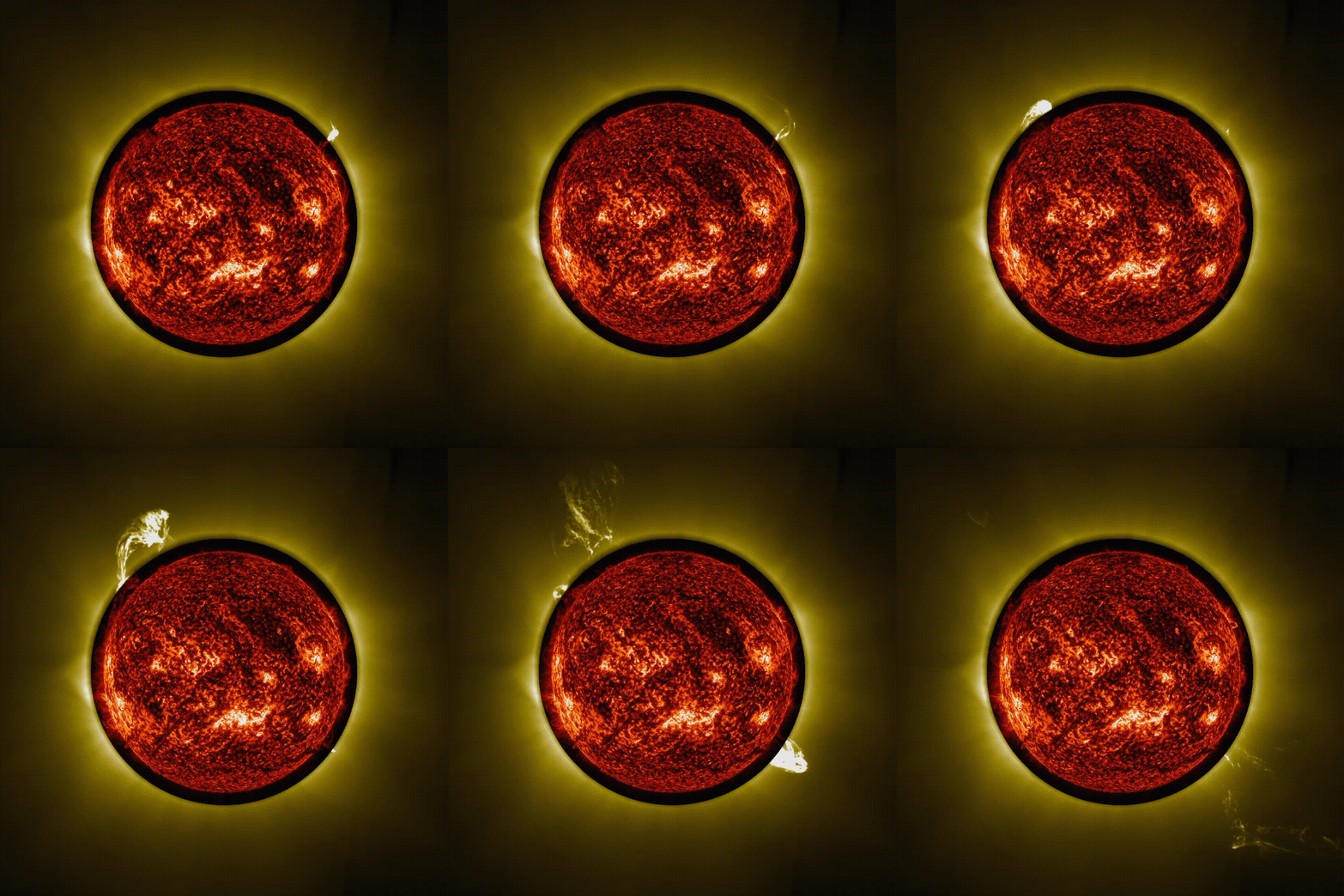
The spacecraft on the Sun-side is the Occulter, designed to block the solar disk for the Earth-side craft: the Coronagraph. The Occulter casts a shadow 8 centimeters (3.15 inches) across onto the Coronagraph optical instrument, ASPIICS.
“Our ‘artificial eclipse’ images are comparable with those taken during a natural eclipse. The difference is that we can create our eclipse once every 19.6-hour orbit, while total solar eclipses only occur naturally around once, very rarely twice a year,” Andreii Zhukov, Principal Investigator for ASPIICS, explained last year.
"On top of that, natural total eclipses only last a few minutes, while Proba-3 can hold its artificial eclipse for up to 6 hours.”
So, space-based missions can indeed provide long, uninterrupted views of the corona, but they struggle to capture the lowest layers of the corona clearly, losing out on some of the details and dynamism happening there that we can only view during the more inconveniently timed real eclipses.
What if we could have something in between?
More eclipses, more!
The fact that solar eclipses are not happening every month seems like a location problem more than anything else. The Moon can still block the Sun effectively if you are in the right place, even though in most cases that place is on Earth.
Earlier this year, scientists submitted a mission proposal to ESA for the Moon-Enabled Solar Occultation Mission, or MESOM. The proposed craft would fly on a trajectory that will allow it to experience total eclipses every lunar month.
Using a spacecraft means that you can orbit the Earth-Moon barycentre at the necessary distance and then pass through the shadow cast by the Moon once per month, seeing total eclipses during this time.
Prof Lucie Green
On top of that, while here on Earth, totality lasts between 10 seconds and 7.5 minutes, MESOM would be able to see eclipses for as long as 48 minutes.
“MESOM takes advantage of the Moon being a perfect natural occulter for the Sun, when viewed from the distance that the Earth is when the Sun-Moon-Earth all line up," Professor Green, who is working on the MESOM mission, told IFLScience.
"Using a spacecraft means that in principle, you can orbit the Earth-Moon barycentre at the necessary distance and then pass through the shadow cast by the Moon once per month, seeing total eclipses during this time.”
It is a wonderful cosmic coincidence that the Moon can occult the Sun so well most of the time (it doesn’t in an annular or "ring of fire" eclipse). Scientists will continue to use every opportunity to study these events – naturally occurring, artificial, from space, on Earth, and however they can.
And I will continue to be amazed by the sheer beauty of a truly special event in the universe as I watch it with my own (protected) eyes from Spain next month.

 1
1