Space and Physics
 PUBLISHED
 2
2



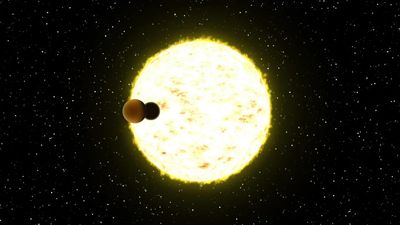


An incredible space event might be happening in the heavens, and it is likely that we are going to miss it. The Kepler-89 system is so far the only other place in the universe where we have seen a planetary alignment, where two exoplanets end up eclipsing each other as they pass in front of their star. This means that four celestial bodies – Earth, the star Kepler-89 A, and two of its four planets, Kepler-89Ad and Kepler-89Ae – will all be on a single line. The team that saw it the first time think it's about to happen again.
The alignment of three or more celestial bodies is known as a syzygy... at least in the Solar System, it is. This is exactly what happens when there is a solar eclipse like the one happening this week (sorry, unless you're a penguin, it’s unlikely you’ll see it). Observations in 2010 saw the outermost planet in Kepler-89A eclipsing the second outermost world in the first known planet-planet eclipse seen outside our Solar System.
Our latest calculation still suggests that there is a good chance of the event happening this April.
Teruyuki Hirano
“Kepler-89 (also known as KOI-94) was the first planetary system in which an “overlapping double transit event” was observed. We refer to this phenomenon as a planet–planet eclipse, although it is also sometimes called an exosyzygy,” Teruyuki Hirano at the Astrobiology Center and National Astronomical Observatory of Japan told IFLScience. Hirano and his team were the first to find evidence of this event.
“To date, no other exoplanetary system has been reported to exhibit a similar phenomenon.”
Back in 2013, the researchers estimated that this alignment would repeat again around this year. There are uncertainties about the actual motion of the planets, so while an April 1 date has been touted as a probable one, it is uncertain when exactly it’s going to happen.
“It would depend on many factors, including the true planet masses, dynamical interactions among planets, and presence/absence of outer (additional) planets in the system. Our latest calculation still suggests that there is a good chance of the event happening this April,” Hirano told IFLScience.
There is a snag in all of this, unfortunately. Currently, there is no facility planning to observe the event in April. Due to the position of the star, moderately close to the Sun in the Sky, the European Space Agency’s CHEOPS wouldn’t be able to look at the system because of it. The team also applied for time on Hubble, but that was also unsuccessful.
“We don't know if any other space telescope can observe the target on April 1st this year, but we at least don't have access to such facilities,” Hirano explained. “So, unfortunately, we will most likely be unable to observe the event in April (the star is best observable in summer, so no ground-based telescope can capture the whole event).”
It is disappointing that it doesn’t look feasible to study this event, at least this time around. The two worlds take many years to be in the right place where we can see them. The importance of this event is not about its uniqueness; there is a lot to learn about the architecture of distant planetary systems.
“Planet–planet eclipses are noteworthy not only because of their rarity, but also because they provide a unique opportunity to directly measure the mutual inclination between the orbital planes of two transiting planets, a quantity that is otherwise difficult to constrain,” Hirano told IFLScience.
The system was originally discovered by NASA’s Kepler almost two decades ago. Things have changed significantly since then. Thanks to JWST, NASA's planet-hunter TESS, and CHEOPS, the first mission to study nearby stars with known exoplanets, we are learning so much more about exoplanets. Maybe soon Kepler-89 might not be the only system with a pair of eclipsing planets.
“Exoplanet research has advanced dramatically over the past couple of decades, and I expect this progress to continue into the next decade. For example, a new dedicated transit survey mission, PLATO, led by the European Space Agency, is scheduled for launch next year and is expected to discover relatively long-period, low-mass planets, including Earth-like planets in or near the habitable zone,” Hirano told IFLScience.
The original paper that modeled the planets' behavior doesn’t go as far as calculating future exosyzygy. Still, if this one is missed, the team will go and work out the next, and let’s hope things will be more favorable then.