Space and Physics
 PUBLISHED





What you'll discover in this article
- Either an enormous planet or a brown dwarf appears to be orbiting Boyajian's Star, once speculated to have an alien megastructure around it because of large dips in its brightness.
- The discovery wouldn't directly explain all the strange things about this star, but there is an indirect role it could play by stirring up the star system.
- The object may have been hidden from past observations because its "transits have happened during the gaps of data that exist, or at the same time [as] the big dips,” Cristina Madurga-Favieres told IFLScience.
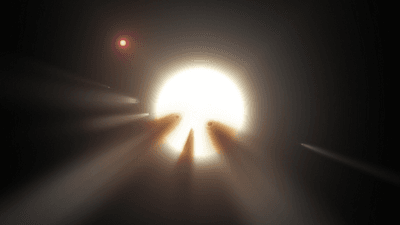
Astronomers have observed a companion orbiting the “Megastructure Star” KIC 8462852. The new object's mass is on the boundary between a planet and a brown dwarf, and it's possible this is what disrupted comets and caused extraordinary dimming of the star 11 years ago.
For those who have forgotten – or might even be too young – citizen scientists in 2015 noted a strange dimming in KIC 8462852. The people who observed this were looking for dips in light associated with planets passing in front of stars observed by the Kepler Space Telescope.
The observations were reported to Dr Tabby Boyajian, who noticed that the observed changes were too large, too long, and too irregular to be from silhouetted planets. Although stars undergo major changes at the start and end of their lives, no one had ever seen a main sequence star acting like this before.
Boyajian and her colleagues proposed several explanations, including the possibility that an alien megastructure, part of an incomplete Dyson Sphere, had blocked our view.
Unlikely as that sounds, the idea caught hold far beyond the normal reach of science journalism. Although the megastructure became increasingly improbable with further observations, Tabby’s star (as it was initially known before Boyajian's Star became favored) has remained an object of fascination and mystery.
Signs Of A Planet
The strange fading makes searching for transiting planets a nightmare, but that’s not the only way we can look for exoplanets. To that end, a team led by PhD student Cristina Madurga-Favieres at the University of Warwick, UK, applied something called the radial velocity method to see if KIC 8462852 is moving under the influence of a hidden object’s gravity.
The answer appears to be yes. In 2019, the Transiting Exoplanet Survey Satellite (TESS) observed a much smaller dip than the ones that made Boyajian’s star famous, in which it lost 1.1 percent of its brightness for 21 hours. That’s about what you would expect for a large object on an orbit around 3-4 Earth years long.
Combining this data with radial velocity measurements from four large telescopes, Madurga-Favieres and her co-authors conclude that the star has a huge companion with a 1,030-day-long to 1,368-day-long orbit.
The team’s best estimate of the companion’s mass is 9.4 times that of Jupiter, but they say there is a chance it’s three times greater. With 13 Jupiter masses generally considered to be the boundary between a planet and a brown dwarf (although some argue it’s higher), it's far from clear what exactly this object is.
With an orbit like this, the mysterious companion couldn’t directly cause the longer changes in brightness observed in 2015, but its gravity could be triggering a chain reaction that may hold the key. A highly eccentric orbit would be particularly likely to knock other planets or planetoids out of their orbits – perhaps causing collisions that throw up dust – or disturb comets.
Madurga-Favieres and her co-authors calculate an eccentricity of just 0.09 for the new object, limiting its impact, but with so much mass, even a small deviation from circularity could matter.
An Indirect Explanation?
As the authors note: “The strongest theory is that a group of exocomets or planetesimal fragments are responsible for the irregular and apparently non-periodic dips in the Kepler light curve.” An object this large could easily throw comets around, sending some of them close enough to the star to cause them to break up and temporarily block its light.
We’ve now watched KIC 8462852 intently for a decade, with intermittent observations going back to 1890, so the companion should have completed several orbits in that time, yet only one apparent transit has been seen.
Madurga-Favieres told IFLScience: “The explanation we find is that the previous transits have happened during the gaps of data that exist, or at the same time [as] the big dips.” These might obscure a smaller change caused by the transit.
Naturally, the team is keen to learn more about this object and determine whether it’s really behind the changes we've seen in Boyajian’s Star, as well as to find any smaller planets that might also be present.
Unfortunately, the authors report that the object can't be resolved by direct imaging, and that won't change whether it's an exoplanet or a brown dwarf.
Since brown dwarfs produce a little of their own heat, they can sometimes be seen directly where planets cannot, including when the glare of a nearby star is too bright. Nevertheless, Madurga-Favieres told IFLScience: “The direct imaging would be the same if it is a giant exoplanet or a brown dwarf.”
Technically, Boyajian’s Star is also thought to have a red dwarf companion. However, this star, known as KIC 8462852B, is considered to be far too distant to be contributing to the fluctuations in brightness.
The paper is open access in Monthly Notices of the Royal Astronomical Society.