Space and Physics
 PUBLISHED





In this article you will discover
- Astronomers have started a citizen science project called Black Hole hunters as part of the Zooniverse citizen science platform.
- Its goal is to find missing black holes in the Milky Way, with a particular focus on binary black holes.
- “Every single person who takes part might be the one to find the first of this new population of black holes that we haven't found before,” Dr Adam McMaster told IFLScience.
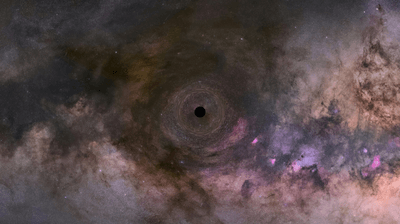
The closest black hole to Earth is a whopping 1,600 light-years away, one among the 50 stellar-sized black holes we know of in the Milky Way. There should be around 100 million out there, so to start chipping away at our ignorance, a new citizen science project is giving anyone the opportunity to find more.
There are a few ways to spot stellar-sized black holes, particularly those in binary systems, which are the targets of the new project.
A binary system is what you get when you have two astronomical objects of approximately equal mass orbiting one another, and it is thought that most of the galaxy's black holes are in binary systems made up of one star and one black hole.
Sometimes, black holes in such systems are spotted stealing material from their companion star. The material glows under the effects of intense gravity as it is pulled into the black hole, giving away its position. Alternatively, black holes in binary systems are identified because they affect the motion of their host star.
We're hoping to be the first ones to find [a self-lensing system] containing a black hole, but a neutron star will be interesting too!
Dr Adam McMaster
“We are looking for stellar mass black holes that are in binaries with stars,” Dr. Adam McMaster at the University of Southampton in the UK, who’s leading the effort, told IFLScience. But, he said, they won't be the kind of black holes you can spot by either of the above methods.
“Unlike most of the stellar mass black holes that we know about, which are in X-ray binaries, we're looking for ones that are in wider binaries, so they're not interacting with their stars, which means they're otherwise completely invisible.”
There is, however, another method that should work for picking out these more distant partners. When a black hole's incredible density warps space time, it magnifies the light behind it in a phenomenon called gravitational lensing.
For binary black holes, the team can make use of a specific type of lensing effect called self-lensing. This is when the lens and the lensed object are moving around each other – which is exactly what should happen in binary systems containing a star and black hole, resulting in periodic changes in the star's brightness.
Pack light, we are hunting black holes
There are already five known self-lensing systems, but none of them contains a black hole. In all five, there was another lensing object, compact but not as compact as a black hole: a white dwarf.
These objects are the final stage of evolution for stars like the Sun, which don't have the necessary mass to go supernova. Stars greater than eight times the Sun's mass will end up producing a supernova, which results in either these stellar-mass black holes or neutron stars.
“No one has found any containing neutron stars or black holes yet, simply because there aren't as many of those,” Dr McMaster told IFLScience. “We're hoping to be the first ones to find one ideally containing a black hole, but a neutron star will be interesting too!”
Human intelligence needed
The team is using data from NASA’s planet-hunting telescope TESS, or the Transiting Exoplanet Survey Satellite. They have trained a neural network – a type of artificial intelligence – to find potential candidates among 15 million light curves from as many stars.
The impressive system was able to find 1 million candidates in just one week, but human eyes are needed to actually work out which ones are reasonable candidates. That's because there are many other phenomena that can periodically increase and decrease a star's brightness.
“It's really simple,” Dr. McMaster told IFLScience. “We show people examples of what it is they need to look at. Every single person who takes part might be the one to find the first of this new population of black holes that we haven't found before.”
There's no knowledge prerequisite. Anyone can join in on the Zooniverse Citizen Science project and quickly join the search.
From the TESS data, the team expects dozens of detections, but there might be thousands more waiting to be found. The team will include more surveys over time from the ground-based Next Generation Transit Survey (NGTS) project to space-based observatories like Euclid and the Nancy Grace Roman.