Space and Physics
 PUBLISHED





The search for alien life, within our Solar System at least, is focused on a few promising areas.
There's Mars, of course. With potential biosignatures found by Perseverance, this may be our best hope for signs of life on another planet within our lifetimes, Mars sample return-dependent.
Then there are the icy Moons of the gas giants, in particular Jupiter's Europa and Saturn's Enceladus, which could potentially harbor life in subsurface oceans.
If you want to get wilder, there are even proposals that life may exist in the clouds of Venus, and that an unusual phosphine signature (and potentially ammonia) may be evidence of it.
“There are a number of weirdnesses in Venus's atmosphere. Phosphine is just a new one that's come along," Dr Dave Clements at Imperial College London told IFLScience.
"Amongst the other strange things is the way that the amount of water and the amount of SO2 in the atmosphere vary over time. It's not known why. The variations haven't been monitored to a great extent, but it's known that there are variations on time scales from at least days to years."
Respected astronomer and science communicator Carl Sagan was a fan of this idea, suggesting in 1961 that life might be able to survive in the higher altitudes of Venus's atmosphere, just beneath the cloud layer. But he also went one further, writing a speculative paper about the possibility of life on our largest gas giant, Jupiter.
Sinkers, floaters, and hunters
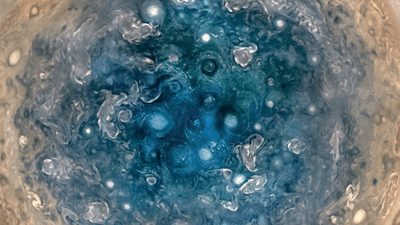
Jupiter, you are probably aware, isn't really suitable for our kind of life. We like a solid surface and luxuries like "breathable oxygen," making a gas giant composed primarily of hydrogen less than ideal as a second home. But, according to Sagan at least, it could be home to a type of life. Hell, that life might even grow to be massive.
In their 1975 paper, Sagan and Edwin E. Salpeter mused on what Jovian life could look like. The main problems they identified were that living things would risk being pulled down by Jupiter's enormous gravity to regions so hot that they absolutely would not be able to survive. But this, they thought, could be overcome by lifeforms through a few different evolutionary innovations.
"If hypothetical organisms are capable of slow, powered locomotion and coalescence, they can grow large enough to achieve buoyancy," the two wrote in their paper. "Ecological niches for sinkers, floaters and hunters appear to exist in the Jovian atmosphere."
Sinkers are probably the least exciting of these proposed lifeforms, being very simple organisms that simply race to reproduce before they sink too far into the planet.
"One way to make a living under these conditions is to reproduce before you are fried and hope that convection will carry some of your offspring to the higher and cooler layers of the atmosphere," Sagan said in his documentary series Cosmos. "Such organisms could be very little. We call them sinkers."
While being little and sinky could help these proposed organisms, there is also an advantage to being big and floaty.
"You could also be a floater, some vast hydrogen balloon pumping helium and heavier gases out of its interior and leaving only the lightest gas, hydrogen; or a hot-air balloon, staying buoyant by keeping your interior warm, using energy acquired from the food you eat," Sagan continued.
"Like familiar terrestrial balloons, the deeper a floater is carried, the stronger is the buoyant force returning it to the higher, cooler, safer regions of the atmosphere."
Up until a certain point, the larger a floater is, the more efficient it would be. Not shying away from a little fun speculation (backed up by a little science, of course), Sagan and Salpeter suggested these creatures could dwarf every known animal on Earth, perhaps reaching kilometers across.
They proposed that floaters could propel themselves through the Jovian atmosphere using gas, somewhat appropriately farting their way around a gas giant.
And they would need propulsion, because Sagan and Salpeter suggest that floaters, with enough food available to them, could evolve into hunters.
Charming, but could they exist?
The two looked at energy sources on Jupiter and potential ecological niches, buoyancy, and growth rates, concluding there were plenty of ecological niches that could be filled in the atmosphere of Jupiter. But that doesn't mean they are really there.
These days, the focus of the hunt for life is targeted towards less-hellish environments, deemed less hostile to life. But the idea hasn't been forgotten altogether, with papers as recent as 2021 suggesting that it may be more viable than life in Venus's clouds, at least.
“Our research shows that the sulphuric acid clouds in Venus have too little water for active life to exist, based on what we know of life on Earth," Dr John E. Hallsworth at Queen’s University Belfast explained in a statement at the time.
"We have also found that the conditions of water and temperature within Jupiter’s clouds could allow microbial-type life to subsist, assuming that other requirements such as nutrients are present.”
For what it is worth, Sagan and Salpeter didn't expect these creatures to actually exist, but they wanted to imagine how they could.
"Physics and chemistry permit such lifeforms. Art endows them with a certain charm," Sagan explained.
"Nature, however, is not obliged to follow our speculations. But if there are billions of inhabited worlds in the Milky Way Galaxy, perhaps there will be a few populated by the sinkers, floaters and hunters which our imaginations, tempered by the laws of physics and chemistry, have generated."
Sagan and Salpeter's paper is available via NASA.